
We read your photo as:
How does a decrease in temperature affect the rate of reaction, activation energy, and total product volume, using the example of aluminum reacting with sulfuric acid?
ScanSolve AI Answer
Here are the solutions to Investigation II.
5.2 Investigation II
When the investigation is repeated at using the same reactants and catalyst, compared to Investigation I:
-
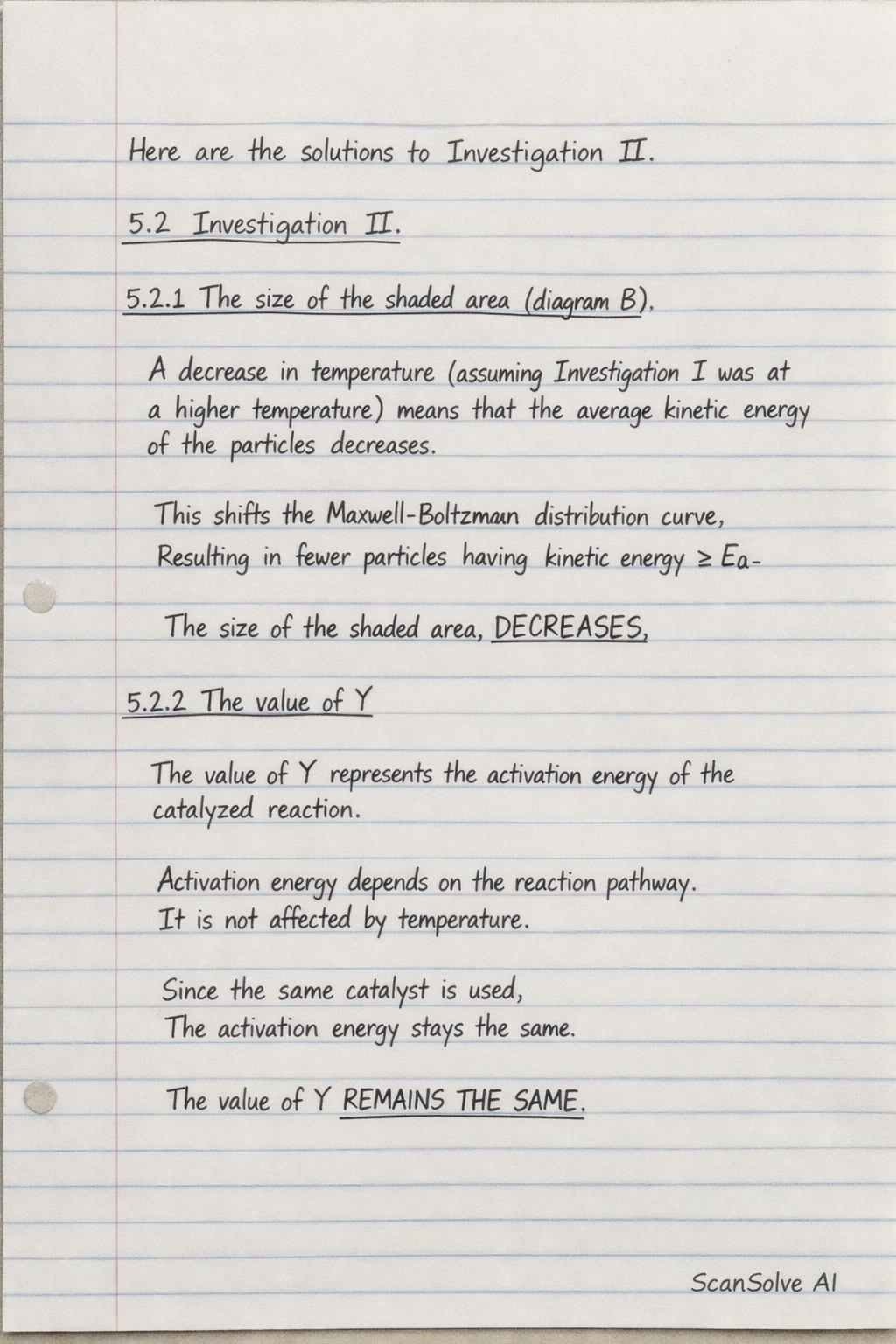
5.2.1 The size of the shaded area (diagram B) A decrease in temperature (assuming Investigation I was at a higher temperature) means that the average kinetic energy of the particles decreases. This shifts the Maxwell-Boltzmann distribution curve, resulting in fewer particles having kinetic energy equal to or greater than the activation energy. The size of the shaded area DECREASES.
-
5.2.2 The value of Y The value of Y represents the activation energy of the catalyzed reaction. Activation energy is a property of the reaction pathway and is only affected by the presence of a catalyst or a change in the reaction mechanism. Temperature does not change the activation energy itself. Since the same catalyst is used, the activation energy remains unchanged. The value of Y REMAINS THE SAME.
-
5.2.3 The TOTAL volume of hydrogen gas produced The total volume of hydrogen gas produced depends on the amount of the limiting reactant. In this investigation, of Al powder is used with excess , meaning aluminum is the limiting reactant. Changing the temperature affects the rate of the reaction, but not the total amount of product formed, as long as the limiting reactant amount is unchanged and the reaction goes to completion. The TOTAL volume of hydrogen gas produced REMAINS THE SAME.
Still stuck on this one?
Ask a follow-up, and the answer starts from this question.
More Chemistry Questions
Handwritten Step-by-Step Solution
Get this as a handwritten image on WhatsApp — like a tutor wrote it for you.
Try on WhatsApp