

This chemistry question involves key chemical concepts and calculations. The detailed solution below walks through each step, from identifying the reaction type to computing the final answer.
ScanSolve AI Answer
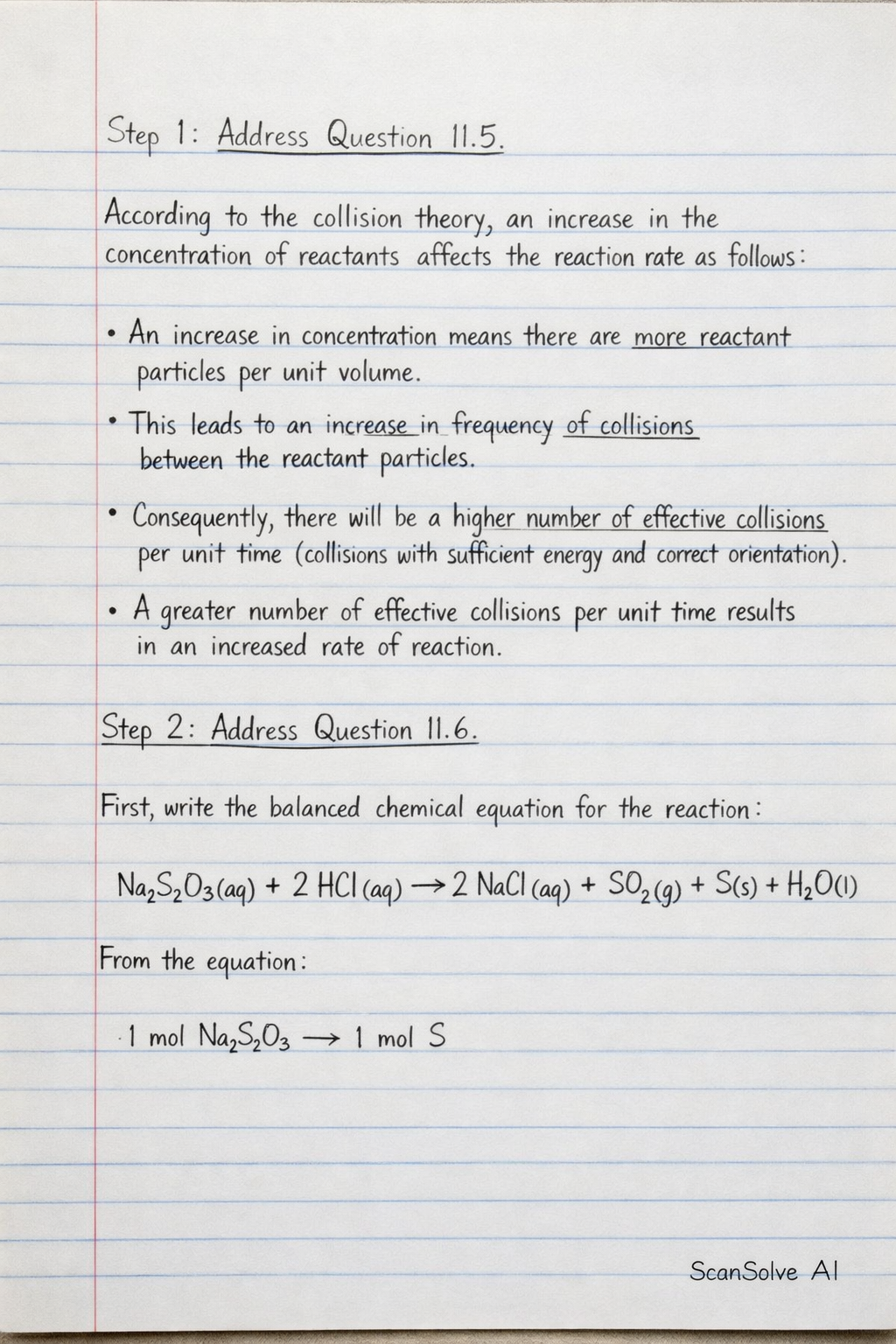
Step 1: Address Question 11.5. According to the collision theory, an increase in the concentration of reactants affects the reaction rate as follows: • An increase in concentration means there are more reactant particles per unit volume. • This leads to an increase in the frequency of collisions between the reactant particles. • Consequently, there will be a higher number of effective collisions per unit time (collisions with sufficient energy and correct orientation). • A greater number of effective collisions per unit time results in an increased rate of reaction. Step 2: Address Question 11.6. First, write the balanced chemical equation for the reaction: Na_2S_2O_3(aq) + 2HCl(aq) 2NaCl(aq) + SO_2(g) + S(s) + H_2O(l) From the equation, 1 mole of Na_2S_2O_3 produces 1 mole of S. Step 3: Calculate the molar masses. Molar mass of Sulphur (S) = 32.07 g/mol Molar mass of Sodium thiosulphate (Na_2S_2O_3) = (2 × 22.99) + (2 × 32.07) + (3 × 16.00) = 45.98 + 64.14 + 48.00 = 158.12 g/mol Step 4: Calculate the moles of sulphur produced. Given mass of S = 1.62 g Moles of S = Mass of SMolar mass of S Moles of S = 1.62 g32.07 g/mol ≈ 0.0505145 mol Step 5: Calculate the moles of sodium thiosulphate used. From the balanced equation, the mole ratio of Na_2S_2O_3 to S is 1:1. Moles of Na_2S_2O_3 = Moles of S ≈ 0.0505145 mol Step 6: Calculate the mass of sodium thiosulphate used. Mass of Na_2S_2O_3 = Moles of Na_2S_2O_3 × Molar mass of Na_2S_2O_3 Mass of Na_2S_2O_3 = 0.0505145 mol × 158.12 g/mol Mass of Na_2S_2O_3 ≈ 7.987 g Rounding to two decimal places: The mass of the sodium thiosulphate used in experiment 1 is 7.99 g. Last free one today — make it count tomorrow, or type /upgrade for unlimited.