

This chemistry question involves key chemical concepts and calculations. The detailed solution below walks through each step, from identifying the reaction type to computing the final answer.
ScanSolve AI Answer
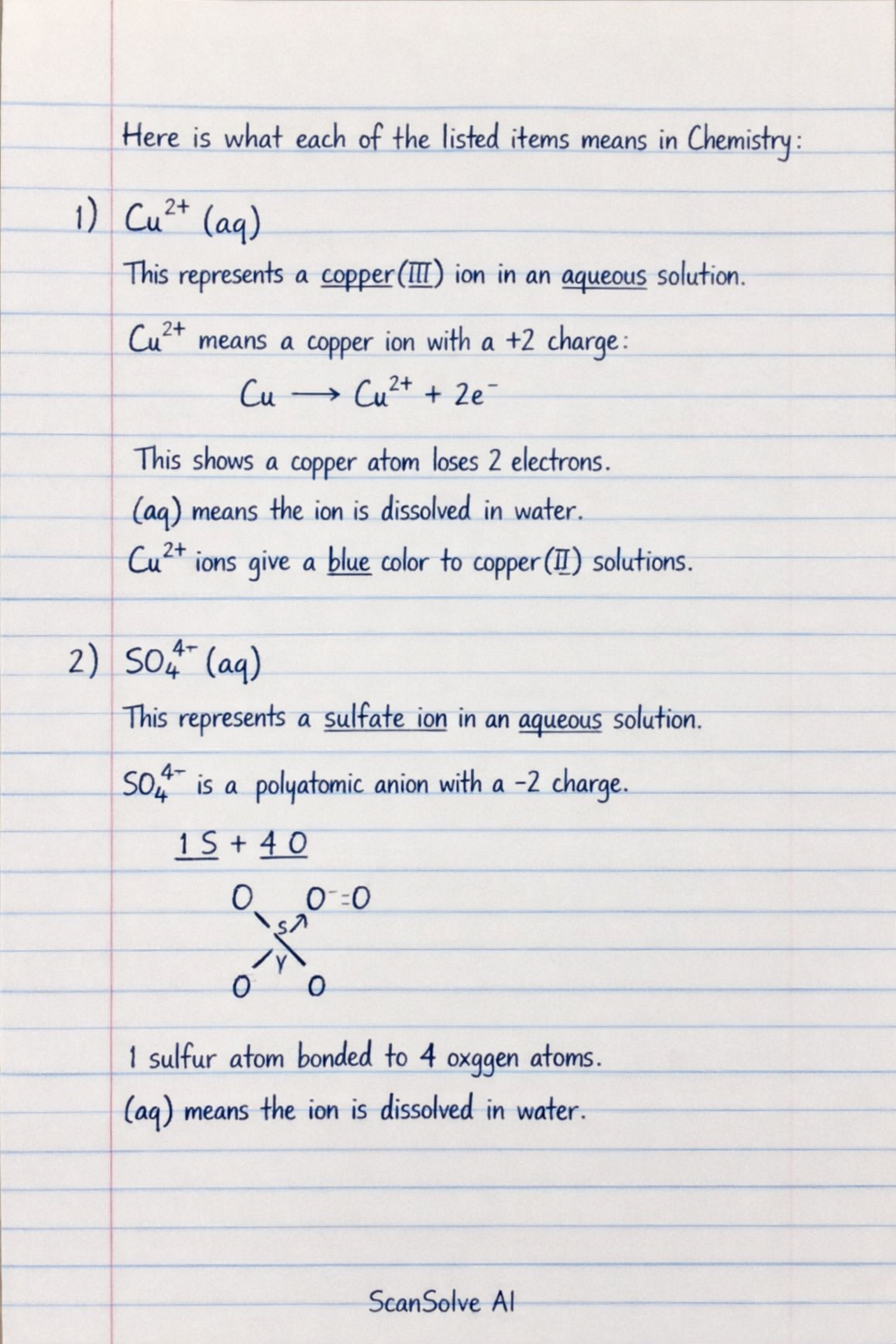
Here is what each of the listed items means in Chemistry: 1. Cu^2+(aq) This represents a copper(II) ion in an aqueous solution. Copper(II) ions are positively charged ions (cations) formed when a copper atom loses two electrons. The (aq) state symbol indicates that the ion is dissolved in water. These ions are responsible for the characteristic blue color of copper(II) salt solutions. 2. SO_4^2-(aq) This represents a sulfate ion in an aqueous solution. A sulfate ion is a polyatomic anion with a charge of -2. It consists of one sulfur atom bonded to four oxygen atoms. The (aq) state symbol indicates that the ion is dissolved in water. 3. H^+(aq) This represents a hydrogen ion in an aqueous solution. A hydrogen ion is a positively charged ion (cation) formed when a hydrogen atom loses its electron. In aqueous solutions, H^+ ions are typically hydrated, forming hydronium ions (H_3O^+), but are often simplified as H^+(aq). These ions are responsible for the acidic properties of a solution. 4. OH^-(aq) This represents a hydroxide ion in an aqueous solution. A hydroxide ion is a polyatomic anion with a charge of -1. It consists of one oxygen atom bonded to one hydrogen atom. The (aq) state symbol indicates that the ion is dissolved in water. These ions are responsible for the basic properties of a solution. 5. 2H_2O(l) O_2(g) + 4H^+(aq) + 4e^- This is a half-reaction representing the oxidation of water. 2H_2O(l): Two molecules of liquid water are the reactants. *: Indicates the reaction proceeds from reactants to products. O_2(g): One molecule of oxygen gas is produced. The (g) state symbol indicates it is in the gaseous state. 4H^+(aq): Four hydrogen ions are produced in aqueous solution. 4e^-: Four electrons are released. The release of electrons signifies an oxidation process. This reaction typically occurs at the anode (positive electrode) during the electrolysis of aqueous solutions, especially when other anions (like sulfate) are harder to oxidize than water. It shows that water can be oxidized to produce oxygen gas, hydrogen ions, and electrons.