
Help me with everything important in chemistry advance level
Chemistry
ScanSolve AI Answer
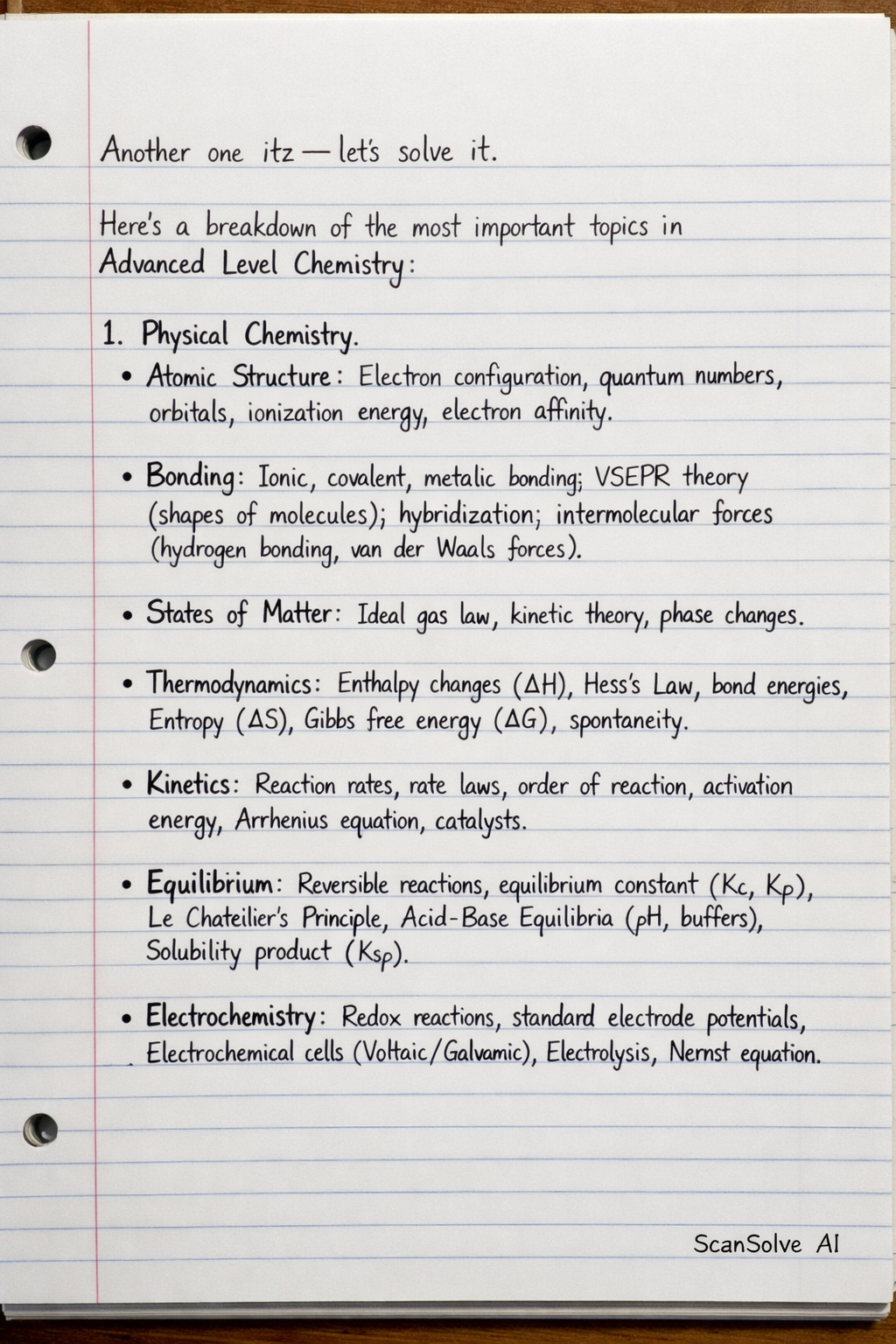
Here's a breakdown of the most important topics in Advanced Level Chemistry:
1. Physical Chemistry
- Atomic Structure: Electron configuration, quantum numbers, orbitals, ionization energy, electron affinity.
- Bonding: Ionic, covalent, metallic bonding; VSEPR theory (shapes of molecules); hybridization; intermolecular forces (hydrogen bonding, van der Waals forces).
- States of Matter: Ideal gas law, kinetic theory, phase changes.
- Thermodynamics: Enthalpy changes (), Hess's Law, bond energies, entropy (), Gibbs free energy (), spontaneity.
- Kinetics: Reaction rates, rate laws, order of reaction, activation energy, Arrhenius equation, catalysts.
- Equilibrium: Reversible reactions, equilibrium constant (), Le Chatelier's Principle, acid-base equilibria (pH, buffers), solubility product ().
- Electrochemistry: Redox reactions, standard electrode potentials, electrochemical cells (voltaic/galvanic), electrolysis, Nernst equation.
2. Inorganic Chemistry
- Periodic Table: Trends in atomic radius, ionization energy, electronegativity, metallic character across periods and down groups.
- Group 1 & 2 Elements: Properties and reactions of alkali metals and alkaline earth metals.
- Group 13-18 Elements: Properties and reactions of non-metals and metalloids (e.g., halogens, noble gases, nitrogen, oxygen, sulfur).
- Transition Metals: Characteristic properties (variable oxidation states, complex ion formation, catalytic activity, coloured compounds), ligands, coordination numbers.
- Redox Reactions: Balancing redox equations, identifying oxidizing and reducing agents.
3. Organic Chemistry
- Nomenclature: IUPAC naming for various functional groups.
- Isomerism: Structural (chain, positional, functional group), stereoisomerism (geometric/E-Z, optical/enantiomers).
- Reaction Mechanisms: Understanding electron movement in reactions (e.g., SN1, SN2, E1, E2, electrophilic addition, electrophilic substitution, nucleophilic addition, nucleophilic acyl substitution, free radical substitution).
- Functional Groups:
- Alkanes, Alkenes, Alkynes: Reactions (combustion, substitution, addition).
- Arenes: Electrophilic substitution reactions.
- Halogenoalkanes: Nucleophilic substitution, elimination.
- Alcohols & Phenols: Reactions, acidity.
- Aldehydes & Ketones: Nucleophilic addition, oxidation/reduction.
- Carboxylic Acids & Derivatives (Esters, Acyl Chlorides, Amides): Acidity, esterification, hydrolysis, condensation.
- Amines: Basicity, reactions.
- Polymers: Addition and condensation polymerization.
- Spectroscopy: Basic principles and interpretation of IR, NMR (H and C), and Mass Spectrometry for structure determination.
4. Analytical Chemistry
- Titrations: Acid-base, redox, complexometric titrations.
- Chromatography: Principles of TLC, GC, HPLC.
- Spectroscopic Techniques: UV-Vis, Atomic Absorption/Emission.
Was this helpful?
Still stuck on this one?
Ask a follow-up, and the answer starts from this question.
Got a different question?Ask your own question
More Chemistry Questions
Handwritten Step-by-Step Solution
Get this as a handwritten image on WhatsApp — like a tutor wrote it for you.
Try on WhatsApp