
We read your photo as:
Extracting sodium metal by electrolysis of molten sodium chloride. Explain the reactions and purpose of the setup.
ScanSolve AI Answer
Answer
here are the solutions to the questions:
-
The diagram below shows the method used to extract sodium metal by electrolysis at molten sodium chloride. Study it and answer the questions that follow.
a) Write the equation for the reaction taking place at the graphite anode.
At the anode, chloride ions are oxidized to chlorine gas.b) In this process, the anode is surrounded by diaphragm. What is the purpose of the diaphragm?
The purpose of the diaphragm is to prevent the mixing of molten sodium metal and chlorine gas. If they mix, they would react violently and explosively.c) Name an industry that can be built next to a sodium extraction plant.
An industry that uses either sodium metal or chlorine gas, such as a plant for manufacturing PVC (which uses chlorine) or sodium compounds.d) Why is the anode made of graphite in this case instead of steel which is a better conductor of electricity?
Graphite is used because it is inert and resistant to corrosion by the chlorine gas produced at the anode at high temperatures. Steel would react with chlorine and corrode.e) Give a reason why large quantities of electricity is required for this process.
Large quantities of electricity are required to melt the sodium chloride (which has a high melting point) and to overcome the strong electrostatic forces of attraction between the and ions in the molten state, as well as to drive the non-spontaneous redox reactions.f) Explain why aqueous sodium chloride is not suitable as an electrolyte for the manufacture of sodium in the Down's Process.
If aqueous sodium chloride were used, water would be preferentially reduced at the cathode instead of sodium ions, producing hydrogen gas and hydroxide ions. Sodium metal would not be formed.g) Sodium metal with air to form two oxides. Give the formulae of two oxides.
The two common oxides are: (sodium oxide) and (sodium peroxide).h) What property of sodium makes it possible to be separated from the electrolyte?
Sodium metal has a lower density than the molten sodium chloride electrolyte, allowing it to float on top and be collected separately.
Try one yourself
A new problem that tests the same skill.
Still stuck on this one?
Ask a follow-up, and the answer starts from this question.
More Chemistry Questions
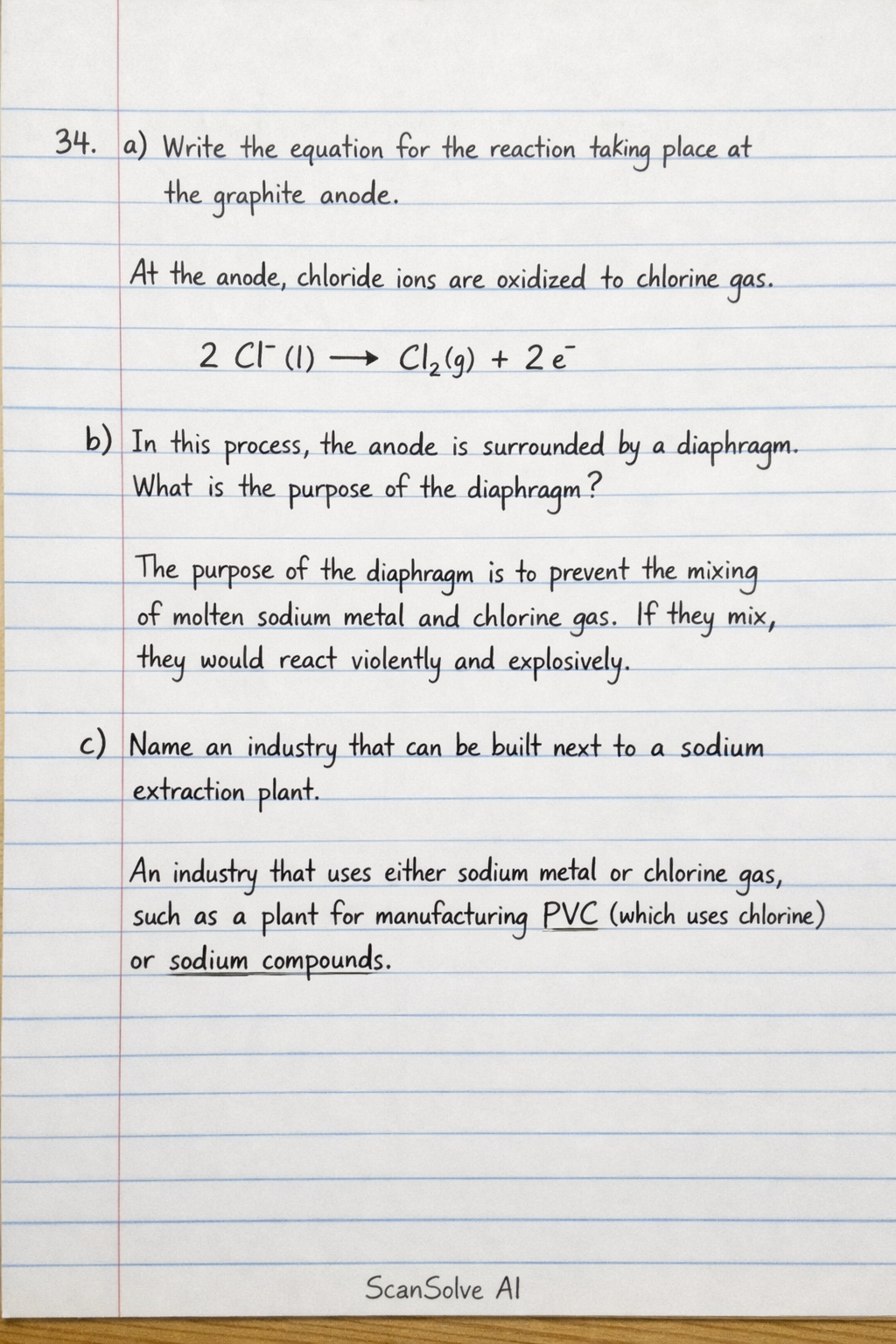
Handwritten Step-by-Step Solution
Get this as a handwritten image on WhatsApp — like a tutor wrote it for you.
Try on WhatsApp