
We read your photo as:
A student sets up the apparatus to carry out the electrolysis of concentrated sodium chloride solution using carbon electrodes as shown in Fig. 6.1. (a) Name all the positive ions present in aqueous sodium chloride. (b) Name gases C and D. (c) Explain why the solution formed is alkaline.
ScanSolve AI Answer
Answers
2 partsStep-by-step solution
6 stepsPart a
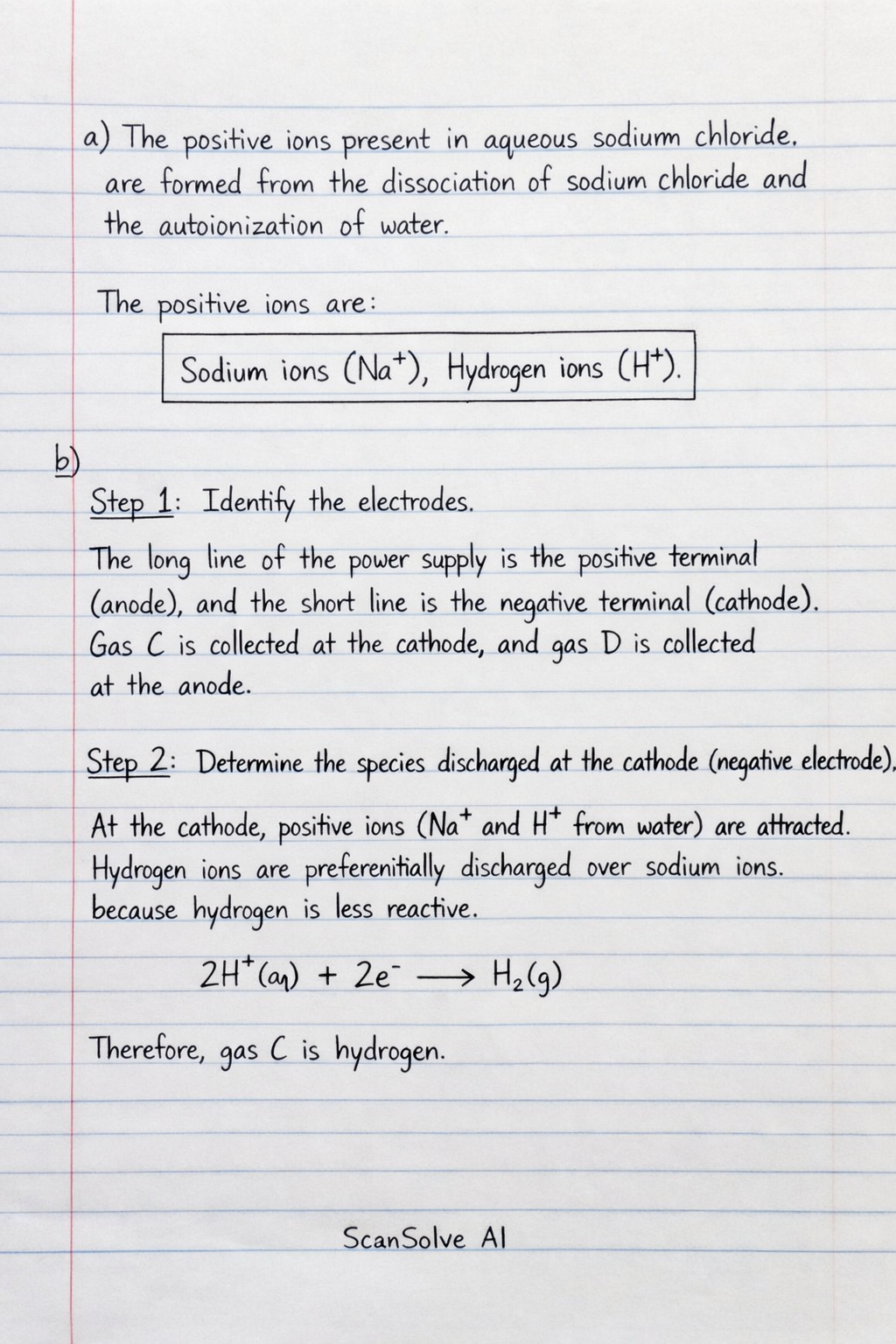
The positive ions present in aqueous sodium chloride are formed from the dissociation of sodium chloride and the autoionization of water.
The positive ions are .
Part b
Identify the electrodes.
The long line of the power supply is the positive terminal (anode), and the short line is the negative terminal (cathode). Gas C is collected at the cathode, and gas D is collected at the anode.
Determine the species discharged at the cathode (negative electrode).
At the cathode, positive ions ( and from water) are attracted. Hydrogen ions are preferentially discharged over sodium ions because hydrogen is less reactive.
Therefore, gas C is hydrogen.
Determine the species discharged at the anode (positive electrode).
At the anode, negative ions ( and from water) are attracted. In concentrated sodium chloride solution, chloride ions are preferentially discharged over hydroxide ions.
Therefore, gas D is chlorine.
C:
D:
Part c· 3 steps
Identify the ions remaining in the solution.
During the electrolysis, hydrogen ions () are discharged at the cathode and chloride ions () are discharged at the anode. This leaves sodium ions () and hydroxide ions () in the solution.
Explain the formation of hydroxide ions.
As ions are removed from the solution at the cathode, the equilibrium of water dissociation () shifts to the right to replenish the ions. This leads to an increase in the concentration of ions.
Conclude why the solution is alkaline.
The accumulation of ions (along with ions, forming sodium hydroxide) makes the solution alkaline.
Try one yourself
A new problem that tests the same skill.
Still stuck on this one?
Ask a follow-up, and the answer starts from this question.
More Chemistry Questions
Handwritten Step-by-Step Solution
Get this as a handwritten image on WhatsApp — like a tutor wrote it for you.
Try on WhatsApp