
We read your photo as:
Evaluate the following statements about alkanes: Statement 1: Alkanes are insoluble in water. Statement 2: The boiling points of alkanes increase with increasing molecular weight. Statement 3: Branche
ScanSolve AI Answer
Answer
Step-by-step solution
39 stepsPart 40· 4 steps
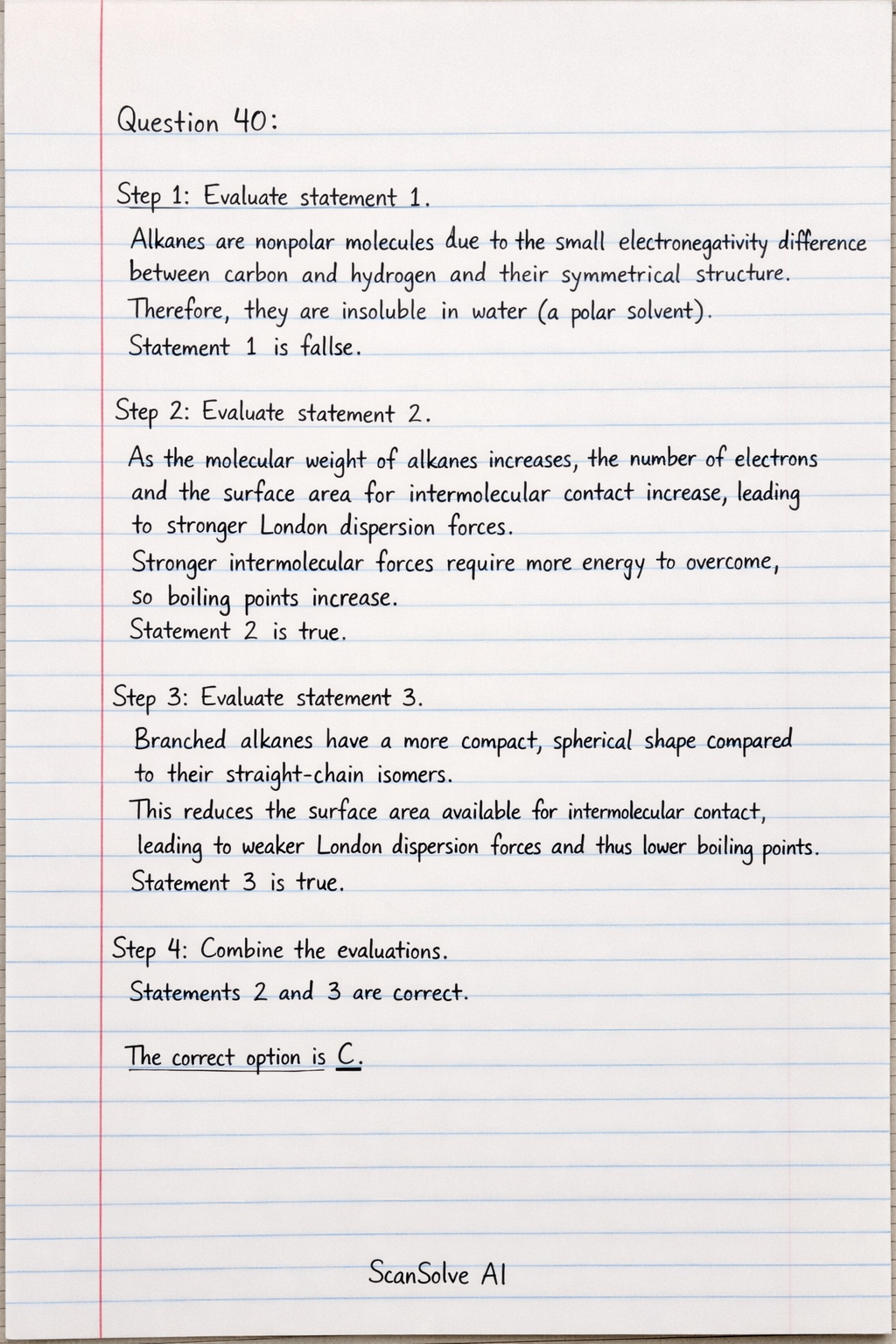
Evaluate statement 1.
Alkanes are nonpolar molecules due to the small electronegativity difference between carbon and hydrogen and their symmetrical structure. Therefore, they are insoluble in water (a polar solvent). Statement 1 is false.
Evaluate statement 2.
As the molecular weight of alkanes increases, the number of electrons and the surface area for intermolecular contact increase, leading to stronger London dispersion forces. Stronger intermolecular forces require more energy to overcome, so boiling points increase. Statement 2 is true.
Evaluate statement 3.
Branched alkanes have a more compact, spherical shape compared to their straight-chain isomers. This reduces the surface area available for intermolecular contact, leading to weaker London dispersion forces and thus lower boiling points. Statement 3 is true.
Combine the evaluations.
Statements 2 and 3 are correct.
The correct option is C.
Part 41· 4 steps
Evaluate statement 1.
Protons and neutrons are indeed located in the nucleus of an atom. Statement 1 is true.
Evaluate statement 2.
Electrons carry a negative charge and have a very small mass (approximately the mass of a proton), which is often considered negligible in atomic mass calculations. Statement 2 is true.
Evaluate statement 3.
The atomic number (Z) of an element is defined by the number of protons in its nucleus. The number of neutrons can vary (isotopes) and is not necessarily equal to the atomic number. Statement 3 is false.
Combine the evaluations.
Statements 1 and 2 are correct.
The correct option is B.
Part 42· 4 steps
Evaluate statement 1.
X-ray diffraction (XRD) is a powerful technique used to determine the arrangement of atoms in a crystalline solid, which defines its crystal structure. Statement 1 is true.
Evaluate statement 2.
From the diffraction pattern, the dimensions of the unit cell (lattice parameters) can be calculated. Statement 2 is true.
Evaluate statement 3.
XRD allows for the determination of the precise positions of atoms within the unit cell, which is fundamental to understanding crystal structure. Statement 3 is true.
Combine the evaluations.
All three statements are correct.
The correct option is A.
Part 43· 4 steps
Evaluate statement 1.
S-block elements (Group 1 and Group 2 metals) typically form basic oxides (e.g., , ) that react with water to form hydroxides or with acids to form salt and water. Statement 1 is true.
Evaluate statement 2.
S-block elements are metals with large atomic radii and relatively few valence electrons, which they readily lose. This results in low ionization energies. Statement 2 is true.
Evaluate statement 3.
S-block elements are metals, and metals are generally excellent conductors of electricity due to the presence of delocalized valence electrons. Statement 3 is false.
Combine the evaluations.
Statements 1 and 2 are correct.
The correct option is B.
Part 44· 4 steps
Evaluate statement 1.
Benzene is an aromatic compound with a highly stable delocalized electron system. This aromatic stability makes it less reactive than alkenes towards addition reactions. Benzene typically undergoes substitution reactions to preserve its aromaticity. Statement 1 is false.
Evaluate statement 2.
The characteristic reaction of benzene and other aromatic compounds is electrophilic aromatic substitution, where an electrophile replaces a hydrogen atom on the ring. Statement 2 is true.
Evaluate statement 3.
Benzene has a planar hexagonal structure with all carbon-carbon bond lengths being equal (intermediate between single and double bonds) due to the delocalization of its electrons above and below the ring. Statement 3 is true.
Combine the evaluations.
Statements 2 and 3 are correct.
The correct option is C.
Part 45· 4 steps
Evaluate statement 1.
A catalyst works by providing an alternative reaction pathway with a lower activation energy. Statement 1 is true.
Evaluate statement 2.
By providing an alternative pathway, a catalyst effectively lowers the activation energy required for the reaction to proceed. Statement 2 is true.
Evaluate statement 3.
Catalysts participate in the reaction mechanism but are regenerated at the end of the reaction, meaning they are not consumed. Statement 3 is false.
Combine the evaluations.
Statements 1 and 2 are correct.
The correct option is B.
Part 46· 3 steps
Evaluate the first statement.
Ammonia () is indeed produced industrially through the Haber process, which involves the reaction of nitrogen and hydrogen. The first statement is true.
Evaluate the second statement.
The Haber process involves the reaction of nitrogen () with hydrogen () to form ammonia () under high pressure and temperature, typically using an iron catalyst. It does not involve oxygen. The second statement is false.
Determine the relationship.
The first statement is true, and the second statement is false.
The correct option is C.
Part 47· 3 steps
Evaluate the first statement.
1,2-dichloroethene () has a carbon-carbon double bond, and each carbon atom of the double bond is attached to two different groups (one hydrogen and one chlorine). This allows for cis-trans isomerism (geometric isomerism). The first statement is true.
Evaluate the second statement.
Geometric isomerism (cis-trans isomerism) in alkenes arises because there is restricted rotation around the carbon-carbon double bond, preventing interconversion between the isomers without breaking bonds. The second statement is true.
Determine the relationship.
Both statements are true, and the second statement correctly explains why 1,2-dichloroethene exhibits geometric isomerism.
The correct option is A.
Part 48· 3 steps
Evaluate the first statement.
In a dynamic chemical equilibrium, the rates of the forward reaction and the reverse reaction are equal. This is the fundamental definition of dynamic equilibrium. The first statement is true.
Evaluate the second statement.
At equilibrium, the concentrations of reactants and products remain constant because the forward and reverse reactions occur at equal rates, leading to no net change in the concentrations over time. The second statement is true.
Determine the relationship.
Both statements are true. However, the second statement describes a consequence of the equal rates (constant concentrations, no net change), rather than providing an explanation for why the rates are equal. The equal rates are the defining characteristic, and constant concentrations are the observable result. Therefore, the second statement is not a correct explanation of the first.
The correct option is B.
Part 49· 3 steps
Evaluate the first statement.
Silicon tetrachloride () reacts readily with water (hydrolyzes) to produce silicon dioxide () and hydrogen chloride (). The gas, when exposed to moist air, forms tiny droplets of hydrochloric acid, which appear as white fumes. The reaction is: . The first statement is true.
Evaluate the second statement.
In , silicon is bonded to four chlorine atoms. According to VSEPR theory, this results in a tetrahedral molecular geometry. Since the four bonds are identical and arranged symmetrically around the central silicon atom, the bond dipoles cancel out, making the molecule non-polar. The second statement is true.
Determine the relationship.
Both statements are true. However, the tetrahedral geometry and non-polarity of do not explain its hydrolysis reaction. Hydrolysis occurs because silicon has available d-orbitals to accept lone pairs from water molecules, initiating the reaction. Therefore, the second statement is not a correct explanation of the first.
The correct option is B.
Part 50· 3 steps
Evaluate the first statement.
In nucleophilic substitution reactions, the leaving group ability is crucial. A good leaving group is a weak base. Iodide ion () is a much better leaving group than chloride ion () because it is larger and more polarizable, making the bond weaker and easier to break. Therefore, iodoalkanes react faster than chloroalkanes in nucleophilic substitution reactions. The first statement is false.
Evaluate the second statement.
The bond is longer and weaker than the bond due to the larger atomic size of iodine and less effective orbital overlap with carbon. The second statement is true.
Determine the relationship.
The first statement is false, and the second statement is true.
The correct option is D.
Try one yourself
A new problem that tests the same skill.
Still stuck on this one?
Ask a follow-up, and the answer starts from this question.
More Chemistry Questions
Handwritten Step-by-Step Solution
Get this as a handwritten image on WhatsApp — like a tutor wrote it for you.
Try on WhatsApp