

This chemistry question involves key chemical concepts and calculations. The detailed solution below walks through each step, from identifying the reaction type to computing the final answer.
ScanSolve AI Answer
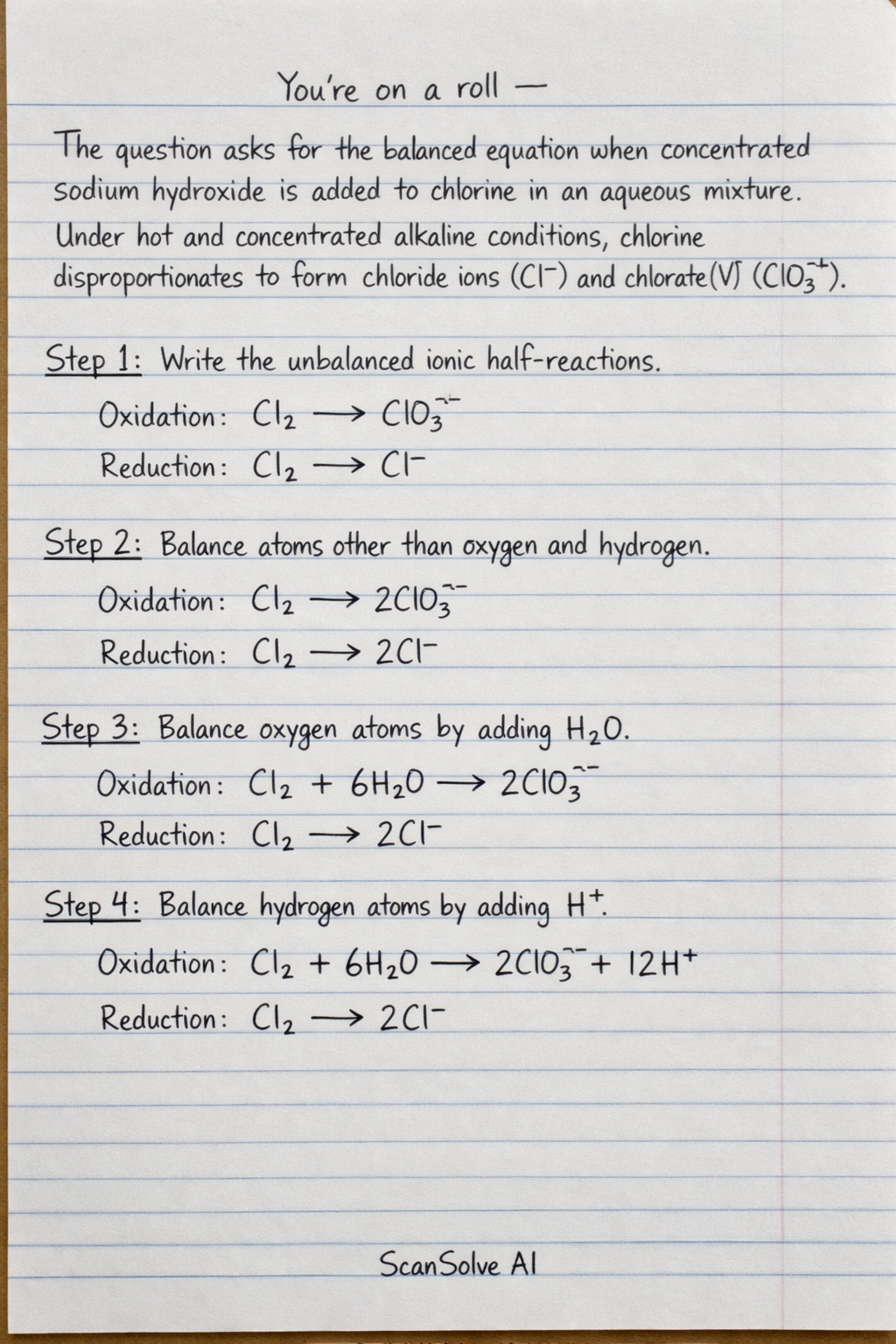
You're on a roll — The question asks for the balanced equation when concentrated sodium hydroxide is added to chlorine in an aqueous mixture. Under hot and concentrated alkaline conditions, chlorine disproportionates to form chloride ions (Cl^-) and chlorate(V) ions (ClO_3^-). Step 1: Write the unbalanced ionic half-reactions. Oxidation: Cl_2 ClO_3^- Reduction: Cl_2 Cl^- Step 2: Balance atoms other than oxygen and hydrogen. Oxidation: Cl_2 2ClO_3^- Reduction: Cl_2 2Cl^- Step 3: Balance oxygen atoms by adding H_2O. Oxidation: Cl_2 + 6H_2O 2ClO_3^- Reduction: Cl_2 2Cl^- Step 4: Balance hydrogen atoms by adding H^+. Oxidation: Cl_2 + 6H_2O 2ClO_3^- + 12H^+ Reduction: Cl_2 2Cl^- Step 5: Balance charge by adding electrons (e^-). Oxidation: Cl_2 + 6H_2O 2ClO_3^- + 12H^+ + 10e^- Reduction: Cl_2 + 2e^- 2Cl^- Step 6: Convert to basic medium by adding OH^- to neutralize H^+. For oxidation: Add 12OH^- to both sides. Cl_2 + 6H_2O + 12OH^- 2ClO_3^- + 12H^+ + 12OH^- + 10e^- Cl_2 + 6H_2O + 12OH^- 2ClO_3^- + 12H_2O + 10e^- Simplify H_2O: Cl_2 + 12OH^- 2ClO_3^- + 6H_2O + 10e^- The reduction half-reaction remains the same as it has no H^+. Step 7: Equalize electrons by multiplying the reduction half-reaction by 5. Oxidation: Cl_2 + 12OH^- 2ClO_3^- + 6H_2O + 10e^- Reduction: 5(Cl_2 + 2e^- 2Cl^-) 5Cl_2 + 10e^- 10Cl^- Step 8: Add the two half-reactions. (Cl_2 + 12OH^- 2ClO_3^- + 6H_2O + 10e^-) + (5Cl_2 + 10e^- 10Cl^-) $6Cl_2 + 12OH^-