
Help me with formula in physical chemistry advance level
Chemistry
ScanSolve AI Answer
here are the key formulas in Physical Chemistry for advanced level:
1. Thermodynamics
- First Law of Thermodynamics: (where is work done by the system)
- Enthalpy Change:
- Entropy Change:
- Gibbs Free Energy Change:
2. Chemical Kinetics
- Rate Law:
- Integrated Rate Laws:
- First Order:
- Second Order:
- Arrhenius Equation:
3. Chemical Equilibrium
- Equilibrium Constant:
- Van't Hoff Equation:
4. Electrochemistry
- Nernst Equation:
- Relationship between and :
- Faraday's Law of Electrolysis: (where is moles of electrons, is Faraday constant)
5. Quantum Chemistry (Basic)
- Planck's Equation:
- De Broglie Wavelength:
Was this helpful?
Still stuck on this one?
Ask a follow-up, and the answer starts from this question.
Got a different question?Ask your own question
More Chemistry Questions
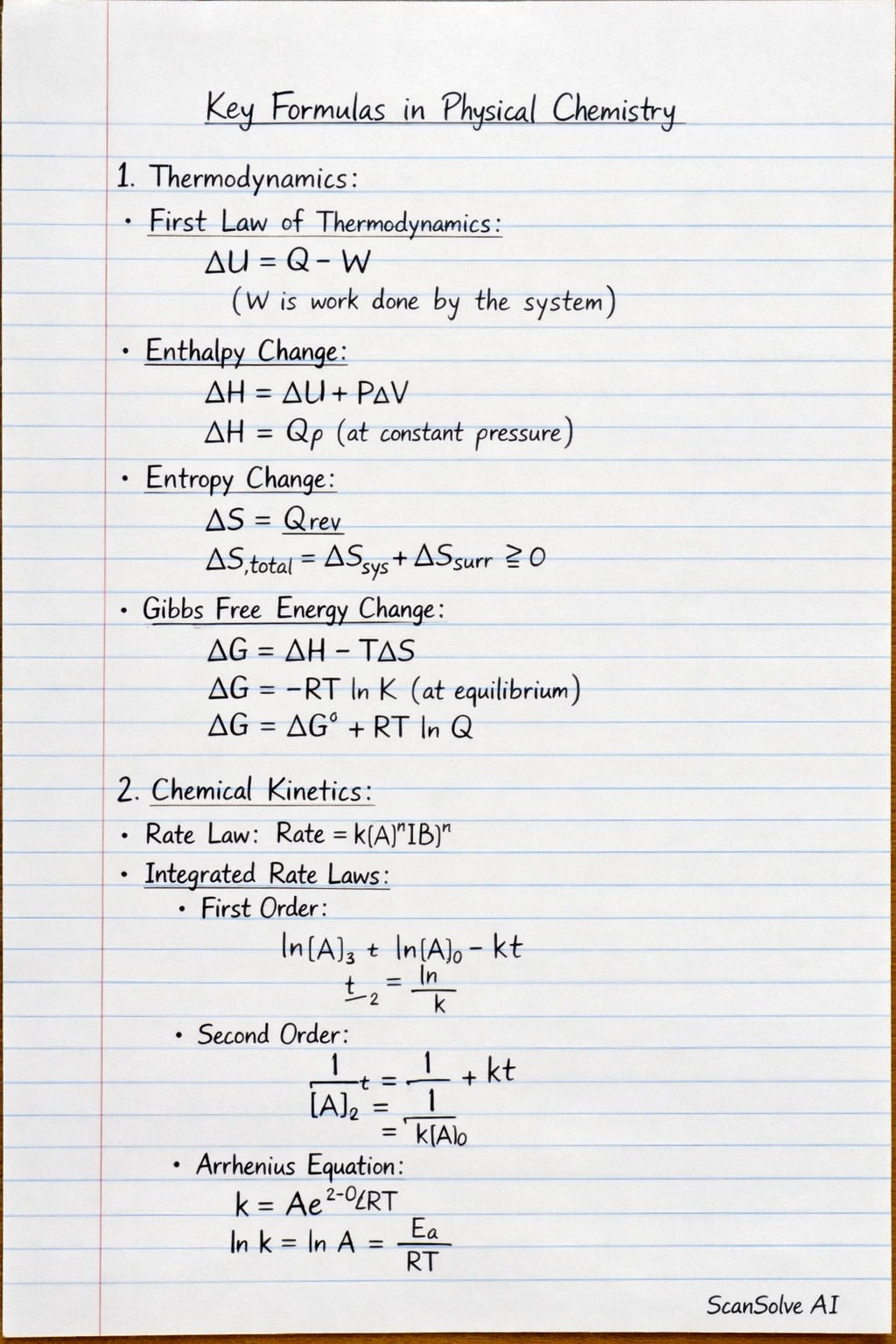
Handwritten Step-by-Step Solution
Get this as a handwritten image on WhatsApp — like a tutor wrote it for you.
Try on WhatsApp