
We read your photo as:
Given the data from an experiment, determine the rate constant (k_f) for the reaction.
Chemistry
ScanSolve AI Answer
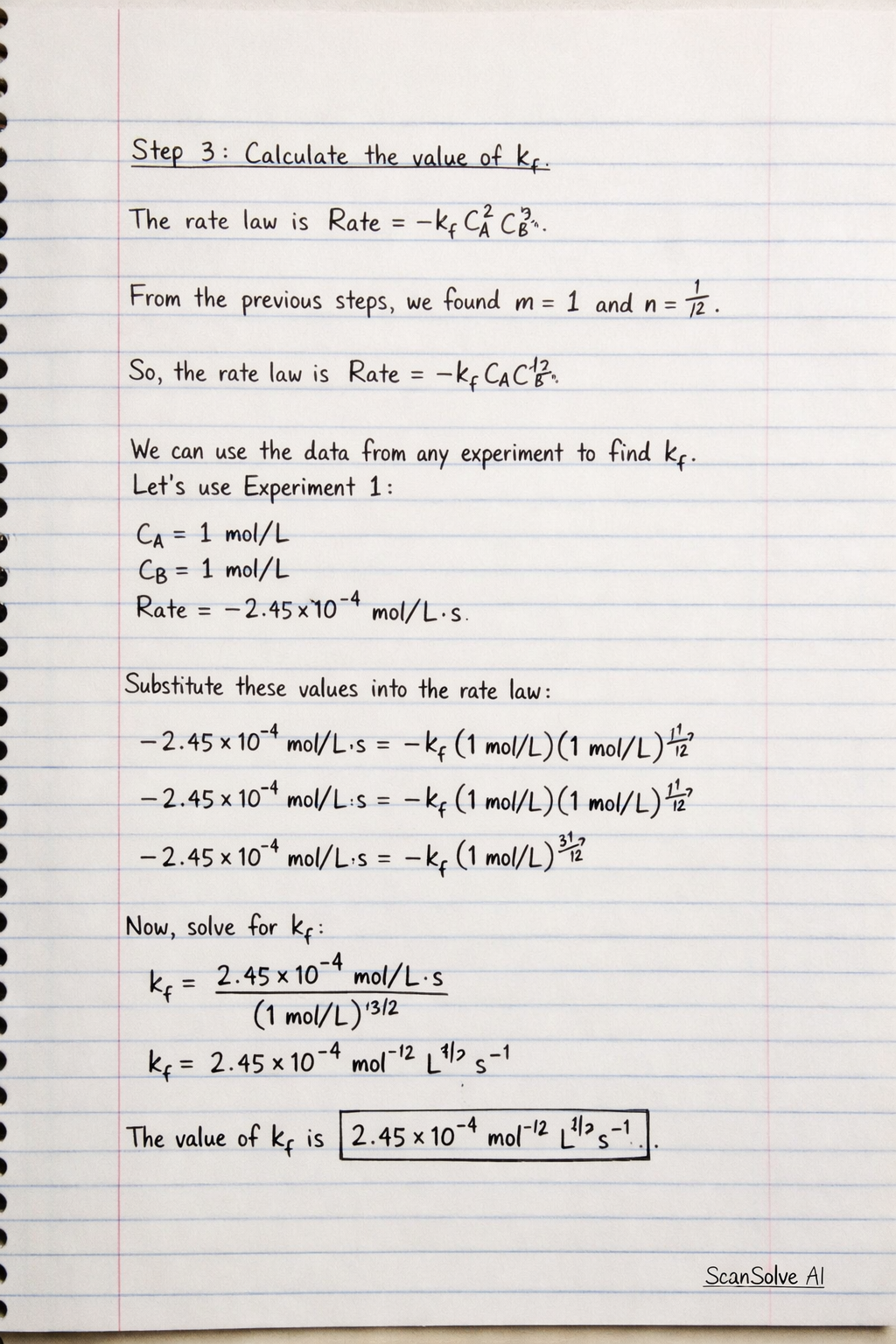
Step 3: Calculate the value of .
The rate law is .
From the previous steps, we found and .
So, the rate law is .
We can use the data from any experiment to find . Let's use Experiment 1:
Substitute these values into the rate law:
Now, solve for :
The value of is .
Was this helpful?
Still stuck on this one?
Ask a follow-up, and the answer starts from this question.
Got a different question?Ask your own question
More Chemistry Questions
QDetermine the reaction order and rate constant from the given experimental data. Rate law: rate…QGiven the following experimental data, determine the reaction orders m and n for the reaction rate…QDetermine the units of the specific rate constant k given the rate law d[x]/dt = k[B]^(3/4).QDetermine the order of the reaction given the rate constant K = 5.5 × 10⁻¹⁴ s⁻¹.QComplete Table 1 by calculating the Rate, 1/t ( exts⁻¹) for each experiment.
Handwritten Step-by-Step Solution
Get this as a handwritten image on WhatsApp — like a tutor wrote it for you.
Try on WhatsApp