
We read your photo as:
Given the following rate data for F2(g) + 2ClO2(g) -> 2ClO2F(g), determine the order of reaction with respect to each reactant, the overall order of the reaction, write the rate equation for the reaction, and calculate the rate constant of the reaction.
ScanSolve AI Answer
Step-by-step solution
5 stepsHere are the solutions based on the provided rate data:
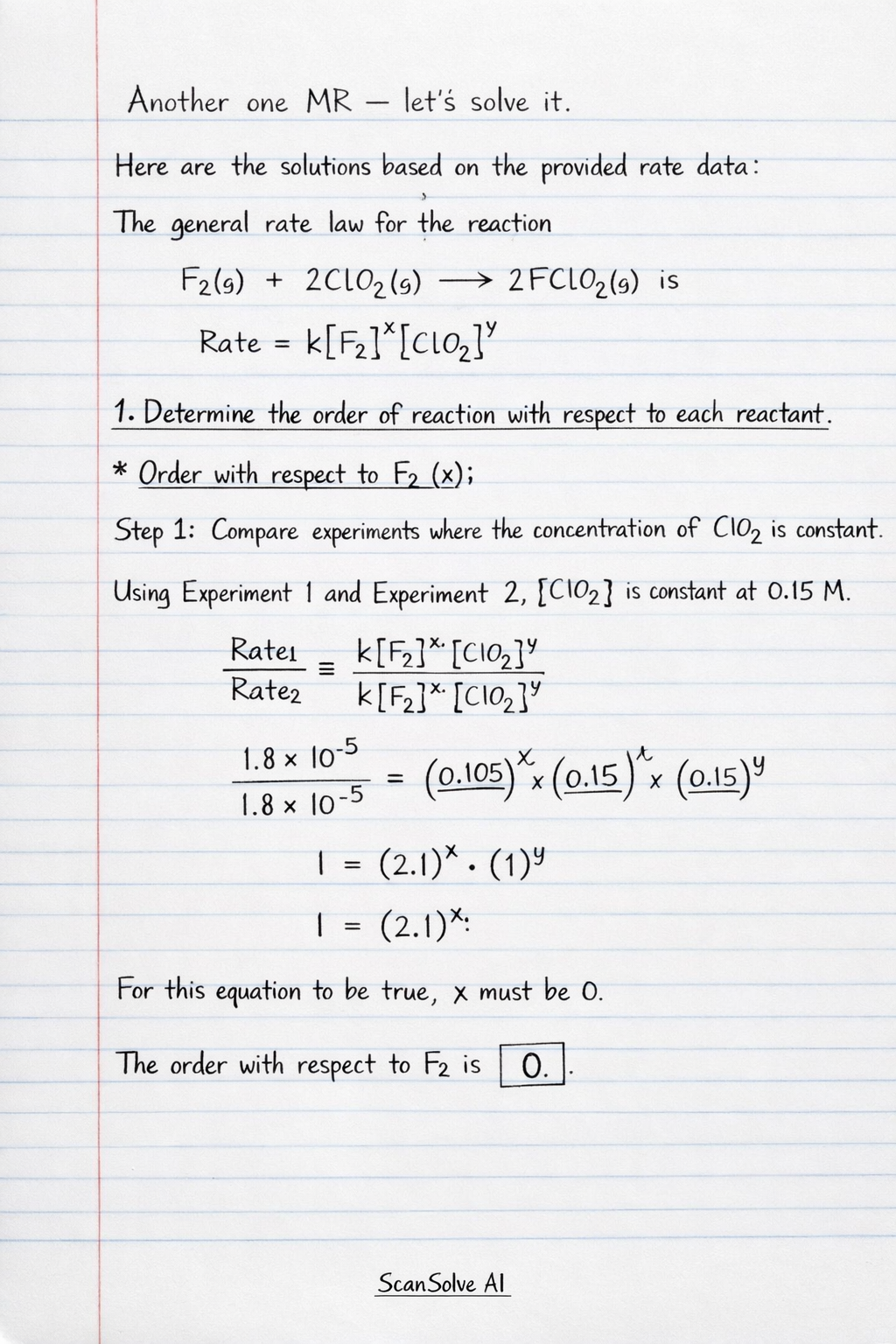
The general rate law for the reaction is .
1. Determine the order of reaction with respect to each reactant.
- Order with respect to ():
Compare experiments where the concentration of is constant.
Using Experiment 1 and Experiment 2, $[ClO_2]$ is constant at 0.15 M. $$ \frac{Rate_1}{Rate_2} = \frac{k[F_2]_1^x[ClO_2]_1^y}{k[F_2]_2^x[ClO_2]_2^y} $$ $$ \frac{1.8 \times 10^{-5}}{1.8 \times 10^{-5}} = \left(\frac{0.105}{0.05}\right)^x \left(\frac{0.15}{0.15}\right)^y $$ $$ 1 = (2.1)^x \cdot 1^y $$ For this equation to be true, $x$ must be 0. The order with respect to $F_2$ is $\boxed{0}$.- Order with respect to ():
Compare experiments where the concentration of is constant.
Using Experiment 3 and Experiment 4, $[F_2]$ is constant at 0.052 M. $$ \frac{Rate_3}{Rate_4} = \frac{k[F_2]_3^x[ClO_2]_3^y}{k[F_2]_4^x[ClO_2]_4^y} $$ $$ \frac{7.1 \times 10^{-5}}{8.9 \times 10^{-6}} = \left(\frac{0.052}{0.052}\right)^x \left(\frac{0.30}{0.15}\right)^y $$ $$ 7.9775 \approx (1)^x (2)^y $$ $$ 7.9775 \approx 2^y $$ Since $2^3 = 8$, $y$ is approximately 3. The order with respect to $ClO_2$ is $\boxed{3}$.2. Determine the overall order of reaction.
The overall order is the sum of the individual orders ().
3. Write the rate equation for the reaction.
Substitute the determined orders into the general rate law.
Since :
4. Calculate the rate constant of the reaction.
Use the rate equation and the data from any experiment to calculate .
Note: There is an inconsistency in the provided data, as calculating from experiments 1 and 2 yields a different value than from experiments 3 and 4. We will use experiments 3 and 4, which were used to determine the order of .
-
Using Experiment 3:
-
Using Experiment 4:
Averaging the values from experiments 3 and 4:
The rate constant is .
-
Still stuck on this one?
Ask a follow-up, and the answer starts from this question.
More Chemistry Questions
Handwritten Step-by-Step Solution
Get this as a handwritten image on WhatsApp — like a tutor wrote it for you.
Try on WhatsApp