
We read your photo as:
Explain the hybridization and bonding in methane (CH₄) and ethyne (C₂H₂).
ScanSolve AI Answer
Answer
Step-by-step solution
10 steps1. Hybrid Orbitals and Bonding
Part a· 3 steps
Methane (CH₄)
Determine the electron configuration of the central carbon atom.
Carbon has an electron configuration of . To form four bonds, one electron from the orbital is promoted to an empty orbital, resulting in .
Identify the hybridization.
The carbon atom mixes one orbital and three orbitals to form four equivalent hybrid orbitals.
Describe the bonding.
Each of the four hybrid orbitals on carbon contains one electron and overlaps head-on with the orbital of a hydrogen atom (which also contains one electron) to form a strong sigma () bond. This results in four C-H sigma bonds. The hybridization leads to a tetrahedral geometry around the carbon atom with bond angles of .
Part b
Ethyne (H-C≡C-H)
Determine the electron configuration of each carbon atom.
Each carbon atom has an electron configuration of . For bonding, one electron from the orbital is promoted to an empty orbital, resulting in .
Identify the hybridization.
Each carbon atom is bonded to one hydrogen and one other carbon atom, forming two electron domains. Therefore, each carbon atom undergoes hybridization, mixing one orbital and one orbital to form two hybrid orbitals. Two orbitals remain unhybridized.
Describe the bonding.
- One hybrid orbital on each carbon overlaps with the orbital of a hydrogen atom to form a C-H sigma () bond.
- The other hybrid orbital on each carbon overlaps head-on with the hybrid orbital of the adjacent carbon atom to form a C-C sigma () bond.
- The two unhybridized orbitals on each carbon (oriented perpendicular to each other and to the orbitals) overlap side-by-side with the corresponding unhybridized orbitals on the adjacent carbon atom to form two pi () bonds. This results in a triple bond between the carbon atoms (one and two bonds) and two C-H sigma bonds. The hybridization leads to a linear geometry around each carbon atom with bond angles of .
2. Valence Bond Theory and Bonding in NH₃
Determine the electron configuration of the central nitrogen atom.
Nitrogen has an electron configuration of . It has one lone pair in the orbital and three unpaired electrons in the orbitals.
Apply the concept of hybridization within Valence Bond Theory.
While the orbitals could theoretically overlap with hydrogen orbitals to form three bonds, this would predict bond angles of . However, the experimentally observed bond angle in ammonia is approximately . To account for this, Valence Bond Theory uses the concept of hybridization. The nitrogen atom undergoes hybridization.
Describe the formation of hybrid orbitals and bonding.
The nitrogen atom mixes its one orbital and three orbitals to form four equivalent hybrid orbitals.
- One of these hybrid orbitals contains the lone pair of electrons.
- The other three hybrid orbitals each contain one unpaired electron and overlap head-on with the orbital of a hydrogen atom (each containing one electron) to form three N-H sigma () bonds.
Explain the molecular geometry.
The four hybrid orbitals arrange themselves in a tetrahedral electron geometry. However, because one position is occupied by a lone pair, the molecular geometry of NH₃ is trigonal pyramidal. The lone pair exerts greater repulsion on the bonding pairs, compressing the H-N-H bond angles from the ideal to approximately .
Try one yourself
A new problem that tests the same skill.
Still stuck on this one?
Ask a follow-up, and the answer starts from this question.
More Chemistry Questions
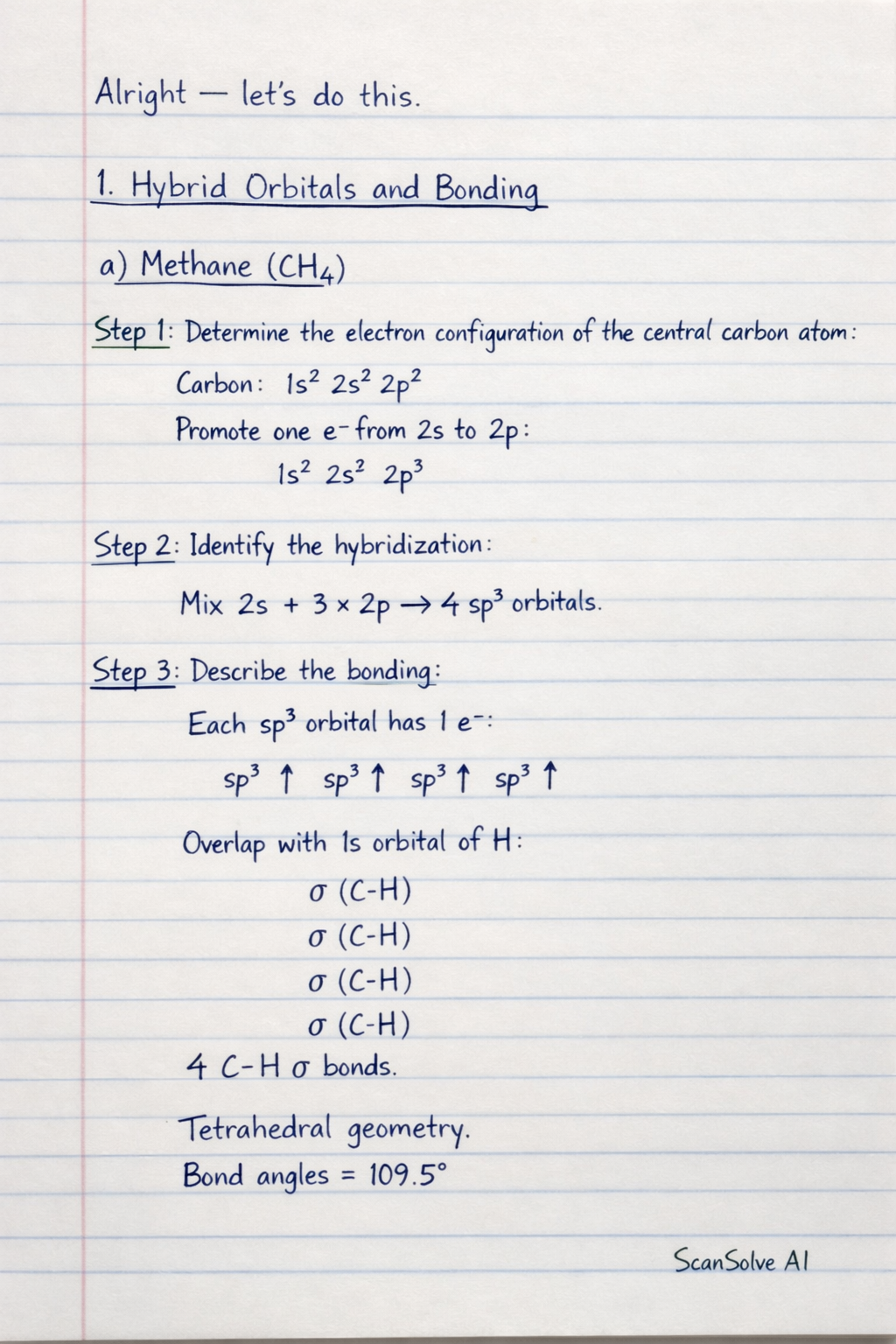
Handwritten Step-by-Step Solution
Get this as a handwritten image on WhatsApp — like a tutor wrote it for you.
Try on WhatsApp