
We read your photo as:
How do I convert exactly 0.1 M HCl using the dilution equation and information from Table 5?
ScanSolve AI Answer
Step-by-step solution
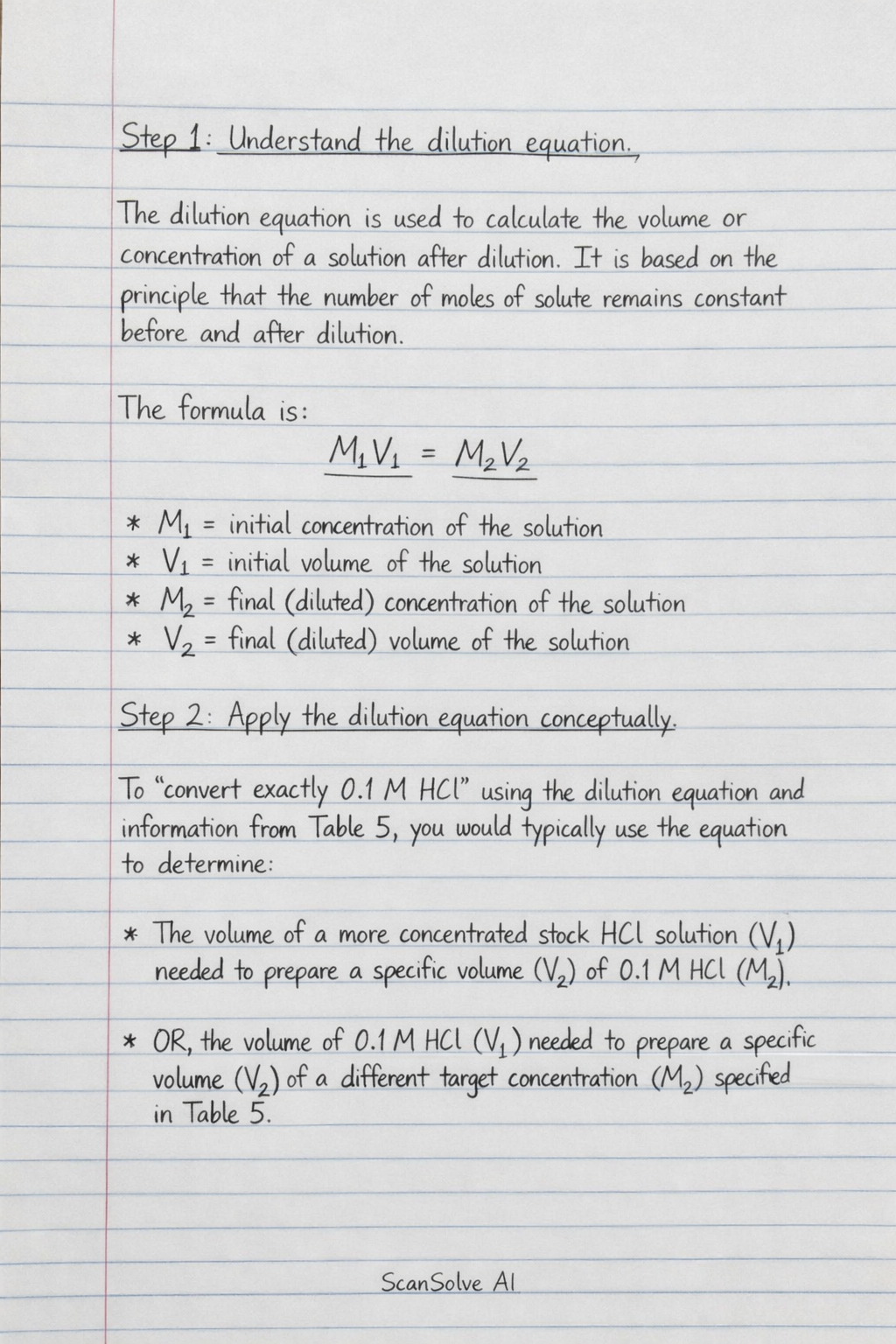
4 stepsUnderstand the dilution equation.
The dilution equation is used to calculate the volume or concentration of a solution after dilution. It is based on the principle that the number of moles of solute remains constant before and after dilution.
The formula is:Where:
- = initial concentration of the solution
- = initial volume of the solution
- = final (diluted) concentration of the solution
- = final (diluted) volume of the solution
Apply the dilution equation conceptually.
To "convert exactly 0.1 M HCl" using the dilution equation and information from Table 5, you would typically use the equation to determine:
- The volume of a more concentrated stock HCl solution () needed to prepare a specific volume () of 0.1 M HCl ().
- OR, the volume of 0.1 M HCl () needed to prepare a specific volume () of a different target concentration () specified in Table 5.
Identify missing information.
To perform the exact calculation for step (i), the following information from "Table 5" would be required:
- The initial concentration of the stock HCl solution (if preparing 0.1 M HCl).
- The desired final concentration () and/or the desired final volume () of the diluted HCl solution (if diluting 0.1 M HCl further). Without this specific information, a numerical calculation cannot be provided.
Summarize the overall procedure (steps ii-iv).
Steps (ii) through (iv) describe a standard acid-base titration procedure:
- Washing and setting up apparatus (ii) ensures proper cleanliness to prevent contamination and impurities, which would affect the accuracy of the results.
- Pipetting the required base, adding indicators, and titrating (iii) involves accurately measuring a known volume of one reactant (the base) into a conical flask, adding an indicator to visually determine the endpoint, and then slowly adding the other reactant (the acid) from a burette until the reaction is complete.
- Recording and repeating titrations (iv) ensures precision by obtaining multiple consistent readings (titre values). The average titre value is then used in stoichiometric calculations to determine the unknown concentration of either the acid or the base.
Still stuck on this one?
Ask a follow-up, and the answer starts from this question.
More Chemistry Questions
Handwritten Step-by-Step Solution
Get this as a handwritten image on WhatsApp — like a tutor wrote it for you.
Try on WhatsApp