
We read your photo as:
I. Find the equilibrium income
ScanSolve AI Answer
Answer
Step-by-step solution
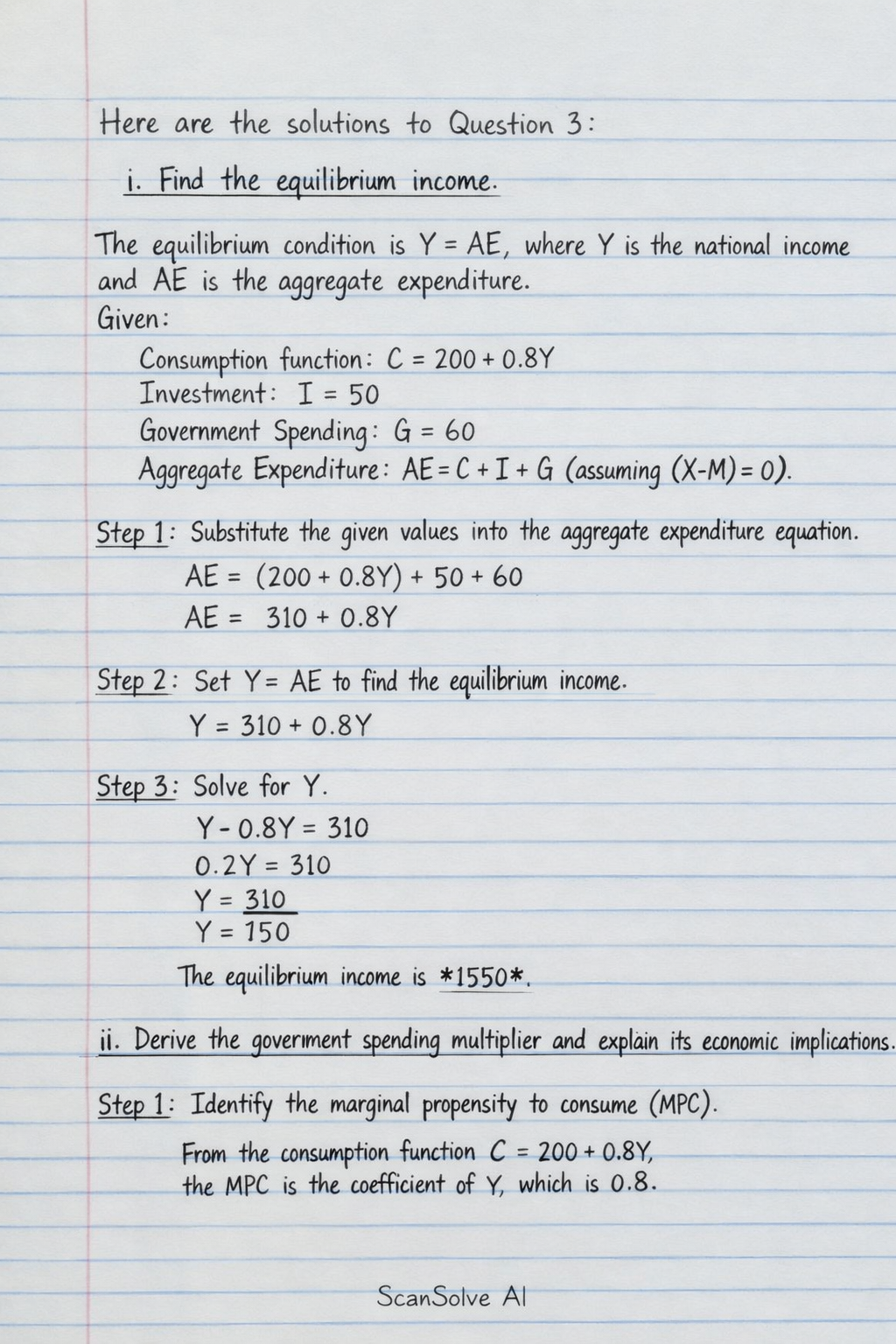
5 stepsHere are the solutions to Question 3:
Part i· 3 steps
Find the equilibrium income
The equilibrium condition is , where is the national income and is the aggregate expenditure.
Given:
Consumption function:
Investment:
Government Spending:
Aggregate Expenditure: (assuming as no information is provided for net exports)
Substitute the given values into the aggregate expenditure equation.
Set to find the equilibrium income.
Solve for .
The equilibrium income is .
Part ii· 2 steps
Derive the government spending multiplier and explain its economic implications
Identify the marginal propensity to consume (MPC).
From the consumption function , the MPC is the coefficient of , which is 0.8.
Calculate the government spending multiplier ().
The formula for the government spending multiplier is:
The government spending multiplier is $\boxed
Try one yourself
A new problem that tests the same skill.
Still stuck on this one?
Ask a follow-up, and the answer starts from this question.
More Chemistry Questions
Handwritten Step-by-Step Solution
Get this as a handwritten image on WhatsApp — like a tutor wrote it for you.
Try on WhatsApp