
We read your photo as:
I. State the law of mass action. ii. Using relevant illustrative reaction, distinguish between reaction quotient (Q) and the equilibrium constant (K).
ScanSolve AI Answer
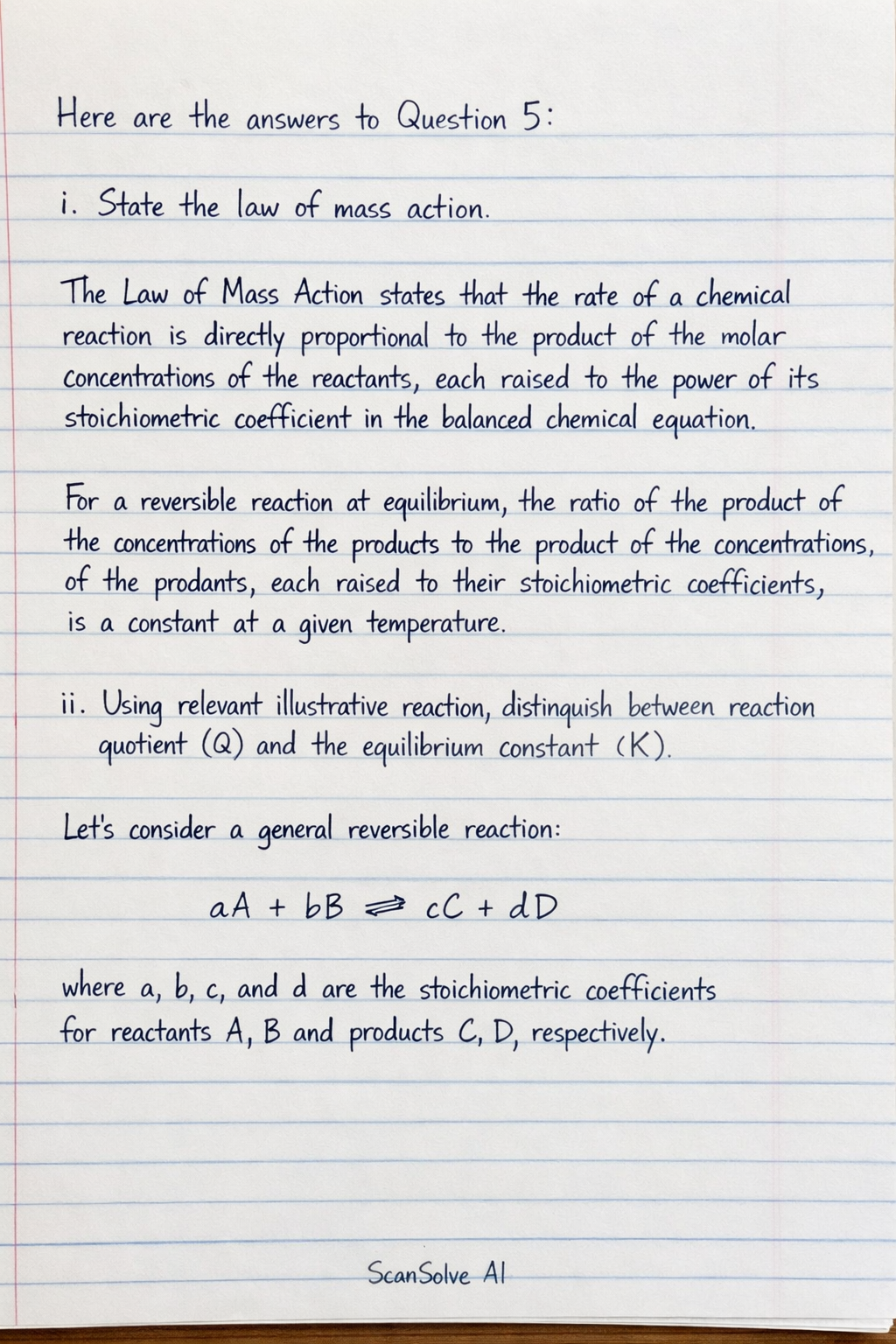
Here are the answers to Question 5:
i. State the law of mass action
The Law of Mass Action states that the rate of a chemical reaction is directly proportional to the product of the molar concentrations of the reactants, each raised to the power of its stoichiometric coefficient in the balanced chemical equation. For a reversible reaction at equilibrium, the ratio of the product of the concentrations of the products to the product of the concentrations of the reactants, each raised to their stoichiometric coefficients, is a constant at a given temperature.
ii. Using relevant illustrative reaction, distinguish between reaction quotient (Q) and the equilibrium constant (K).
Let's consider a general reversible reaction:
where a, b, c, and d are the stoichiometric coefficients for reactants A, B and products C, D, respectively.
- Reaction Quotient (Q): The reaction quotient (Q) is a measure of the relative amounts of products and reactants present in a reaction at any given time. It is calculated using the same expression as the equilibrium constant, but with concentrations that are not necessarily at equilibrium. For the given reaction, the reaction quotient is:
The value of Q changes as the reaction proceeds towards equilibrium.
- Equilibrium Constant (K): The equilibrium constant (K) is a specific value of the reaction quotient when the reaction has reached chemical equilibrium at a given temperature. At equilibrium, the rates of the forward and reverse reactions are equal, and the net change in concentrations of reactants and products is zero. For the given reaction, the equilibrium constant is:
where the subscript 'eq' denotes concentrations at equilibrium. K is a constant for a particular reaction at a specific temperature.
Distinction:
The key difference lies in the state of the reaction when they are calculated:
- Q can be calculated at any point during a reaction, whether it is at equilibrium or not.
- K is calculated only when the reaction is at equilibrium.
Comparing Q and K helps predict the direction a reaction will shift to reach equilibrium:
- If : The ratio of products to reactants is too small. The reaction will proceed in the forward direction (towards products) to reach equilibrium.
- If : The ratio of products to reactants is too large. The reaction will proceed in the reverse direction (towards reactants) to reach equilibrium.
- If : The reaction is at equilibrium, and there will be no net change in concentrations.
Still stuck on this one?
Ask a follow-up, and the answer starts from this question.
More Chemistry Questions
Handwritten Step-by-Step Solution
Get this as a handwritten image on WhatsApp — like a tutor wrote it for you.
Try on WhatsApp