
We read your photo as:
Identify the gas, write the equations of the reactions, and suggest one more test to identify the acid radical present.
ScanSolve AI Answer
Step-by-step solution
6 stepshere are the answers to your questions:
3. Crystalline colorless salt on heating with dilute HCl produced a gas with suffocating odor of burning sulphur, which give green coloration when a filter paper moisten with acidified potassium dichromate held on the mouth of the test-tube. Identify the gas, write the equations of the reactions above and suggest one more test that can be use to identify the acid radical present.
-
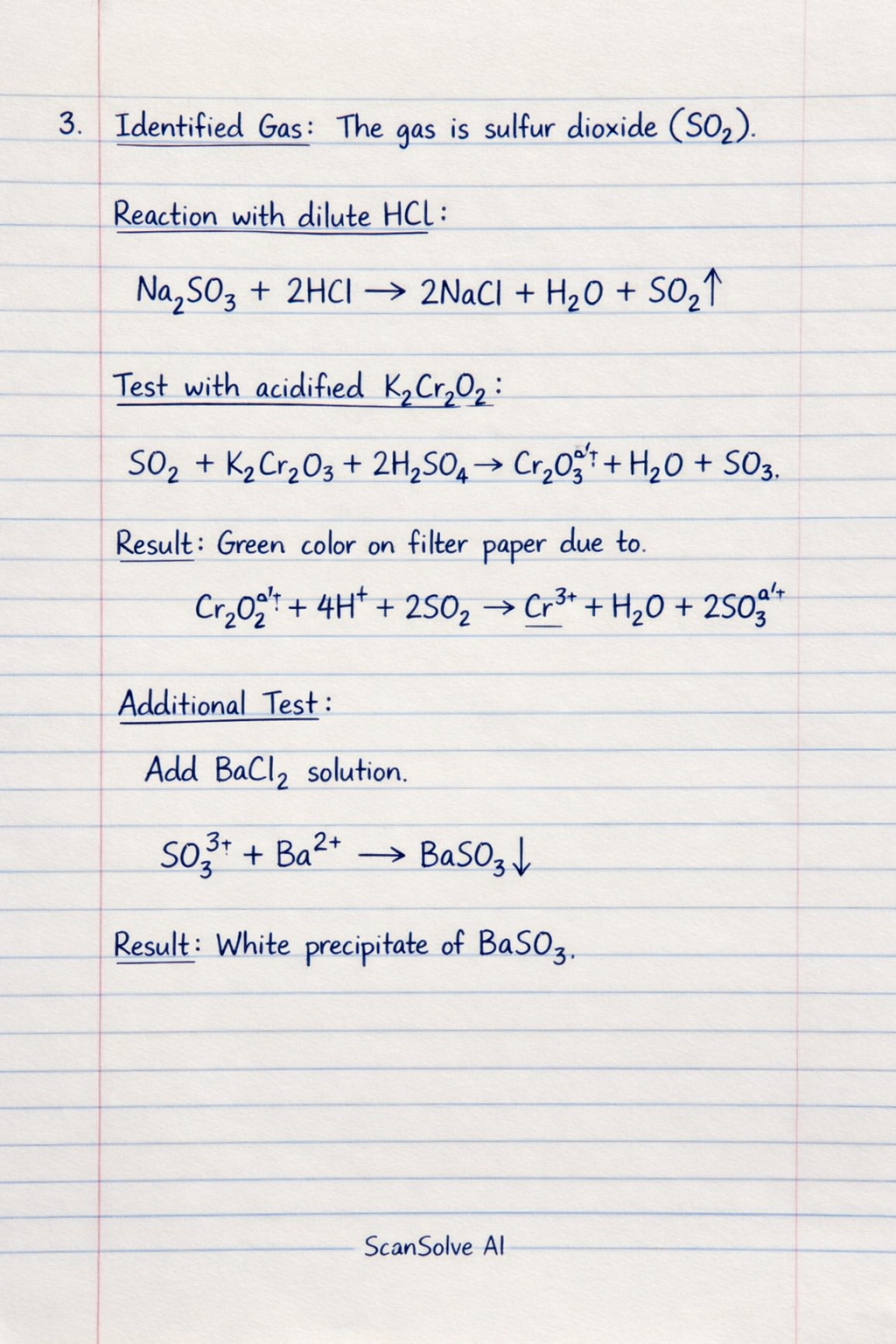
Identified Gas: The gas is sulfur dioxide ().
-
Equations of Reactions:
Reaction of a sulfite salt (e.g., sodium sulfite) with dilute hydrochloric acid.
$$ \text{Na}_2\text{SO}_3(\text{s}) + 2\text{HCl}(\text{aq}) \rightarrow 2\text{NaCl}(\text{aq}) + \text{H}_2\text{O}(\text{l}) + \text{SO}_2(\text{g}) $$Reaction of sulfur dioxide with acidified potassium dichromate(VI).
$$ \text{Cr}_2\text{O}_7^{2-}(\text{aq}) + 3\text{SO}_2(\text{g}) + 2\text{H}^{+}(\text{aq}) \rightarrow 2\text{Cr}^{3+}(\text{aq}) + 3\text{SO}_4^{2-}(\text{aq}) + \text{H}_2\text{O}(\text{l}) $$ (Orange dichromate is reduced to green chromium(III) ions).- One more test to identify the acid radical (Sulfite, ): Add a few drops of acidified potassium permanganate () solution to the solution containing the sulfite radical. The purple color of the permanganate solution will be decolorized as the sulfite is oxidized to sulfate.
4. a) What are the physical properties of chlorides? b) Give the equation for the reaction between 0.1M NaCl and con.HSO. c) Write short notes on how to recognize the product above.
-
a) Physical properties of chlorides:
- Most chlorides are white crystalline solids.
- The majority are soluble in water, with notable exceptions like silver chloride (), lead(II) chloride (), and mercury(I) chloride ().
- They generally have high melting and boiling points due to their ionic nature.
- Some transition metal chlorides can be colored (e.g., copper(II) chloride is blue-green).
-
b) Equation for the reaction between 0.1M NaCl and con.HSO: Assuming "con.HSO" refers to concentrated sulfuric acid ():
-
c) How to recognize the product above (HCl gas):
- Dense white fumes with ammonia: Bring a glass rod dipped in concentrated ammonia solution near the gas. Dense white fumes of ammonium chloride will be observed.
- Litmus paper test: The gas turns blue litmus paper red, indicating its acidic nature.
- Silver nitrate test: When passed through silver nitrate solution, it forms a white precipitate of silver chloride, which is insoluble in nitric acid but soluble in ammonium hydroxide.
5. a) Give the physical properties of borates. b) Describe Tumeric paper test for the identification of borates. c) Write equation for the reaction between borate and barium chloride.
-
a) Physical properties of borates:
- Most borates are white crystalline solids.
- Many are sparingly soluble or insoluble in water, though sodium borate (borax) is soluble.
- They often exist as hydrates (containing water of crystallization).
- They are generally stable compounds.
-
b) Turmeric paper test for the identification of borates:
Acidify the borate solution with dilute hydrochloric acid () or sulfuric acid ().
Dip a piece of turmeric paper into the acidified solution.
Dry the paper, preferably by warming it gently.
The turmeric paper will turn a distinct reddish-brown color.
To confirm, add a drop of dilute alkali (like sodium hydroxide solution) to the reddish-brown paper.
The color will change to greenish-black.
- c) Equation for the reaction between borate and barium chloride: Assuming a simple borate like sodium metaborate (): A white precipitate of barium metaborate is formed.
Still stuck on this one?
Ask a follow-up, and the answer starts from this question.
More Chemistry Questions
Handwritten Step-by-Step Solution
Get this as a handwritten image on WhatsApp — like a tutor wrote it for you.
Try on WhatsApp