
![If 60 cm3 of a saturated solution of KNO3 contains 15.6 g of the salt at 35 °C, calculate the solubility of KNO3 in mol dm-3 at that temperature. [K = 39.0, O = 16.0, N = 14.0]](/_next/image?url=https%3A%2F%2Fohijasnjvprzodcmxltt.supabase.co%2Fstorage%2Fv1%2Fobject%2Fpublic%2Fwhatsapp-images%2F1781168059092-842a54753e70f759.png&w=3840&q=75)
This chemistry question involves key chemical concepts and calculations. The detailed solution below walks through each step, from identifying the reaction type to computing the final answer.
ScanSolve AI Answer
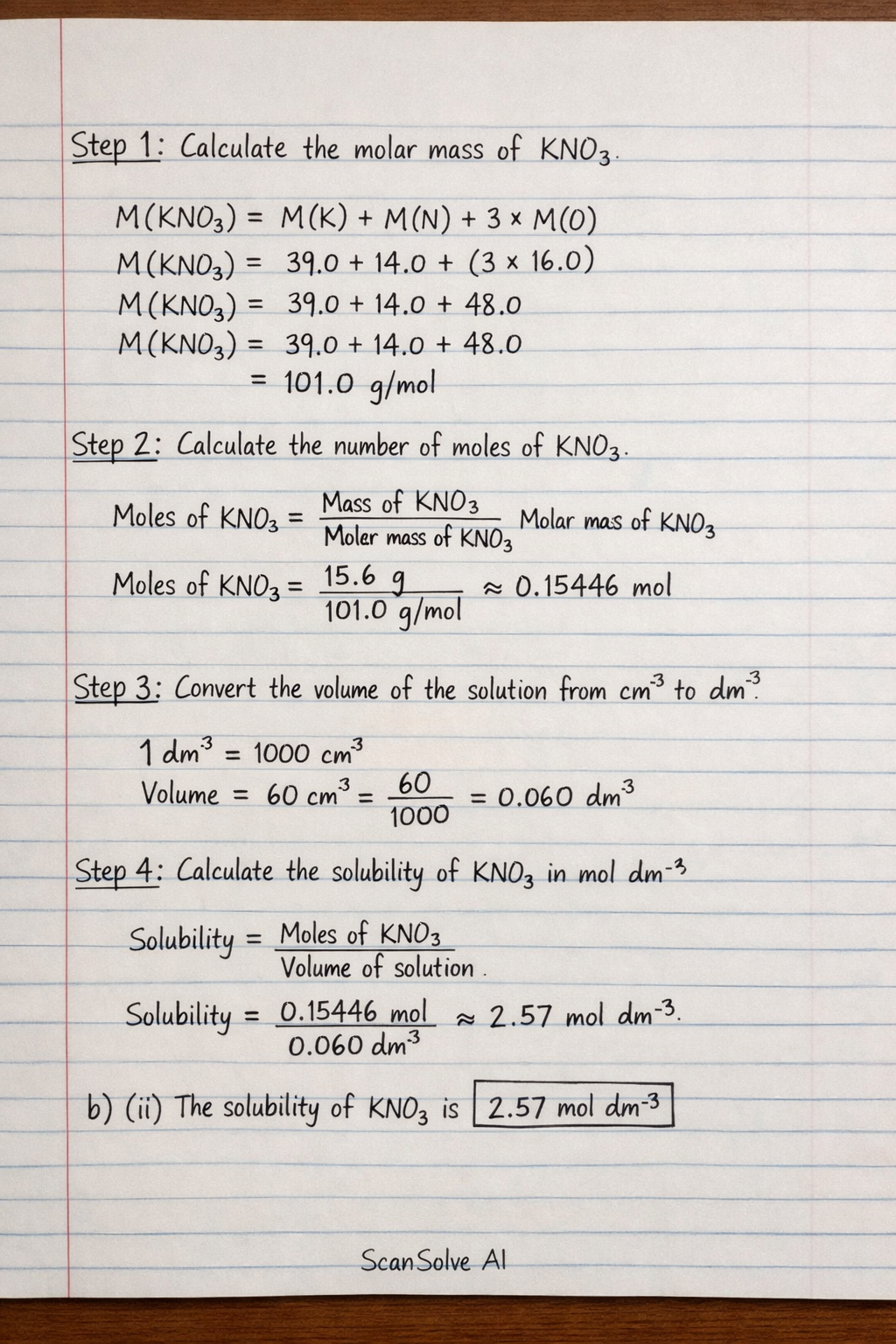
Step 1: Calculate the molar mass of KNO_3. M(KNO_3) = M(K) + M(N) + 3 × M(O) M(KNO_3) = 39.0 + 14.0 + (3 × 16.0) = 39.0 + 14.0 + 48.0 = 101.0 g/mol Step 2: Calculate the number of moles of KNO_3. Moles of KNO_3 = Mass of KNO_3Molar mass of KNO_3 Moles of KNO_3 = 15.6 g101.0 g/mol ≈ 0.15446 mol Step 3: Convert the volume of the solution from cm^3 to dm^3. 1 dm^3 = 1000 cm^3 Volume = 60 cm^3 = (60)/(1000) dm^3 = 0.060 dm^3 Step 4: Calculate the solubility of KNO_3 in mol dm^-3. Solubility = Moles of KNO_3Volume of solution Solubility = 0.15446 mol0.060 dm^3 ≈ 2.57 mol dm^-3 b) (ii) The solubility of KNO_3 is 2.57 mol dm^-3. Step 5: Outline the preparation of PbCl_2(s) from Pb(NO_3)_2 and a mineral acid. c) (i) To prepare PbCl_2(s), mix an aqueous solution of lead(II) nitrate (Pb(NO_3)_2) with a mineral acid containing chloride ions, such as hydrochloric acid (HCl). Lead(II) chloride will precipitate out as a solid. Filter the precipitate, wash it with distilled water, and then dry it. Step 6: Write an equation for the reaction in 2(c)(i). c) (ii) Pb(NO_3)_2(aq) + 2HCl(aq) PbCl_2(s) + 2HNO_3(aq) Step 7: Give the reason for copper's electron configuration. d) (i) The electron configuration of copper is 1s^2 2s^2 2p^6 3s^2 3p^6 3d^10 4s^1 because a completely filled d-subshell (3d^10) is more stable than a partially filled d-subshell (3d^9). One electron from the 4s orbital is promoted to the 3d orbital to achieve this greater stability. Step 8: Mention the two oxidation states of iron in its chlorides. d) (ii) The two oxidation states of iron in its chlorides are +2 (in FeCl_2) and +3 (in FeCl_3). Step 9: Name one chemical process in which iron is used as a catalyst. d) (iii) Iron is used as a catalyst in the Haber process (for the synthesis of ammonia). Send me the next one 📸