
Solve in the way that I can explain it to my lecturer
ScanSolve AI Answer
Answer
Step-by-step solution
2 stepsTo explain this solution to your lecturer, you would emphasize the fundamental principles of chemical kinetics for first-order reactions.
The problem asks us to determine the fraction of diethyl ether remaining after a specific time, given its half-life for a first-order decomposition reaction.
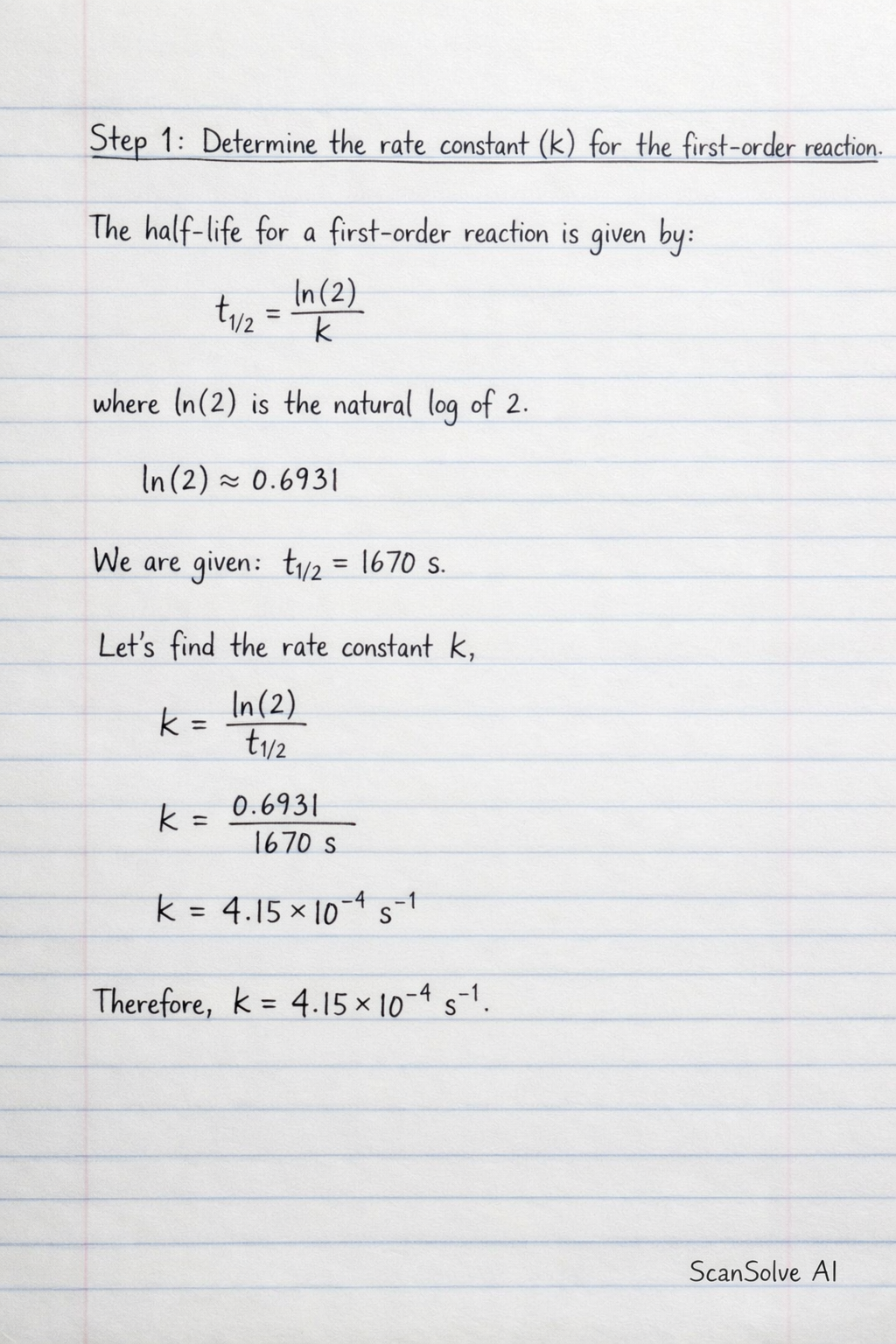
Determine the rate constant () for the first-order reaction.
For a first-order reaction, the rate of reaction is directly proportional to the concentration of a single reactant. A key characteristic of a first-order reaction is its half-life (), which is the time required for the concentration of the reactant to decrease to half of its initial value. For a first-order reaction, the half-life is constant and is related to the rate constant () by the following equation:
Here, is the natural logarithm of 2, which is a constant approximately equal to 0.6931.
We are given the half-life . To determine the rate constant , we rearrange the formula:Substitute the given value for :
This calculated rate constant quantifies the intrinsic speed of the decomposition reaction.
Calculate the fraction of diethyl ether remaining after .
To determine the amount of reactant remaining after a specific time , we utilize the integrated rate law for a first-order reaction. This equation relates the concentration of the reactant at time () to its initial concentration (), the rate constant (), and the elapsed time ():
The ratio represents the fraction of the reactant remaining at time . To solve for this fraction, we need to eliminate the natural logarithm (). This is achieved by taking the exponential (base ) of both sides of the equation:
This simplifies to:
Now, we substitute the calculated rate constant and the given time :
First, we compute the product in the exponent:
Thus, the equation becomes:
Finally, we evaluate the exponential term:
This result indicates that after , approximately 0.1416 (or ) of the initial diethyl ether remains.
Note: The value 0.750 was not used in these calculations. The constant derived from the half-life formula for a first-order reaction is .
The fraction of diethyl ether remaining after is approximately .
Try one yourself
A new problem that tests the same skill.
Still stuck on this one?
Ask a follow-up, and the answer starts from this question.
More Chemistry Questions
Handwritten Step-by-Step Solution
Get this as a handwritten image on WhatsApp — like a tutor wrote it for you.
Try on WhatsApp