

This chemistry question involves key chemical concepts and calculations. The detailed solution below walks through each step, from identifying the reaction type to computing the final answer.
ScanSolve AI Answer
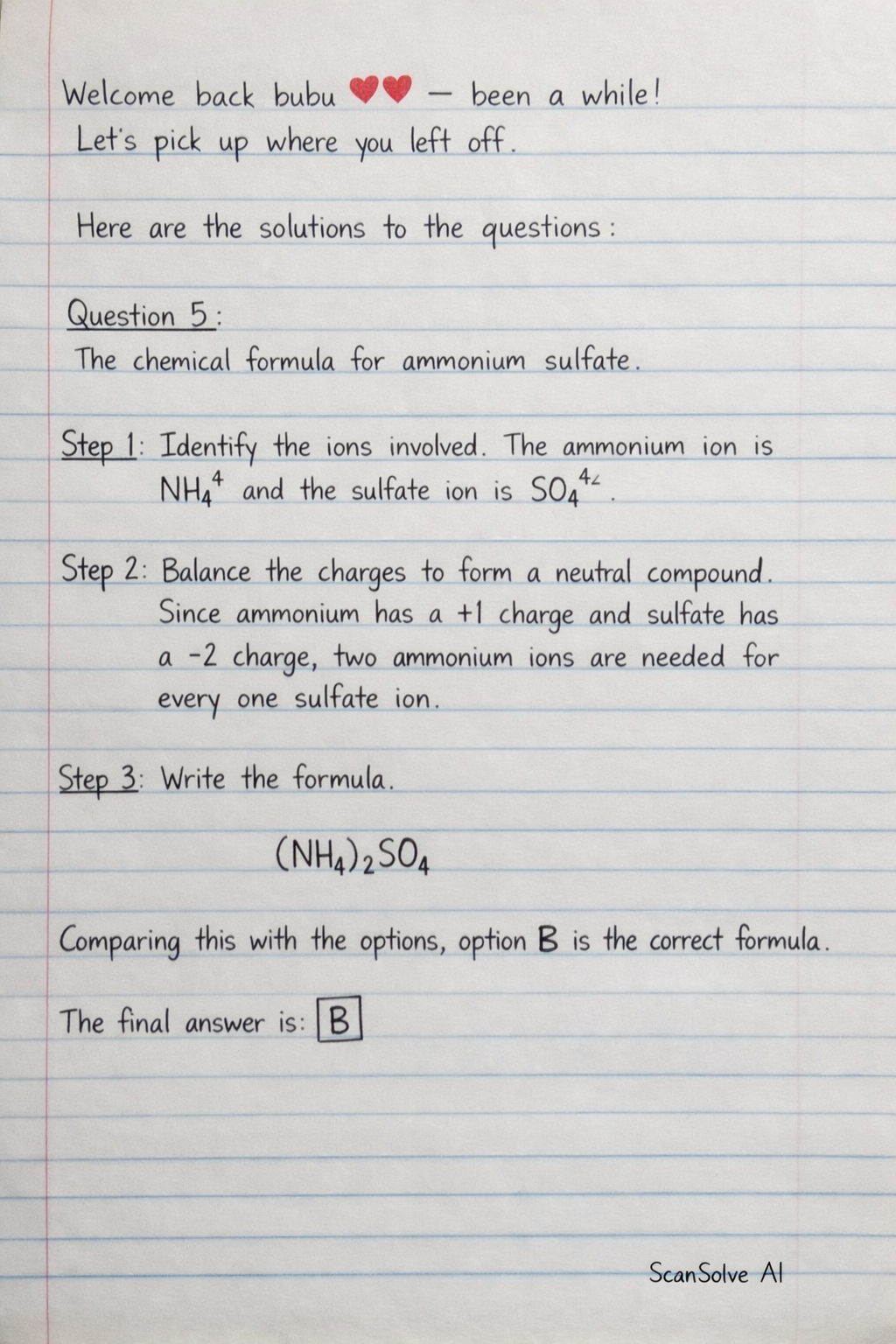
Here are the solutions to the questions: Question 5: The chemical formula for ammonium sulfate. Step 1: Identify the ions involved. The ammonium ion is NH_4^+ and the sulfate ion is SO_4^2-. Step 2: Balance the charges to form a neutral compound. Since ammonium has a +1 charge and sulfate has a -2 charge, two ammonium ions are needed for every one sulfate ion. Step 3: Write the formula. (NH_4)_2SO_4 Comparing this with the options, option B is the correct formula. The final answer is B Question 6: The atom P and Y have the same... Step 1: Analyze the question and options. The question is incomplete, but it asks what two atoms P and Y have in common. This often refers to relationships like isotopes, isobars, or isotones. Step 2: Consider the most common interpretation in chemistry. If P and Y are isotopes (atoms of the same element with different numbers of neutrons), they must have the same number of protons. The number of protons defines the element. Step 3: Evaluate the options based on this interpretation. • A. Nucleon number (mass number): Same for isobars. • B. Number of electrons: Can be same for isoelectronic species (ions or atoms). • C. Number of neutrons: Same for isotones. • D. Number of protons: Same for isotopes (atoms of the same element). Assuming the question implies P and Y are isotopes or atoms of the same element, they would have the same number of protons. The final answer is D Question 7: Iron (III) phosphate has the formula Fe(PO_4)_x. What is the valency of a phosphate ion? Step 1: Determine the charge of the iron ion. Iron (III) indicates that the iron ion is Fe^3+. Step 2: Determine the charge of the phosphate ion. For a neutral compound, the total positive charge must balance the total negative charge. In Iron(III) phosphate, the formula is FePO_4, meaning x=1. Step 3: Since there is one Fe^3+ ion, the single phosphate ion (PO_4) must have a charge of -3 to balance it. The valency is the magnitude of this charge. The valency of the phosphate ion is 3. The final answer is C Question 8: Which one of the following is not an example of a mineral acid? Step 1: Define mineral acids. Mineral acids (or inorganic acids) are derived from inorganic compounds and typically do not contain carbon (with some exceptions like carbonic acid). Step 2: Evaluate each option: • A. Sulphuric acid (H_2SO_4): A common mineral acid. • B. Nitric acid (HNO_3): A common mineral acid. • C. Hydrochloric acid (HCl): A common mineral acid. • D. Citric acid (C_6H_8O_7): An organic acid found in citrus fruits, characterized by carboxyl groups. Step 3: Identify the acid that is not a mineral acid. Citric acid is an organic acid. The final answer is D Question 9: Which of the following reaction represents the reaction between magnesium and aqueous copper (II) sulphate? Step 1: Identify the reactants and type of reaction. Magnesium (Mg) is a metal, and copper(II) sulfate (CuSO_4) is an aqueous salt solution. This is a single displacement reaction because magnesium is more reactive than copper. Step 2: Predict the products. Magnesium will displace copper from the solution, forming magnesium sulfate and solid copper. The balanced chemical equation is: Mg(s) + CuSO_4(aq) → MgSO_4(aq) + Cu(s) The net ionic equation is: Mg(s) + Cu^2+(aq) → Mg^2+(aq) + Cu(s) Step 3: Compare with the given options. • A. Mg(s) + CuSO_4(aq) → Mg^2+(aq) + Cu(s): This option correctly shows magnesium displacing copper(II) ions. The sulfate ion is a spectator ion and is omitted from the product side, which is consistent with a net ionic representation. • B. Mg^2+ + Cu(s) → Mg(s) + Cu^2+: This is the reverse reaction and would not occur spontaneously. • C. Mg^2+ + SO_4^2- → MgSO_4(aq): This shows the formation of magnesium sulfate from its ions, not the displacement reaction. • D. Mg(s) + SO_4^2-(aq) → MgSO_4(aq): This is incorrect as magnesium reacts with copper ions, not sulfate ions directly in this context. The final answer is A Question 10: Acids are substances that can turn... Step 1: Recall the properties of acids with common indicators. Acids are known to change the color of certain indicators. Step 2: Evaluate the options based on indicator properties: • A. Blue litmus paper red: Acids turn blue litmus paper red. This is a characteristic property of acids. • B. Red litmus paper blue: Bases turn red litmus paper blue. • C. Neutral litmus paper red: Neutral litmus paper is typically purple; acids would turn it red. However, "blue litmus paper red" is the most precise and common statement. • D. Universal indicator blue: Universal indicator turns blue in alkaline (basic) solutions, not acidic ones. In acidic solutions, it turns red, orange, or yellow. The final answer is A