

This chemistry question involves key chemical concepts and calculations. The detailed solution below walks through each step, from identifying the reaction type to computing the final answer.
ScanSolve AI Answer
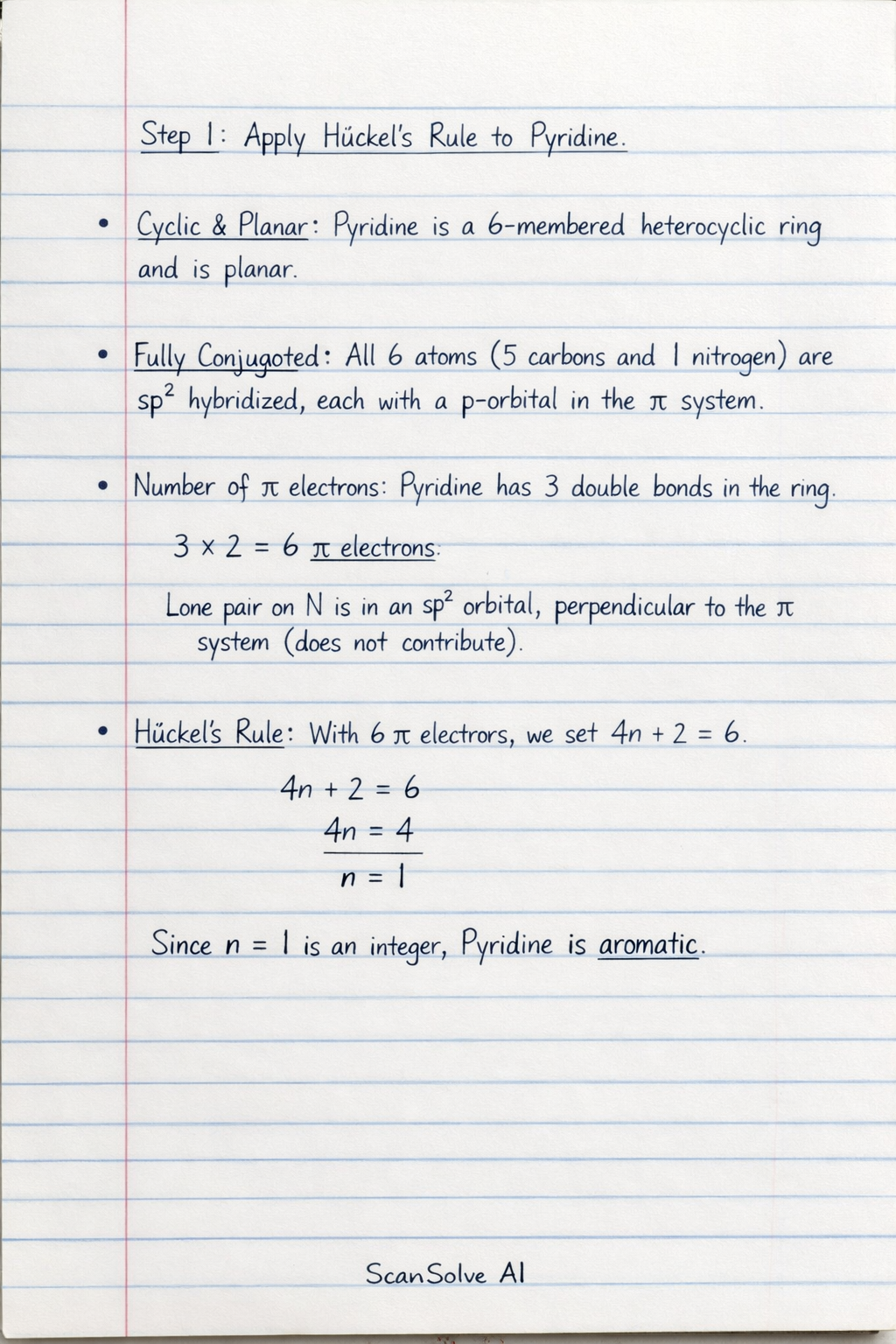
You're on a roll — Step 1: Apply Hückel's Rule to Pyridine. Hückel's rule states that a compound is aromatic if it is cyclic, planar, fully conjugated, and has (4n+2) electrons, where n is a non-negative integer. Cyclic and Planar: Pyridine is a 6-membered heterocyclic ring that is planar. Fully Conjugated: All 6 atoms (5 carbons and 1 nitrogen) are sp^2 hybridized, each contributing a p-orbital to the cyclic system. Number of electrons: Pyridine has three double bonds within the ring, contributing 3 × 2 = 6 electrons. The lone pair on the nitrogen atom is in an sp^2 orbital, perpendicular to the system, and does not contribute to the aromaticity. Hückel's Rule: With 6 electrons, we can set 4n+2 = 6. 4n = 4 n = 1 Since n=1 is an integer, pyridine is aromatic. Step 2: Discuss the heteroatom's contribution in Pyridine. The nitrogen atom in pyridine is sp^2 hybridized. It contributes one electron to the system through its p-orbital, forming part of a double bond. Its lone pair of electrons is localized in an sp^2 orbital that lies in the plane of the ring and is not part of the aromatic system. This lone pair is available for protonation, making pyridine a base. The electronegativity of nitrogen withdraws electron density from the ring, making pyridine less reactive towards electrophilic aromatic substitution compared to benzene. Step 3: Apply Hückel's Rule to Furan. Cyclic and Planar: Furan is a 5-membered heterocyclic ring that is planar. Fully Conjugated: All 5 atoms (4 carbons and 1 oxygen) are sp^2 hybridized, each contributing a p-orbital. Number of electrons: Furan has two double bonds within the ring, contributing 2 × 2 = 4 electrons. The oxygen atom has two lone pairs. One lone pair is in an sp^2 orbital, but the other* lone pair occupies a p-orbital that aligns with the p-orbitals of the carbon atoms, contributing 2 electrons to the cyclic system. Hückel's Rule: Total electrons = 4 + 2 = 6. We can set 4n+2 = 6. 4n = 4 n = 1 Since n=1 is an integer, furan is aromatic. Step 4: Discuss the heteroatom's contribution in Furan. The oxygen atom in furan is sp^2 hybridized. It contributes two electrons from one of its lone pairs to the aromatic system, which occupies a p-orbital. The other lone pair is in an sp^2 orbital and is not part of the system. The contribution of these two electrons from oxygen makes furan an electron-rich aromatic system, which is more reactive towards electrophilic aromatic substitution compared to benzene. The final answers are: Pyridine is aromatic because it is cyclic, planar, fully conjugated, and has 6 electrons (4n+2 with n=1). The nitrogen's lone pair is not part of the system. Furan is aromatic because it is cyclic, planar, fully conjugated, and has 6 electrons (4n+2 with n=1). One of the oxygen's lone pairs contributes to the system. Got more? Send 'em 📸