
We read your photo as:
Calculate the moles of a dibasic acid that reacts with 25 cm extsuperscript3 of 8 g/L NaOH solution.
Chemistry
ScanSolve AI Answer
Answer
Step-by-step solution
5 stepsCalculate the molar mass of sodium hydroxide ().
Calculate the concentration of in mol/L.
The concentration is given as 8 g per litre.
Calculate the moles of used.
The volume of solution used is , which is .
Determine the moles of the dibasic acid.
A dibasic acid reacts with in a 1:2 molar ratio. Let the dibasic acid be .
The neutralization reaction is:From the equation, 1 mole of dibasic acid reacts with 2 moles of .
Calculate the relative molecular mass of the acid.
The mass of the acid is .
The relative molecular mass of the acid is .
Was this helpful?
Try one yourself
A new problem that tests the same skill.
Still stuck on this one?
Ask a follow-up, and the answer starts from this question.
Got a different question?Ask your own question
More Chemistry Questions
QA 30.0 cm3 solution of sodium hydroxide of concentration 8.0 g/L is used to neutralize a dibasic…QQuestion 1: In a filtration experiment 25 cm³ of a solution of Sodium Hydroxide containing 1 litre…QCalculate the moles of sodium hydroxide (NaOH) used.QCalculate the moles of NaOH used in the titration.QA student dissolves 4.00 g of an unknown monoprotic acid in 1.00 L of water. They titrate this…
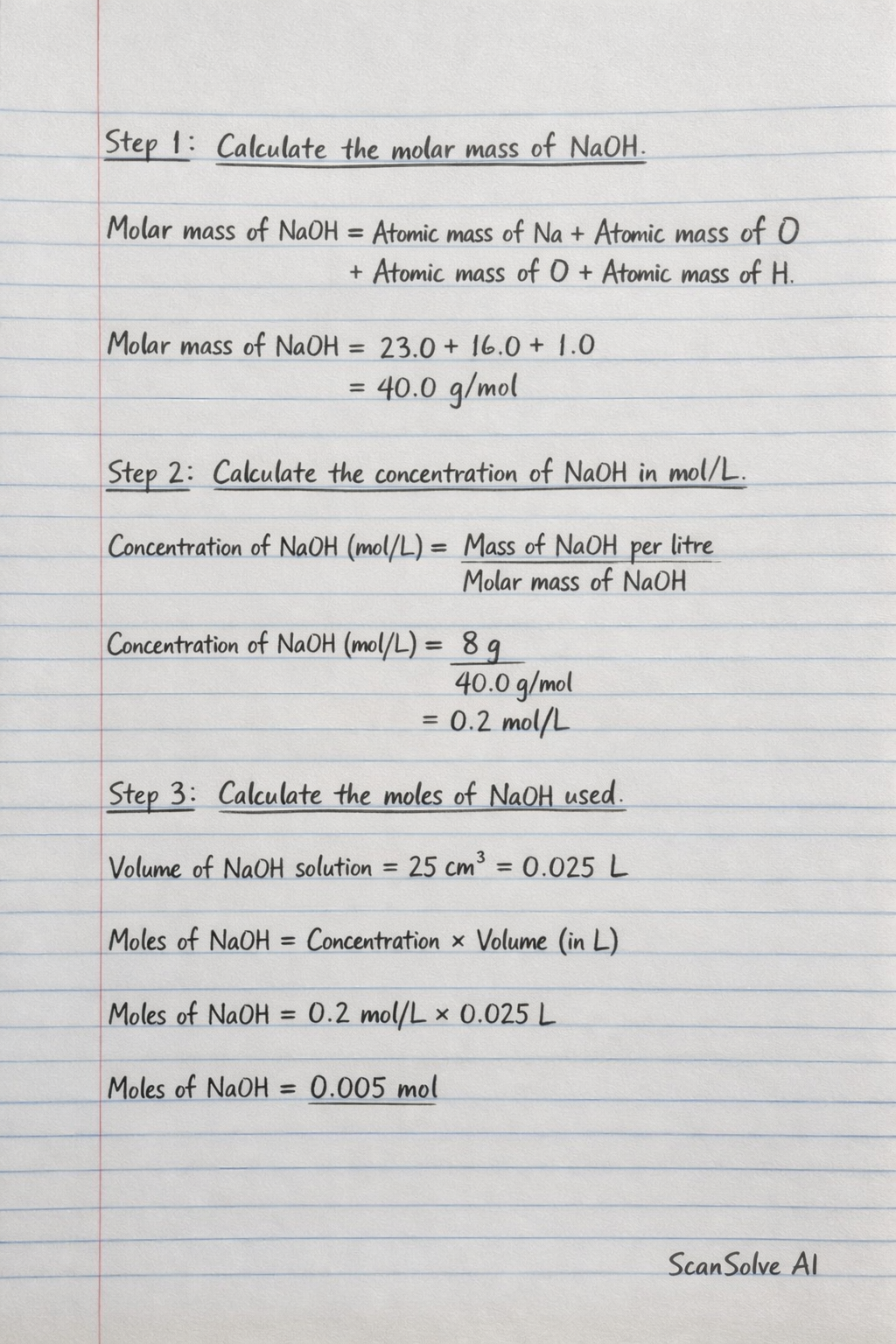
Handwritten Step-by-Step Solution
Get this as a handwritten image on WhatsApp — like a tutor wrote it for you.
Try on WhatsApp