
We read your photo as:
Describe an experiment to determine the enthalpy change of reaction between sodium carbonate and hydrochloric acid, including how to measure temperature changes over time.
ScanSolve AI Answer
Step-by-step solution
4 stepsThis question describes a practical experiment to determine the enthalpy change of reaction between sodium carbonate and hydrochloric acid. Since no experimental data (temperature readings) are provided, a numerical answer cannot be given. However, the procedure and the method for calculating the enthalpy change can be explained.
Part a
Measure temperature changes of the reaction between sodium carbonate and hydrochloric acid with time.
The procedure outlines the steps to collect temperature data over time:
- Place a plastic cup in a glass beaker for support.
- Measure of Solution B ( hydrochloric acid, ) using a measuring cylinder and pour it into the plastic cup.
- Measure the initial temperature of Solution B at time minutes, ensuring the thermometer bulb is fully covered.
- Start the stopwatch. For the first 2 minutes, record the temperature of Solution B every half minute.
- At minutes, add Solid A (impure anhydrous sodium carbonate, ) into the cup and stir the contents.
- Continue to measure and record the temperature of the contents of the cup at minutes, and then every half minute up to minutes. All recorded temperatures should be entered into the provided table.
Part b· 4 steps
Determine the enthalpy change of reaction between sodium carbonate and hydrochloric acid.
To determine the enthalpy change, you would use the temperature data collected in part (a) and apply calorimetric principles.
Determine the maximum temperature change ().
Plot a graph of temperature versus time. Extrapolate the cooling curve (after the maximum temperature is reached) back to the time of mixing (when Solid A was added, minutes) to find the theoretical maximum temperature. The initial temperature is recorded at . The temperature change () is the difference between the extrapolated maximum temperature and the initial temperature.
Calculate the heat absorbed or released by the solution ().
The heat change () is calculated using the formula:
where:
- is the mass of the solution. Assuming the density of the solution is approximately , the mass of of solution is .
- is the specific heat capacity of the solution. Assume it is the same as water, .
- is the temperature change determined from the graph.
Calculate the moles of the limiting reactant.
The reaction is:
The moles of used are:
Since the mass of Solid A () is not given, you would need this information from the experiment to determine the moles of and identify the limiting reactant. For this explanation, we assume is the limiting reactant or that the calculation is based on the moles of if is in excess.
Calculate the enthalpy change of reaction ().
The enthalpy change () is the heat change per mole of the limiting reactant.
The negative sign indicates that if the temperature increases (exothermic reaction), is negative. The units will typically be or .
Without the experimental data, a numerical answer for , , or cannot be provided. The final answer would be the calculated value of in .
Still stuck on this one?
Ask a follow-up, and the answer starts from this question.
More Chemistry Questions
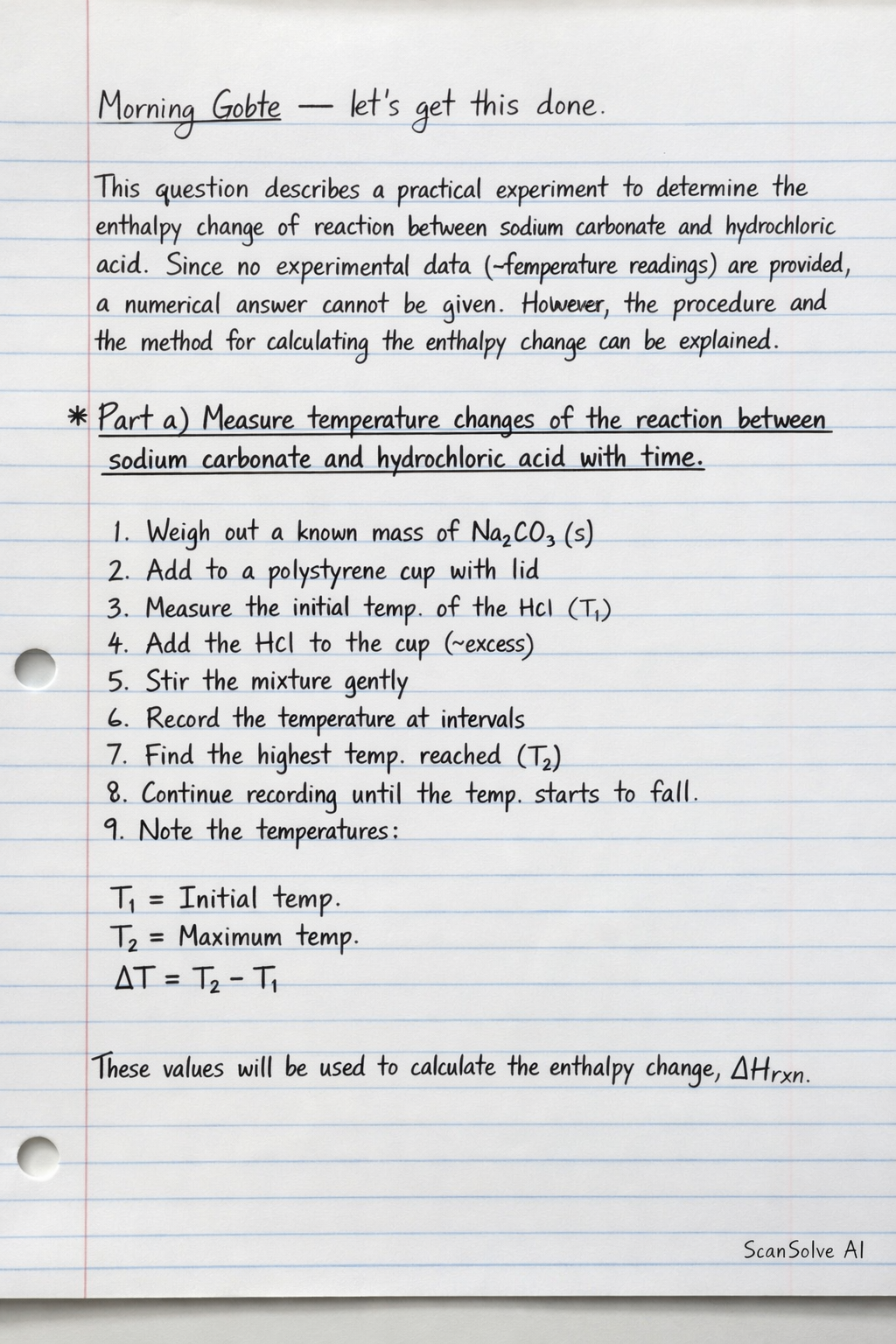
Handwritten Step-by-Step Solution
Get this as a handwritten image on WhatsApp — like a tutor wrote it for you.
Try on WhatsApp