
We read your photo as:
Please answer the following questions about atomic structure: i. Why is almost all the mass of an atom concentrated in its nucleus? ii. Why are elements different? iii. How many neutrons are in 210/83
ScanSolve AI Answer
Step-by-step solution
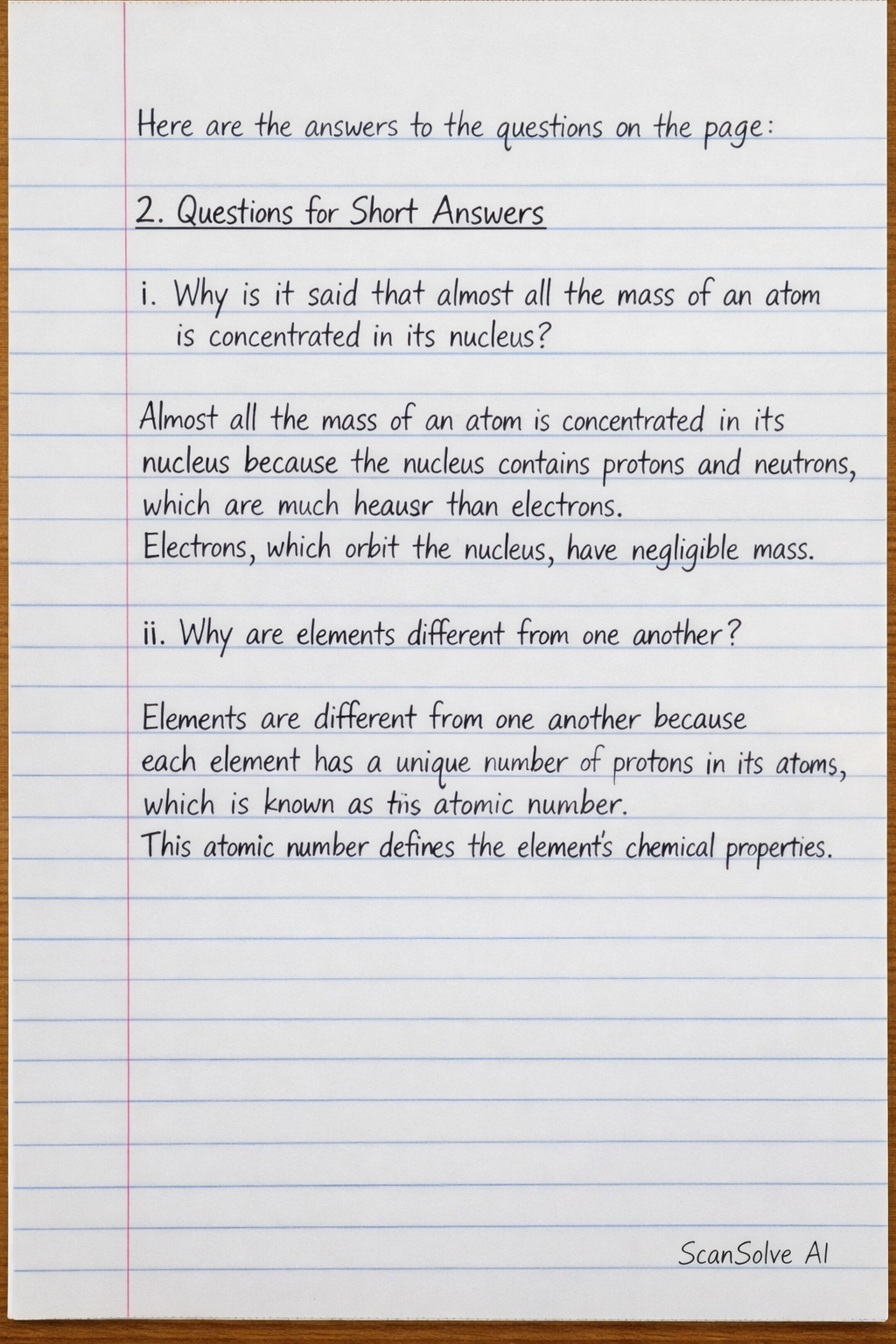
2 stepsHere are the answers to the questions on the page:
2. Questions for Short Answers
-
i. Why is it said that almost all the mass of an atom is concentrated in its nucleus? Almost all the mass of an atom is concentrated in its nucleus because the nucleus contains protons and neutrons, which are much heavier than electrons. Electrons, which orbit the nucleus, have negligible mass.
-
ii. Why are elements different from one another? Elements are different from one another because each element has a unique number of protons in its atoms, which is known as its atomic number. This atomic number defines the element's chemical properties.
-
iii. How many neutrons are present in ?
Identify the mass number (A) and atomic number (Z) from the notation.
For $^{210}_{83}\text{Bi}$, the mass number $\text{A} = 210$ and the atomic number $\text{Z} = 83$.Calculate the number of neutrons using the formula
Number of neutrons = .
Number of neutrons .
There are in .-
iv. Why is tritium () a radioactive element? Tritium () is a radioactive element because its nucleus is unstable. It has one proton and two neutrons, giving it an unfavorable neutron-to-proton ratio, which causes it to undergo radioactive decay to achieve a more stable configuration.
-
v. How can an atom absorb and evolve energy? An atom can absorb energy when its electrons jump from a lower energy level to a higher energy level (excitation). It evolves (emits) energy in the form of electromagnetic radiation (like light) when its excited electrons fall back from a higher energy level to a lower, more stable energy level.
3. Constructed Response Questions
-
i. Why does the energy of electron increase as we move from first shell to second shell? The energy of an electron increases as it moves from the first shell to the second shell because electrons in shells further away from the nucleus are less tightly bound to the positively charged nucleus. They possess higher potential energy due to their greater distance from the attractive force of the nucleus.
-
ii. Why is it needed to lower the pressure of the gas inside the discharge tube? It is necessary to lower the pressure of the gas inside a discharge tube to reduce the number of gas molecules. This allows the electrons to travel longer distances without colliding with gas particles, enabling the formation of cathode rays and the sustained electrical discharge.
-
iii. What is the classical concept of an electron? How has this concept changed with time? The classical concept of an electron, as proposed in the Rutherford model, suggested that electrons orbit the nucleus like planets around the sun. According to classical physics, these orbiting electrons should continuously lose energy and spiral into the nucleus, causing atoms to be unstable. This concept changed with the development of the quantum mechanical model. This modern view states that electrons exist in specific, quantized energy levels or orbitals and do not continuously lose energy while in these stable states, thus explaining the stability of atoms.
-
iv. Why the nuclei of the radioactive elements are unstable? The nuclei of radioactive elements are unstable because they have an imbalanced ratio of neutrons to protons, or they are simply too large. This instability leads to an excess of internal energy, which the nucleus releases by undergoing radioactive decay, emitting particles and/or energy to achieve a more stable configuration.
-
v. During discharge tube experiments, how did the scientists conclude that the same type of electrons and protons are present in all the elements?
- Electrons: Scientists observed that cathode rays (streams of electrons) were produced regardless of the type of gas used in the discharge tube or the material of the cathode. This universality indicated that electrons are fundamental, identical constituents of all elements.
- Protons: When hydrogen gas was used in discharge tubes, the canal rays (streams of positive ions) produced had the smallest positive charge-to-mass ratio, corresponding to a single proton. While other gases produced different positive ions, the proton was identified as a fundamental positive particle, suggesting its presence in all atomic nuclei.
4. Descriptive Questions
-
i. Explain the structure of a hydrogen atom. A hydrogen atom (specifically the most common isotope, protium, ) is the simplest atom. It consists of a nucleus containing a single proton (with a positive charge) and no neutrons. Orbiting this nucleus is a single electron (with a negative charge) in the first energy shell. The positive charge of the proton balances the negative charge of the electron, making the atom electrically neutral.
-
ii. How does the theory of atomic structure explain the ionization of atoms by a radioactive isotope? The theory of atomic structure explains ionization by radioactive isotopes through the interaction of high-energy radiation with electrons. Radioactive isotopes emit energetic particles (like alpha or beta particles) or electromagnetic radiation (gamma rays). When these emissions collide with other atoms, their high energy can overcome the attractive force holding the electrons in their shells, knocking them out of the atom. This process results in the formation of an ion (an atom with a net positive or negative charge).
-
iii. What is radioactivity? Explain any three applications of radioactive isotopes.
- Radioactivity is the spontaneous process by which an unstable atomic nucleus loses energy by emitting radiation, such as alpha particles, beta particles, or gamma rays. This process transforms the unstable nucleus into a more stable one.
- Three applications of radioactive isotopes are:
- Medical Diagnosis and Treatment: Radioactive isotopes like Iodine-131
-
Still stuck on this one?
Ask a follow-up, and the answer starts from this question.
More Chemistry Questions
Handwritten Step-by-Step Solution
Get this as a handwritten image on WhatsApp — like a tutor wrote it for you.
Try on WhatsApp