
We read your photo as:
Define organic chemistry, aliphatic compounds, functional group, molecular formula, and allotropy. Explain why CO2 is inorganic and why carbon is unique.
ScanSolve AI Answer
Step-by-step solution
7 stepsHere are the solutions to the questions:
Part a
Define the following terms.
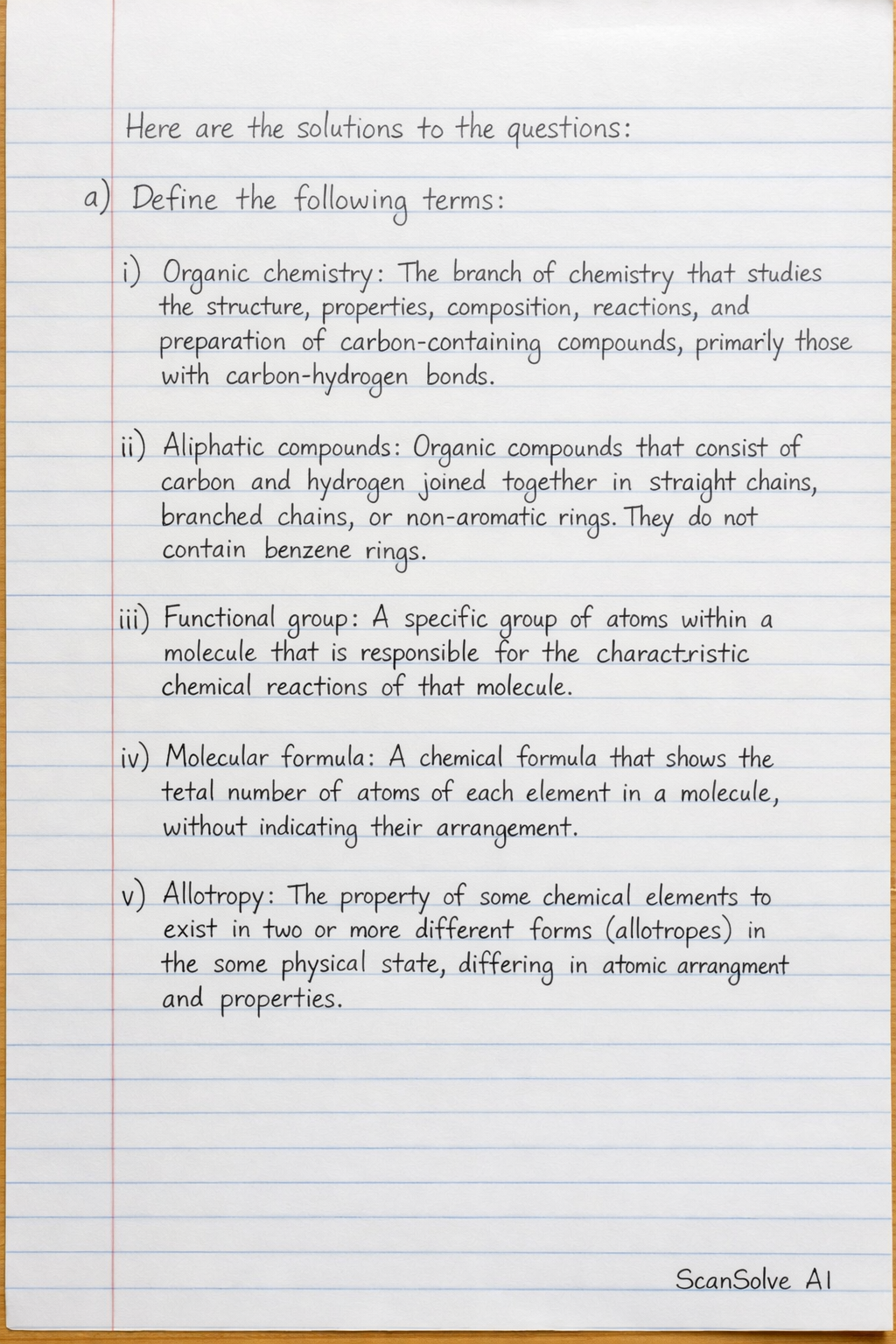
- i) Organic chemistry: The branch of chemistry that studies the structure, properties, composition, reactions, and preparation of carbon-containing compounds, primarily those with carbon-hydrogen bonds.
- ii) Aliphatic compounds: Organic compounds that consist of carbon and hydrogen joined together in straight chains, branched chains, or non-aromatic rings. They do not contain benzene rings.
- iii) Functional group: A specific group of atoms within a molecule that is responsible for the characteristic chemical reactions of that molecule.
- iv) Molecular formula: A chemical formula that shows the total number of atoms of each element in a molecule, without indicating their arrangement.
- v) Allotropy: The property of some chemical elements to exist in two or more different forms (allotropes) in the same physical state, differing in atomic arrangement and properties.
Part b
Why isn't carbon dioxide (CO₂) an organic compound?
Carbon dioxide is generally considered an inorganic compound because it lacks carbon-hydrogen (C-H) bonds, which are characteristic of most organic compounds.
Part c
Why is carbon unique among all other elements?
Carbon is unique due to its ability to form four strong covalent bonds (tetravalency) and its exceptional capacity for catenation, forming long chains, branched chains, and rings with other carbon atoms. This allows for the formation of an immense variety of stable compounds.
Part d· 7 steps
Draw the structures of the following compounds.
-
i) 2,2,3,3-Tetramethylbutane
or
-
ii) Acetylene
-
iii) (E)-1-Bromo-2-chloro-1-fluoro-2-iodoethene
Identify the parent chain as ethene, meaning a two-carbon chain with a double bond.
Identify the substituents
Bromo (Br), Chloro (Cl), Fluoro (F), Iodo (I).
Assign positions
1-Bromo, 1-Fluoro on one carbon; 2-Chloro, 2-Iodo on the other carbon.
Determine (E) configuration.
On carbon 1, Br has higher priority than F. On carbon 2, I has higher priority than Cl. For (E) isomer, the higher priority groups (Br and I) must be on opposite sides of the double bond.
- iv) 2-Methylpropyl butanoate
Identify the ester functional group (-COO-).
The "butanoate" part comes from butanoic acid ().
Identify the "2-methylpropyl" alkyl group, which is attached to the oxygen of the ester.
A propyl group has 3 carbons, and a methyl group is on the second carbon of the propyl chain. This is .
Combine these parts to form the ester.
$$
\mathrm{CH_3CH_2CH_2}-\mathrm{C}(=\mathrm{O})-\mathrm{O}-\mathrm{CH_2CH}(\mathrm{CH_3})\mathrm{CH_3}
$$
Part e
Give the IUPAC name of the following compounds.
The compounds to be named are not provided in the question. Please provide the structures for part (e).
Still stuck on this one?
Ask a follow-up, and the answer starts from this question.
More Chemistry Questions
Handwritten Step-by-Step Solution
Get this as a handwritten image on WhatsApp — like a tutor wrote it for you.
Try on WhatsApp