
We read your photo as:
Explain polyatomic ions and covalent bonds, using the provided notes and examples.
Chemistry
ScanSolve AI Answer
Step-by-step solution
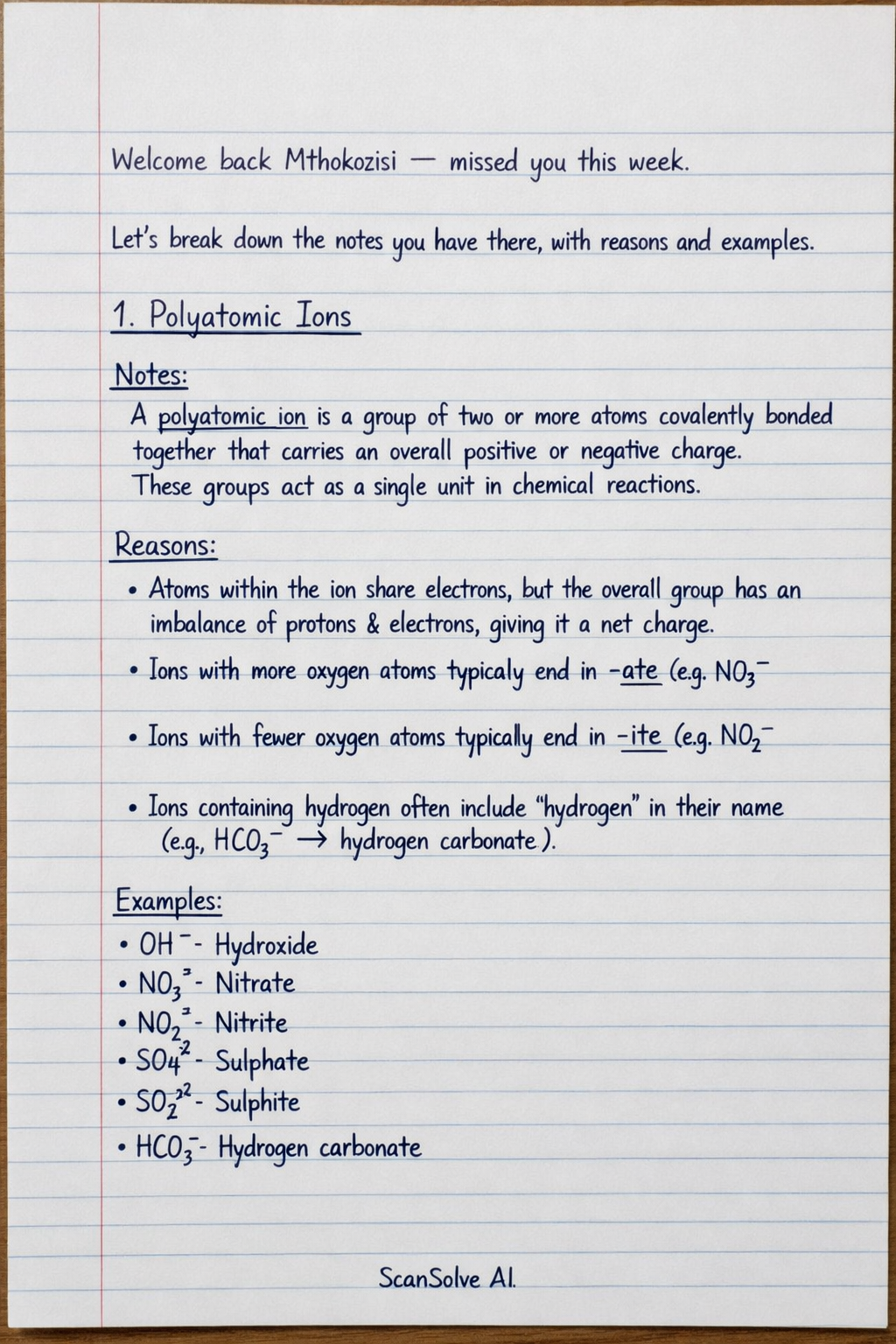
9 stepsLet's break down the notes you have there, with reasons and examples.
1. Polyatomic Ions
- Notes: A polyatomic ion is a group of two or more atoms covalently bonded together that carries an overall positive or negative charge. These groups act as a single unit in chemical reactions.
- Reasons: Atoms within the ion share electrons, but the overall group has an imbalance of protons and electrons, giving it a net charge. Their names often follow patterns:
- Ions with more oxygen atoms typically end in -ate (e.g., nitrate).
- Ions with fewer oxygen atoms typically end in -ite (e.g., nitrite).
- Ions containing hydrogen often include "hydrogen" in their name (e.g., hydrogen carbonate).
- Examples (from your image):
- : Hydroxide
- : Nitrate
- : Nitrite
- : Sulphate
- : Sulphite
- : Hydrogen carbonate
- : Permanganate
2. Covalent Bonds
- Notes: A covalent bond is formed when two atoms share one or more pairs of electrons. This sharing allows both atoms to achieve a stable electron configuration, typically an octet (8 valence electrons) or a duet (2 valence electrons for hydrogen).
- Reasons: Atoms share electrons to fill their outermost electron shells, which leads to a more stable, lower-energy state. This type of bonding usually occurs between two non-metal atoms.
- Examples (from your image):
- Hydrogen molecule ():
Each hydrogen atom has 1 valence electron.
They share their electrons to form a single bond.
* Result: Each hydrogen atom effectively has 2 electrons, achieving a stable duet like Helium. $$ \text{H} \cdot + \cdot \text{H} \longrightarrow \text{H} : \text{H} $$ * **Oxygen molecule ($\text{O}_2$):**Each oxygen atom has 6 valence electrons.
They share two pairs of electrons (a total of 4 electrons) to form a double bond.
* Result: Each oxygen atom effectively has 8 electrons (4 non-bonding and 4 shared), achieving a stable octet. $$ : \ddot{\text{O}} \cdot + \cdot \ddot{\text{O}} : \longrightarrow : \ddot{\text{O}} :: \ddot{\text{O}} : $$ * **Nitrogen molecule ($\text{N}_2$):**Each nitrogen atom has 5 valence electrons.
They share three pairs of electrons (a total of 6 electrons) to form a triple bond.
* Result: Each nitrogen atom effectively has 8 electrons (2 non-bonding and 6 shared), achieving a stable octet. $$ \cdot \ddot{\text{N}} \cdot + \cdot \ddot{\text{N}} \cdot \longrightarrow : \text{N} ::: \text{N} : $$3. Ionic Bonds
- Notes: An ionic bond is formed when there is a complete transfer of one or more electrons from one atom to another. This creates oppositely charged ions (a positive cation and a negative anion) that are attracted to each other.
- Reasons: This transfer typically occurs between a metal atom (which tends to lose electrons) and a non-metal atom (which tends to gain electrons). Both atoms achieve a stable electron configuration (usually an octet). The strong electrostatic attraction between the oppositely charged ions forms the bond.
- Example (from your image - Sodium Chloride, ):
Sodium () is a metal with 1 valence electron.
Chlorine () is a non-metal with 7 valence electrons.
Sodium transfers its 1 valence electron to chlorine.
Sodium becomes a positive ion () with a stable electron configuration.
Chlorine becomes a negative ion () with a stable octet. * Result: The electrostatic attraction between and forms the ionic bond.
Was this helpful?
Still stuck on this one?
Ask a follow-up, and the answer starts from this question.
Got a different question?Ask your own question
More Chemistry Questions
QDescribe the formation of ionic and simple covalent bonds, providing an example for ionic bonding.QExplain covalent bonding to me in simple diagrams and use diagramsQExplain ionic bonding and covalent bonding. (b) State two differences between ionic and covalent…QExplain ionic, covalent, and metallic bonds, including their occurrence, properties, and…QPls teach my on the topic Covalent Bond pls explain in detail with full note pls
Handwritten Step-by-Step Solution
Get this as a handwritten image on WhatsApp — like a tutor wrote it for you.
Try on WhatsApp