
We read your photo as:
Describe the preparation of a pure sample of sodium chloride (NaCl) through the neutralization of hydrochloric acid (HCl) and sodium hydroxide (NaOH).
ScanSolve AI Answer
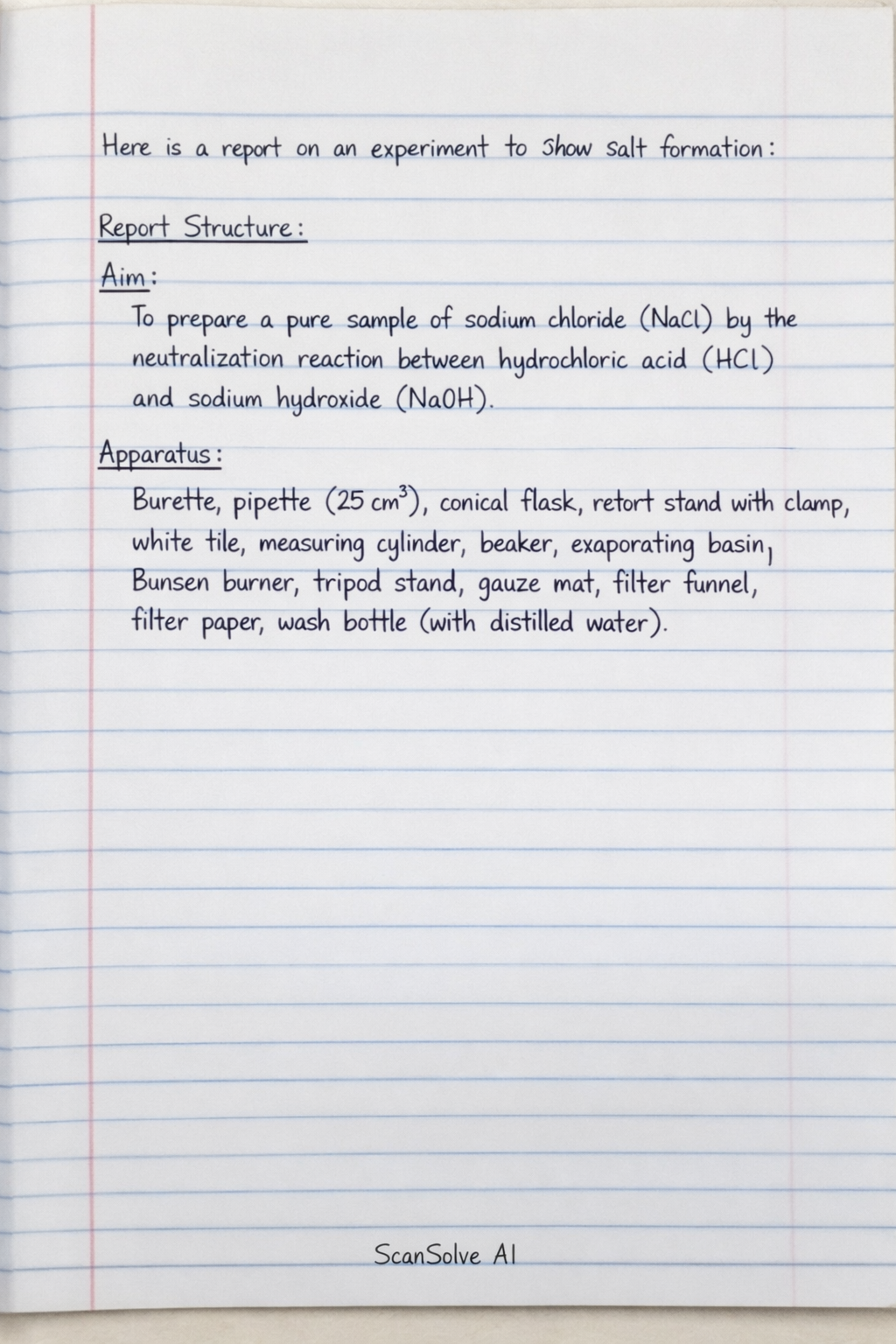
Here is a report on an experiment to show salt formation:
Report Structure:
-
Aim To prepare a pure sample of sodium chloride () by the neutralization reaction between hydrochloric acid () and sodium hydroxide ().
-
Apparatus Burette, pipette (), conical flask, retort stand with clamp, white tile, measuring cylinder, beaker, evaporating basin, Bunsen burner, tripod stand, gauze mat, filter funnel, filter paper, wash bottle (with distilled water).
-
Procedure
- Using a pipette, transfer of sodium hydroxide () solution into a clean conical flask.
- Add 2-3 drops of phenolphthalein indicator to the solution. The solution will turn pink.
- Rinse and fill the burette with hydrochloric acid () solution, ensuring the meniscus is at the zero mark. Record the initial burette reading.
- Place the conical flask on a white tile beneath the burette. Slowly add from the burette to the solution in the conical flask, swirling constantly.
- Continue adding drop by drop until the pink color of the indicator just disappears, indicating the neutralization point. Record the final burette reading to determine the volume of used. This is the titre.
- Repeat steps 1-5 without adding the phenolphthalein indicator, using the exact volume of determined in step 5. This ensures a pure salt solution without indicator contamination.
- Transfer the neutralized solution from the conical flask into an evaporating basin.
- Gently heat the evaporating basin using a Bunsen burner on a tripod stand and gauze mat to evaporate most of the water. Stop heating when small crystals begin to appear at the edges of the solution.
- Allow the concentrated solution to cool slowly at room temperature to allow the sodium chloride crystals to form and grow.
- Filter the crystals using a filter funnel and filter paper. Wash the crystals with a small amount of cold distilled water to remove any remaining impurities.
- Dry the pure sodium chloride crystals between sheets of filter paper or in a desiccator.
-
Observations
- The sodium hydroxide solution with phenolphthalein indicator was initially pink.
- Upon titration with hydrochloric acid, the pink color disappeared at the equivalence point, turning the solution colorless.
- During heating, water evaporated, and white solid crystals began to form.
- After cooling, white, cubic crystals of sodium chloride were obtained.
-
Conclusion Sodium chloride () was successfully prepared as a pure, white crystalline solid through the neutralization reaction between hydrochloric acid and sodium hydroxide. The balanced chemical equation for the reaction is:
-
Limitations of the experiment
- Endpoint accuracy: It can be challenging to determine the exact endpoint of the titration, potentially leading to a slight excess of either acid or base in the final solution.
- Loss of product: Some salt may be lost during transfer between apparatus, filtration, or washing steps.
- Purity of reagents: Impurities in the initial acid or base solutions could affect the purity of the final salt product.
- Overheating: Excessive heating during evaporation can cause the salt to decrepitate (spit) or even decompose if it's not thermally stable, leading to loss of product or impurities.
Still stuck on this one?
Ask a follow-up, and the answer starts from this question.
More Chemistry Questions
Handwritten Step-by-Step Solution
Get this as a handwritten image on WhatsApp — like a tutor wrote it for you.
Try on WhatsApp