
We read your photo as:
Provide the IUPAC names for the following compounds: (I) CH3CH(Br)CH2COOH (II) CH3CH2CH(CH3)COOH
ScanSolve AI Answer
Step-by-step solution
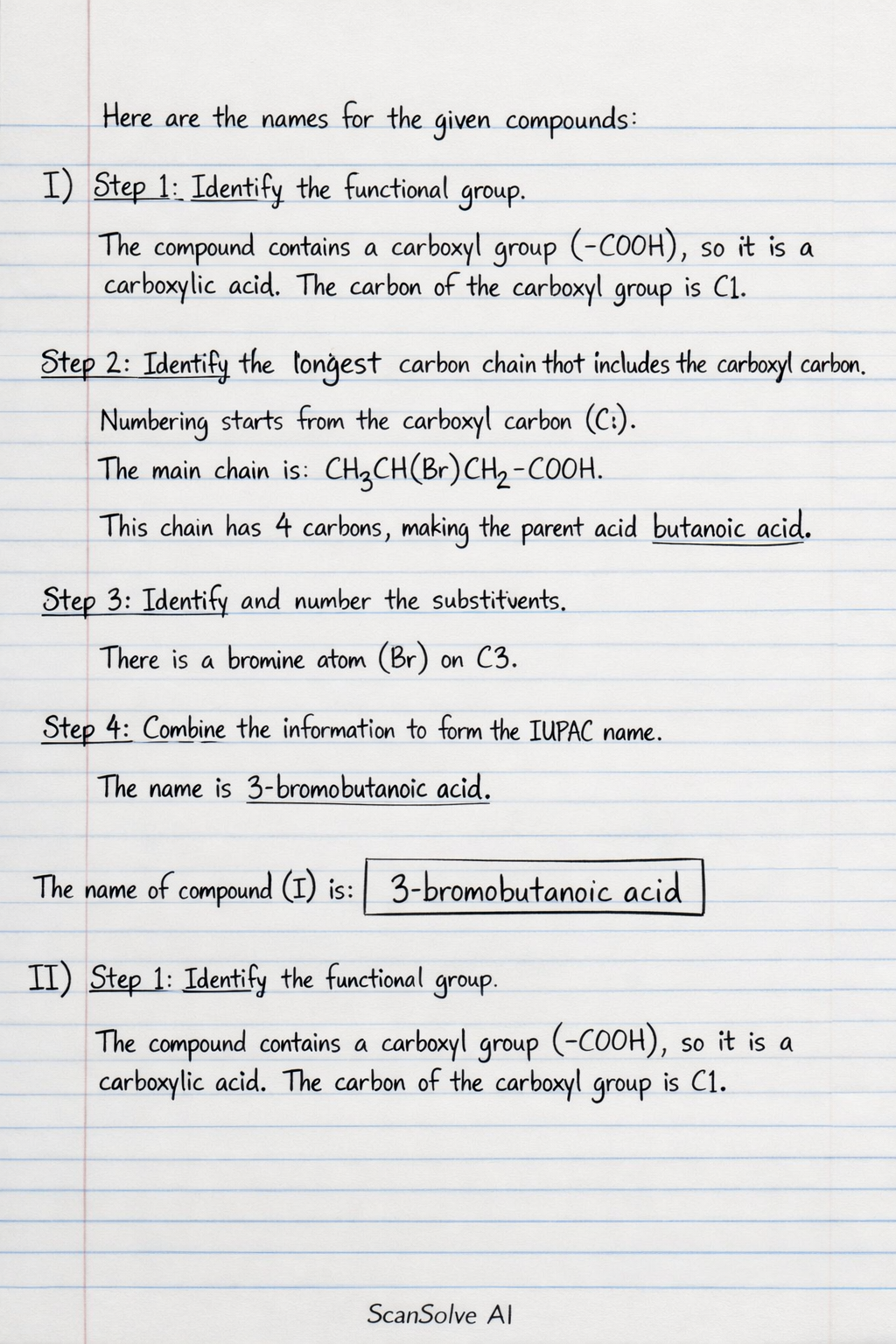
12 stepsHere are the names for the given compounds:
I)
Identify the functional group.
The compound contains a carboxyl group , so it is a carboxylic acid. The carbon of the carboxyl group is C1.
Identify the longest carbon chain that includes the carboxyl carbon.
Numbering starts from the carboxyl carbon (C1).
The main chain is: .
This chain has 4 carbons, making the parent acid butanoic acid.Identify and number the substituents.
There is a bromine atom on C3.
Combine the information to form the IUPAC name.
The name is 3-bromobutanoic acid.
The name of compound (I) is:
II)
Identify the functional group.
The compound contains a carboxyl group , so it is a carboxylic acid. The carbon of the carboxyl group is C1.
Identify the longest carbon chain that includes the carboxyl carbon.
Numbering starts from the carboxyl carbon (C1).
The main chain is: .
This chain has 4 carbons, making the parent acid butanoic acid.Identify and number the substituents.
There is a methyl group on C2.
Combine the information to form the IUPAC name.
The name is 2-methylbutanoic acid.
The name of compound (II) is:
III)
Identify the functional group.
The compound contains a carboxyl group , so it is a carboxylic acid. The carbon of the carboxyl group is C1.
Identify the longest carbon chain that includes the carboxyl carbon.
Numbering starts from the carboxyl carbon (C1).
The structure is:The longest continuous carbon chain that includes the carboxyl carbon (C1) is 5 carbons long:
.
This makes the parent acid pentanoic acid.Identify and number the substituents.
There is a propyl group on C2.
There is a methyl group on C4.Combine the information to form the IUPAC name, listing substituents alphabetically.
The name is 4-methyl-2-propylpentanoic acid.
The name of compound (III) is:
Still stuck on this one?
Ask a follow-up, and the answer starts from this question.
More Chemistry Questions
Handwritten Step-by-Step Solution
Get this as a handwritten image on WhatsApp — like a tutor wrote it for you.
Try on WhatsApp