
We read your photo as:
QUESTION 2 (Start on a new page.) The letters A to F in the table represent SIX substances:
ScanSolve AI Answer
Answer
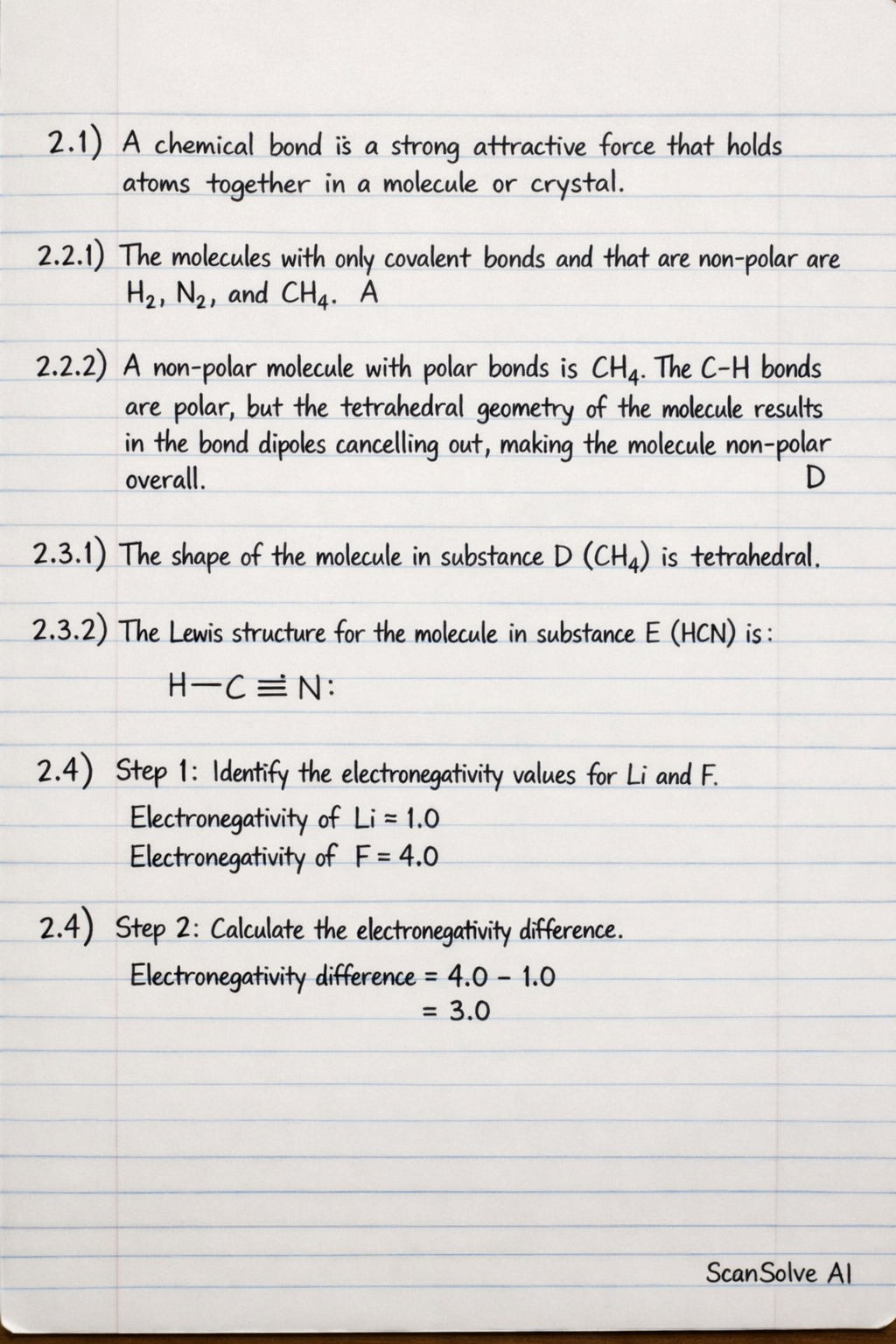
2.1 A chemical bond is a strong attractive force that holds atoms together in a molecule or crystal.
Step-by-step solution
3 steps2.2.1
The molecules with only covalent bonds and that are non-polar are , , and .
A
2.2.2
A non-polar molecule with polar bonds is . The C-H bonds are polar, but the tetrahedral geometry of the molecule results in the bond dipoles cancelling out, making the molecule non-polar overall.
D
2.3.1
The shape of the molecule in substance D () is tetrahedral.
2.3.2
The Lewis structure for the molecule in substance E () is:
2.4
Identify the electronegativity values for Li and F.
The electronegativity of Li is approximately 1.0.
The electronegativity of F is approximately 4.0.Calculate the electronegativity difference.
Determine the type of bond based on the difference.
Since the electronegativity difference (3.0) is greater than 1.7, the bond between Li and F is predominantly ionic.
2.5
The Lewis structure for substance B () is:Nitrogen gas () is unreactive at room temperature and normal pressures because it contains a very strong triple covalent bond between the two nitrogen atoms. A large amount of energy is required to break this bond, making it difficult for to react.
2.6.1
The ion formed when substance C () reacts with the ion is the ammonium ion ().2.6.2
Two requirements for the formation of dative covalent bonds are:- One atom must have a lone pair of electrons to donate.
- Another atom or ion must have an empty orbital to accept the lone pair of electrons.
Still stuck on this one?
Ask a follow-up, and the answer starts from this question.
More Chemistry Questions
Handwritten Step-by-Step Solution
Get this as a handwritten image on WhatsApp — like a tutor wrote it for you.
Try on WhatsApp