
We read your photo as:
Question 3 (a) i. Name a suitable indicator for the titration. Answer: Methyl orange (or Methyl red) ii. State the colour of your chosen indicator.
ScanSolve AI Answer
Step-by-step solution
3 stepsIdentify the chosen indicator.
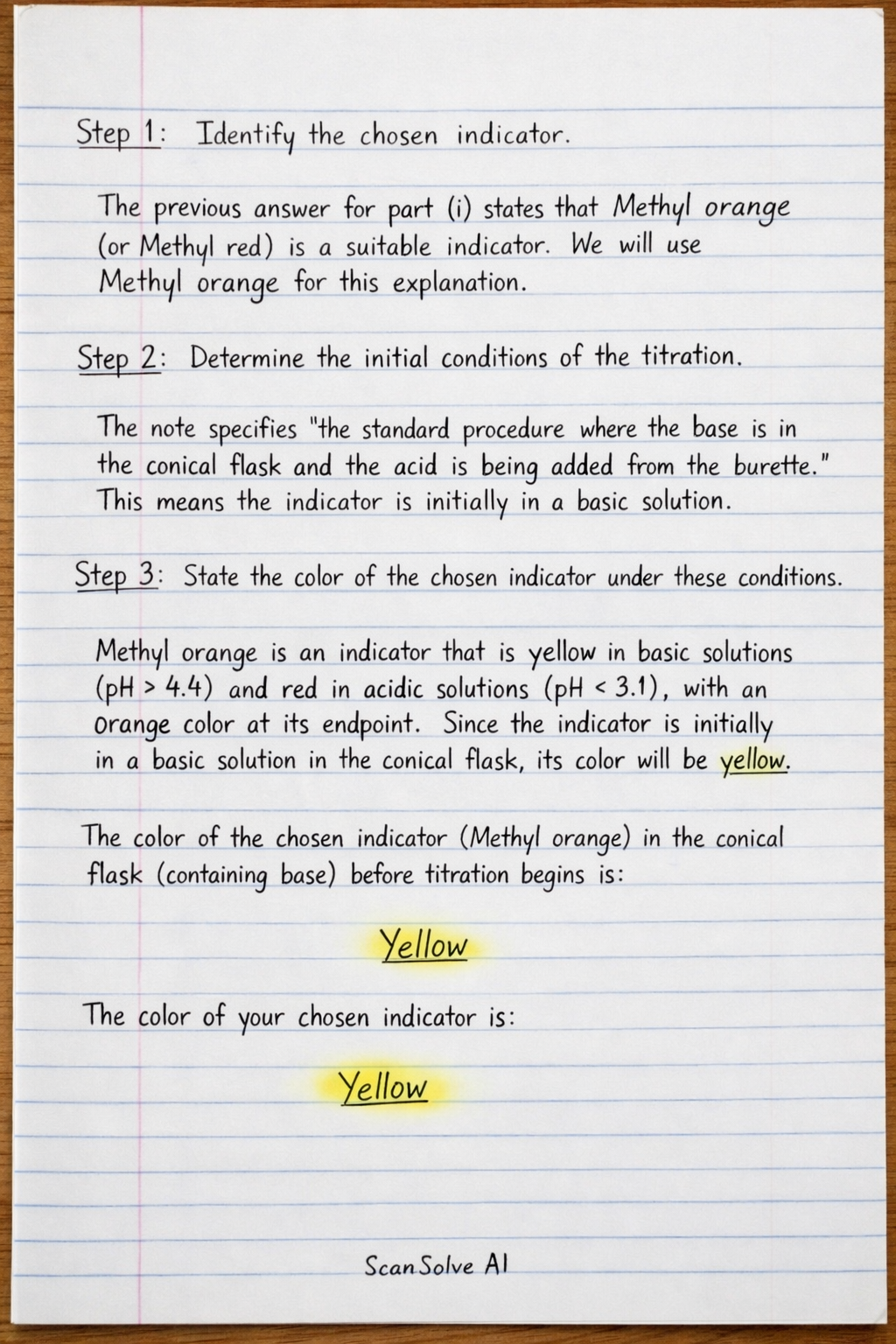
The previous answer for part (i) states that Methyl orange (or Methyl red) is a suitable indicator. We will use Methyl orange for this explanation.
Determine the initial conditions of the titration.
The note specifies "the standard procedure where the base is in the conical flask and the acid is being added from the burette." This means the indicator is initially in a basic solution.
State the color of the chosen indicator under these conditions.
Methyl orange is an indicator that is yellow in basic solutions (pH > 4.4) and red in acidic solutions (pH < 3.1), with an orange color at its endpoint. Since the indicator is initially in a basic solution in the conical flask, its color will be yellow.
The color of the chosen indicator (Methyl orange) in the conical flask (containing base) before titration begins is yellow.
The color of your chosen indicator is:
Yellow
Still stuck on this one?
Ask a follow-up, and the answer starts from this question.
More Chemistry Questions
Handwritten Step-by-Step Solution
Get this as a handwritten image on WhatsApp — like a tutor wrote it for you.
Try on WhatsApp