
We read your photo as:
Question 5: (a) Name two allotropes of sulfur. (b) Explain the reaction of hydrogen sulfide with acidified potassium tetraoxomanganate(VII). (c) What are the products of the reaction of sulfur(IV) oxi
ScanSolve AI Answer
Step-by-step solution
2 stepsHere's the solution to question 5:
5. (a)
i) The names of two allotropes of sulfur are rhombic sulfur and monoclinic sulfur.
ii) When hydrogen sulfide is bubbled through acidified potassium tetraoxomanganate (VII) solution, the purple solution turns colorless and a yellow precipitate (sulfur) is formed. This is because hydrogen sulfide reduces the purple manganate(VII) ion to the colorless manganese(II) ion, while being oxidized to sulfur.
iii) The products of the reaction of sulfur (IV) oxide with hydrogen sulfide are sulfur and water.
5. (b)
i) The raw materials for the manufacture of tetraoxosulphate (VI) acid by the contact process are sulfur, air (as a source of oxygen), and water.
ii) The reaction that requires a catalyst in the contact process is the oxidation of sulfur dioxide to sulfur trioxide.
The catalyst used is vanadium(V) oxide ().
iii)
I. When concentrated reacts with copper turnings:
- Observation: The copper turnings dissolve, forming a blue solution, and a pungent, colorless gas (sulfur dioxide) is evolved.
- Product formed: Copper(II) sulfate ().
II. When concentrated reacts with a cube of sugar:
- Observation: The white sugar turns black and swells up into a porous mass of carbon, with steam being evolved.
- Product formed: Carbon (charcoal).
5. (c)
i) Three uses of sodium trioxocarbonate (IV) are:
- In the manufacture of glass.
- For softening hard water.
- In the manufacture of soap and detergents.
ii) The name given to the reaction is efflorescence.
iii) Calculation of the solubility of :
Identify the given values.
Mass of anhydrous salt =
Volume of saturated solution =Calculate the solubility per of solution.
The solubility of at 25°C is .
Still stuck on this one?
Ask a follow-up, and the answer starts from this question.
More Chemistry Questions
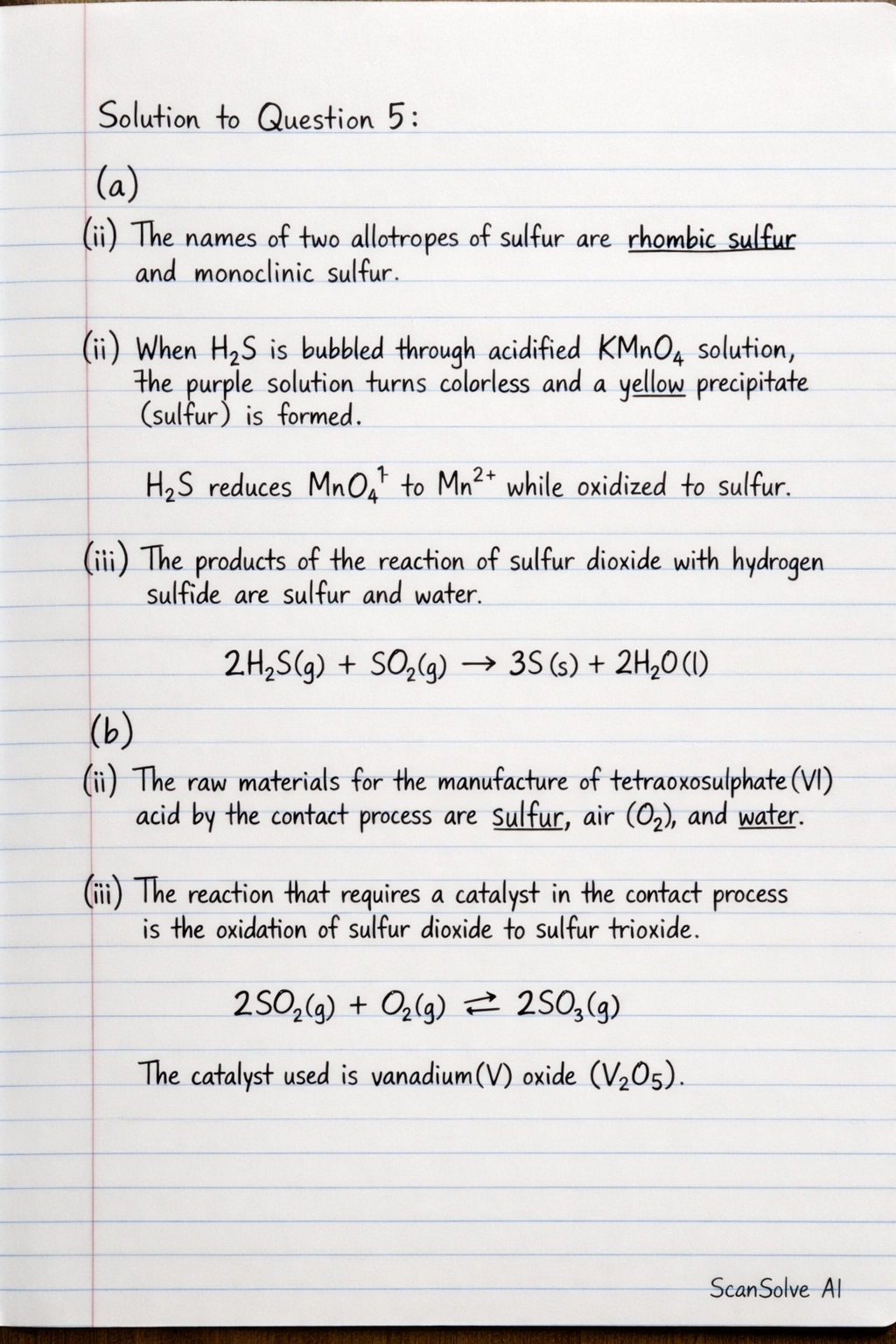
Handwritten Step-by-Step Solution
Get this as a handwritten image on WhatsApp — like a tutor wrote it for you.
Try on WhatsApp