
We read your photo as:
QUESTION 9 (Start on a new page.) The simplified diagram below represents an electrolytic cell used to purify copper.
ScanSolve AI Answer
Answers
3 partsStep-by-step solution
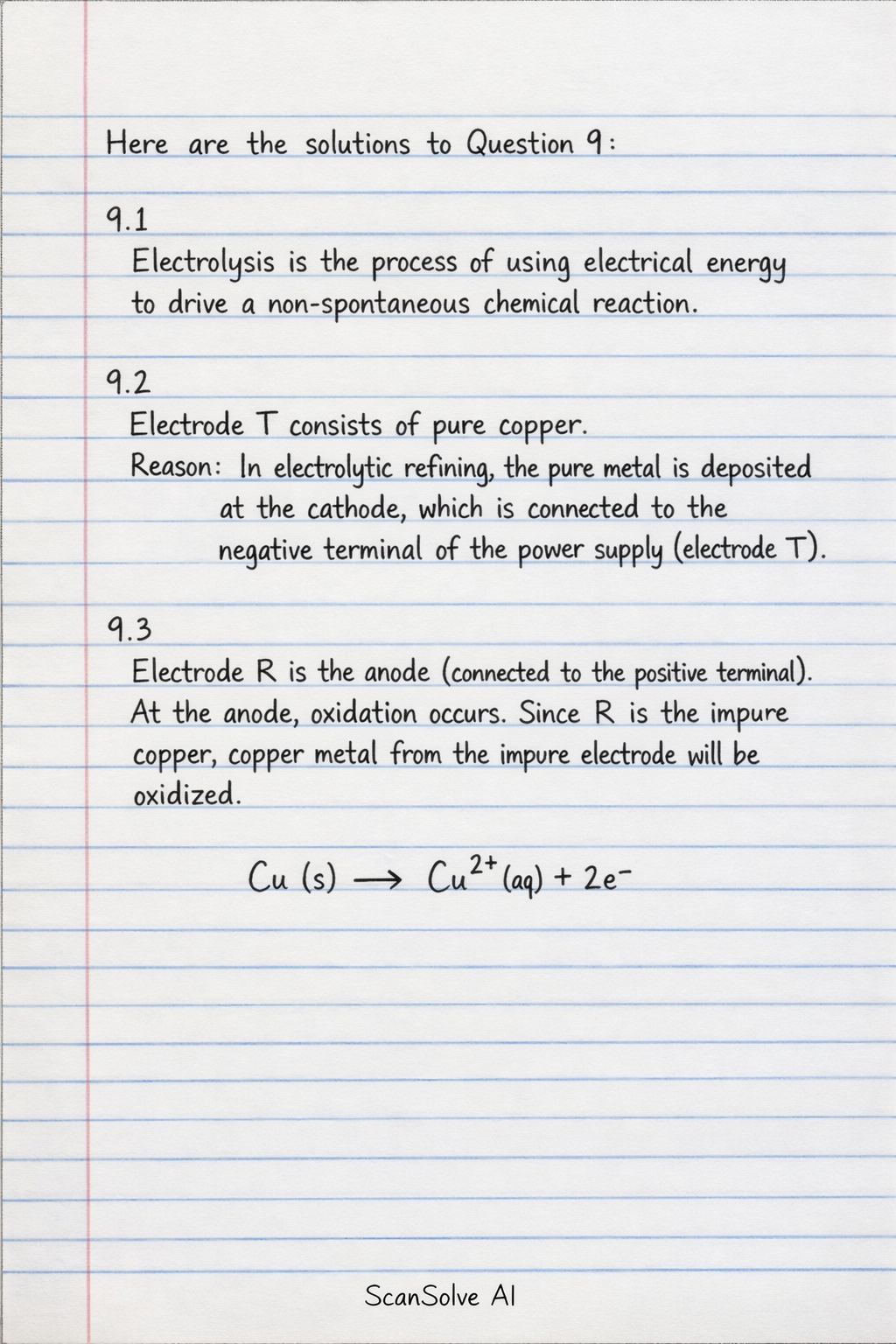
5 stepsHere are the solutions to Question 9:
Part 9.1
Electrolysis is the process of using electrical energy to drive a non-spontaneous chemical reaction.
Part 9.2
Electrode T consists of pure copper.
Reason: In electrolytic refining, the pure metal is deposited at the cathode, which is connected to the negative terminal of the power supply (electrode T).
Part 9.3
Electrode R is the anode (connected to the positive terminal). At the anode, oxidation occurs. Since R is the impure copper, copper metal from the impure electrode will be oxidized.
Part 9.4
The concentration of the electrolyte will .
Reason: At the anode (R), copper metal oxidizes to form ions, increasing the concentration of in the solution. At the cathode (T), ions from the solution are reduced and deposited as copper metal, decreasing the concentration of . In an ideal electrolytic refining process, the rate of formation at the anode is equal to the rate of consumption at the cathode, thus maintaining a constant concentration of in the electrolyte.
Part 9.5
The presence of zinc ions will T influence the quality of the refined copper.
Reason: At the anode, both and (impurity) will oxidize to form and ions in the solution. At the cathode, both and ions are present. However, ions are stronger oxidizing agents () than ions (). Therefore, ions will be preferentially reduced and deposited as pure copper on the cathode, while ions will remain in the solution.
Part 9.6
Convert time to seconds.
Calculate the moles of copper deposited.
The molar mass of copper () is .
Determine the moles of electrons transferred.
The half-reaction at the cathode is .
From the stoichiometry, of electrons are required for every of deposited.Calculate the total charge () transferred.
Using Faraday's constant ():
Calculate the current () using the formula .
The reading on the ammeter is .
Try one yourself
A new problem that tests the same skill.
Still stuck on this one?
Ask a follow-up, and the answer starts from this question.
More Chemistry Questions
Handwritten Step-by-Step Solution
Get this as a handwritten image on WhatsApp — like a tutor wrote it for you.
Try on WhatsApp