
This chemistry question involves key chemical concepts and calculations. The detailed solution below walks through each step, from identifying the reaction type to computing the final answer.
ScanSolve AI Answer
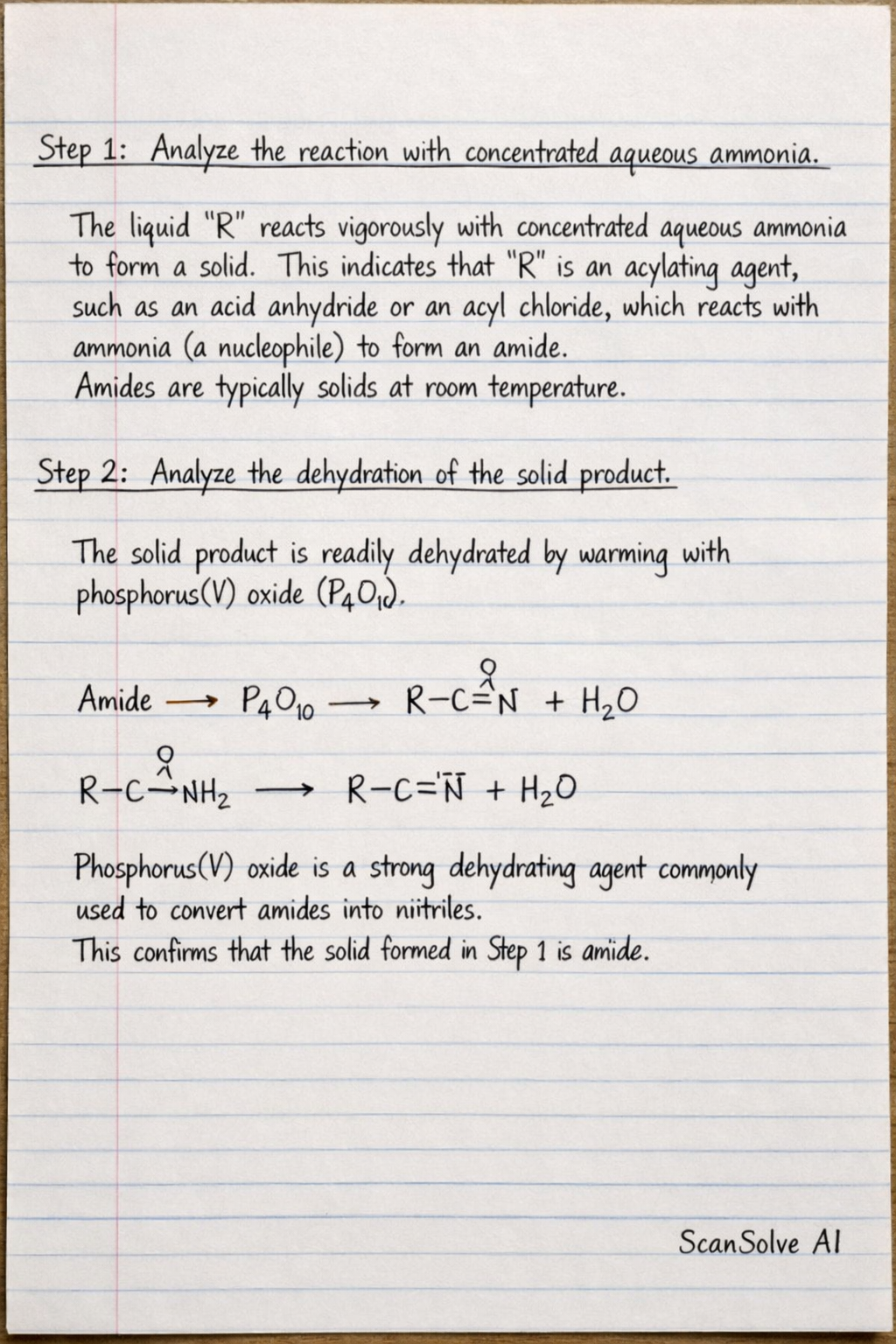
Step 1: Analyze the reaction with concentrated aqueous ammonia. The liquid 'R' reacts vigorously with concentrated aqueous ammonia to form a solid. This indicates that 'R' is an acylating agent, such as an acid anhydride or an acyl chloride, which reacts with ammonia (a nucleophile) to form an amide. Amides are typically solids at room temperature. Step 2: Analyze the dehydration of the solid product. The solid product is readily dehydrated by warming with phosphorus(V) oxide (P_4O_10). Phosphorus(V) oxide is a strong dehydrating agent commonly used to convert amides into nitriles. This confirms that the solid formed in Step 1 is an amide. Step 3: Deduce the identity of 'R'. Combining these observations, 'R' must be a liquid compound that reacts vigorously with ammonia to form an amide. A common example of such a compound is an acid anhydride. For instance, acetic anhydride ((CH_3CO)_2O) is a liquid that reacts with ammonia to form acetamide (CH_3CONH_2), which is a solid. Acetamide can then be dehydrated by P_4O_10 to form acetonitrile (CH_3CN). A possible structure for the compound 'R' is acetic anhydride: CH_3-C(=O)-O-C(=O)-CH_3 Last free one today — make it count tomorrow, or type /upgrade for unlimited.