

This chemistry question involves key chemical concepts and calculations. The detailed solution below walks through each step, from identifying the reaction type to computing the final answer.
ScanSolve AI Answer
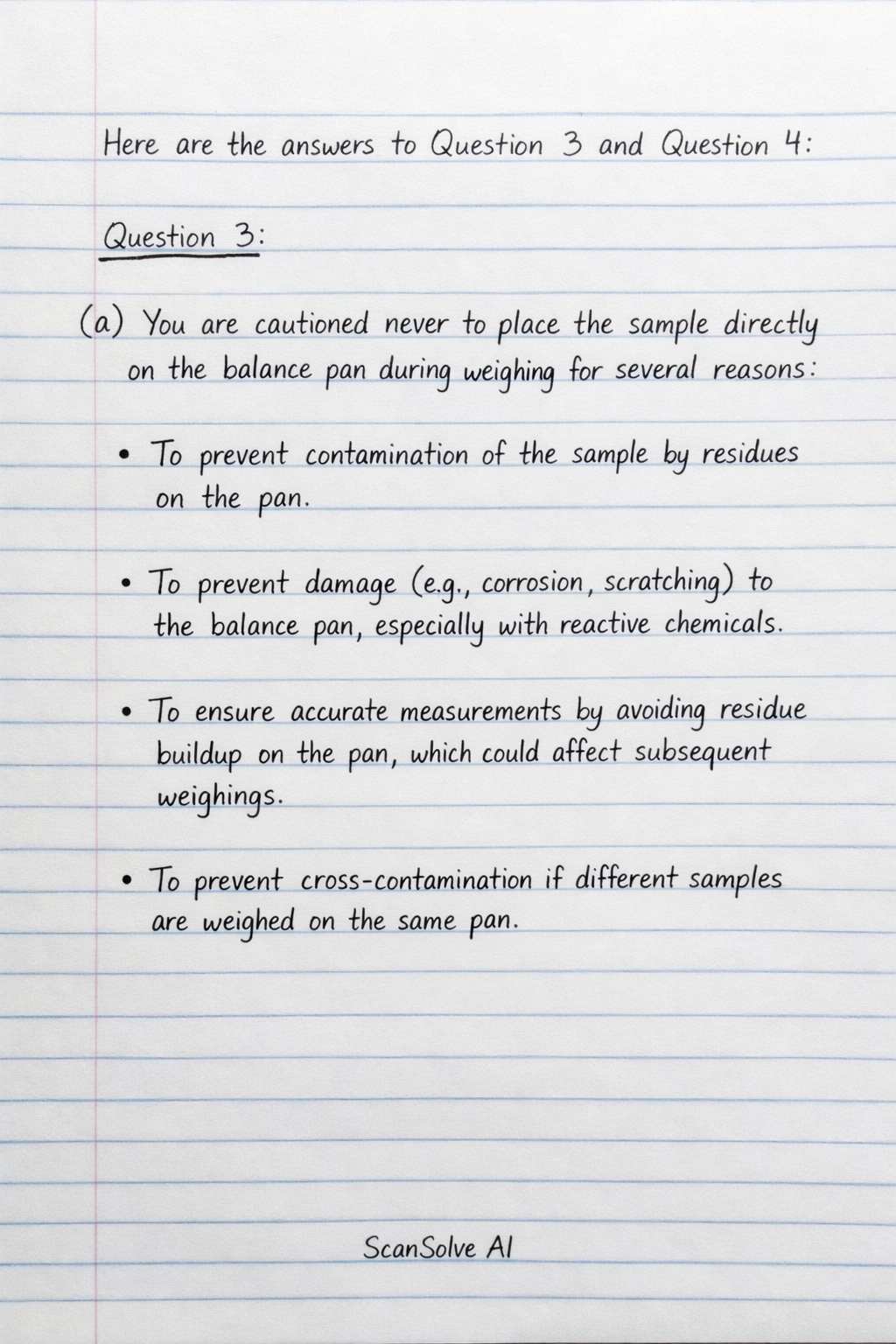
Here are the answers to Question 3 and Question 4: Question 3: a) You are cautioned never to place the sample directly on the balance pan during weighing for several reasons: • To prevent contamination of the sample by residues on the pan. • To prevent damage (e.g., corrosion, scratching) to the balance pan, especially with reactive chemicals. • To ensure accurate measurements by avoiding residue buildup on the pan, which could affect subsequent weighings. • To prevent cross-contamination if different samples are weighed on the same pan. b) Sodium hydroxide (NaOH) cannot be weighed out directly on a balance to make a solution of known concentration because it is hygroscopic and deliquescent. This means it readily absorbs moisture from the air and can even dissolve in the absorbed water. Additionally, it reacts with carbon dioxide (CO_2) in the air to form sodium carbonate (Na_2CO_3). These properties cause its mass to change rapidly and its purity to be uncertain, making it impossible to weigh accurately for a primary standard solution. c) An oxidation-reduction (redox) reaction is a type of chemical reaction that involves the transfer of electrons between two chemical species. • Oxidation is the process where a species loses electrons, resulting in an increase in its oxidation state. • Reduction is the process where a species gains electrons, resulting in a decrease in its oxidation state. These two processes always occur simultaneously; one species is oxidized (the reducing agent) while another is reduced (the oxidizing agent). d) Water hardness is a measure of the concentration of multivalent metal cations dissolved in water, primarily calcium ions (Ca^2+) and magnesium ions (Mg^2+). These ions can react with soap to form insoluble scum and lead to the buildup of scale in pipes and appliances. e) A titrant is a solution of precisely known concentration (a standard solution) that is added incrementally from a burette during a titration. Its purpose is to react completely with an analyte (the substance of unknown concentration) to determine the analyte's concentration. f) A titrand (also known as the analyte) is the solution of unknown concentration that is being analyzed in a titration. It is typically placed in a conical flask or beaker, and the titrant is added to it until the reaction reaches its equivalence point. Question 4: a) Two common acid-base indicators are: • Phenolphthalein • Methyl orange b) The color of phenolphthalein is: • In an acid solution: Colorless • In a base solution: Pink or magenta c) The color of methyl orange in an alkaline solution is yellow. d) Calibration of an analytical balance is the process of adjusting the balance to ensure it provides accurate and precise measurements. This is achieved by comparing the balance's readings against certified reference weights and making necessary adjustments to correct any deviations from the true values. e) One characteristic of a primary standard