

This chemistry question involves key chemical concepts and calculations. The detailed solution below walks through each step, from identifying the reaction type to computing the final answer.
ScanSolve AI Answer
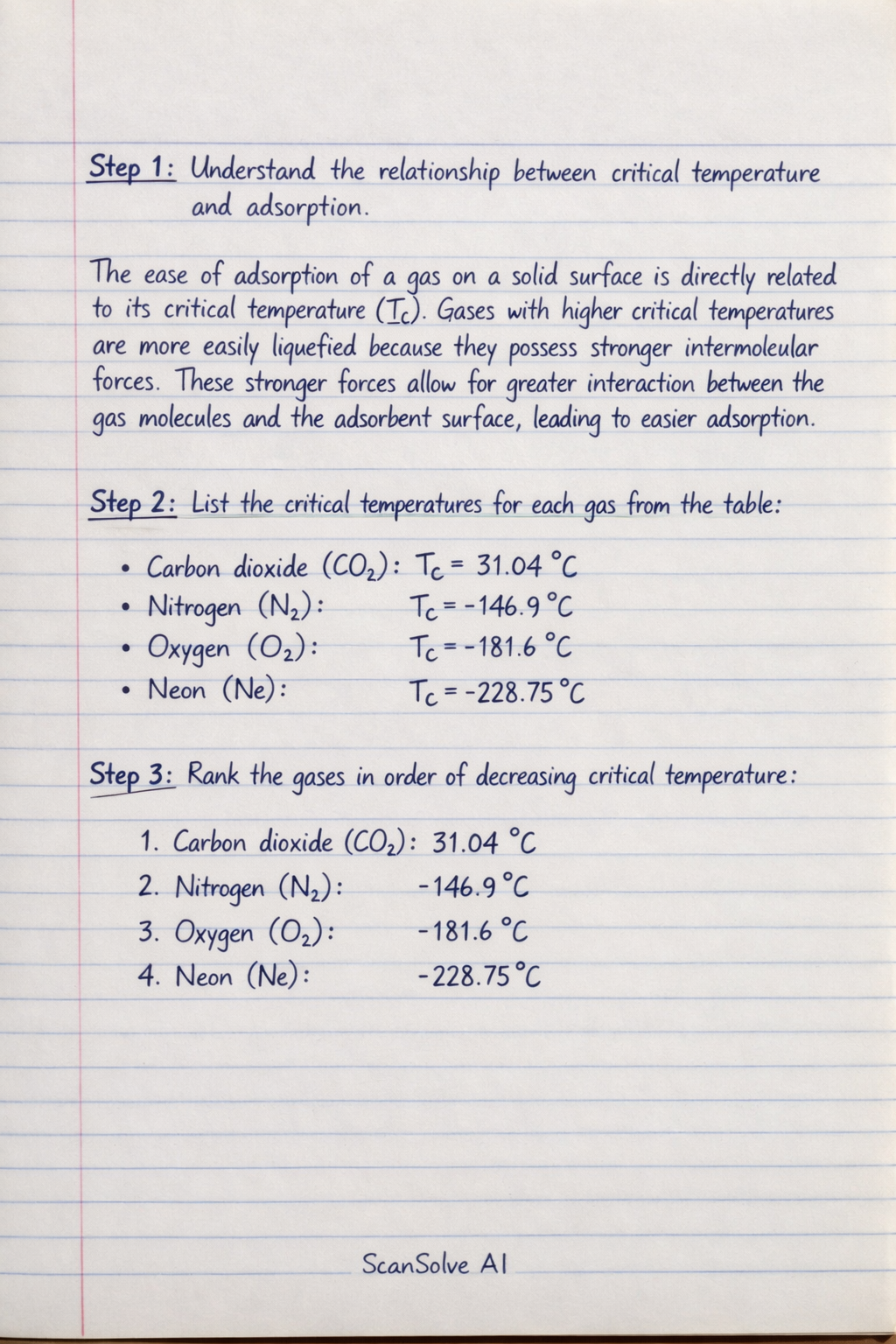
Step 1: Understand the relationship between critical temperature and adsorption. The ease of adsorption of a gas on a solid surface is directly related to its critical temperature (T_c). Gases with higher critical temperatures are more easily liquefied because they possess stronger intermolecular forces. These stronger forces allow for greater interaction between the gas molecules and the adsorbent surface, leading to easier adsorption. Step 2: List the critical temperatures for each gas from the table. Carbon dioxide (CO_2): T_c = 31.04 ^ C Nitrogen (N_2): T_c = -146.9 ^ C Oxygen (O_2): T_c = -181.6 ^ C Neon (Ne): T_c = -228.75 ^ C Step 3: Rank the gases in order of decreasing critical temperature. 1. Carbon dioxide (CO_2): 31.04 ^ C 2. Nitrogen (N_2): -146.9 ^ C 3. Oxygen (O_2): -181.6 ^ C 4. Neon (Ne): -228.75 ^ C Step 4: Determine the order of ease of adsorption. Based on the principle that higher critical temperature leads to easier adsorption, the gases can be rated as follows: Most easily adsorbed:* Carbon dioxide (CO_2) Nitrogen (N_2) Oxygen (O_2) Least easily adsorbed:* Neon (Ne) The final order of ease of adsorption (from most to least) is: Carbon dioxide > Nitrogen > Oxygen > Neon Send me the next one 📸