We read your photo as:

Which of the following properties of a gas molecule is directly proportional to the absolute temperature? Also, calculate the final volume of a gas given initial and final temperature and pressure.

Physics

ScanSolve AI Answer

Answer

B

Temperature

Step-by-step solution

9 steps

Part 5

The average kinetic energy of a molecule of a gas depends on the absolute temperature of the gas. According to the kinetic theory of gases, the average translational kinetic energy of a gas molecule is directly proportional to the absolute temperature.

The correct option is (b) Temperature.


Part 6· 3 steps

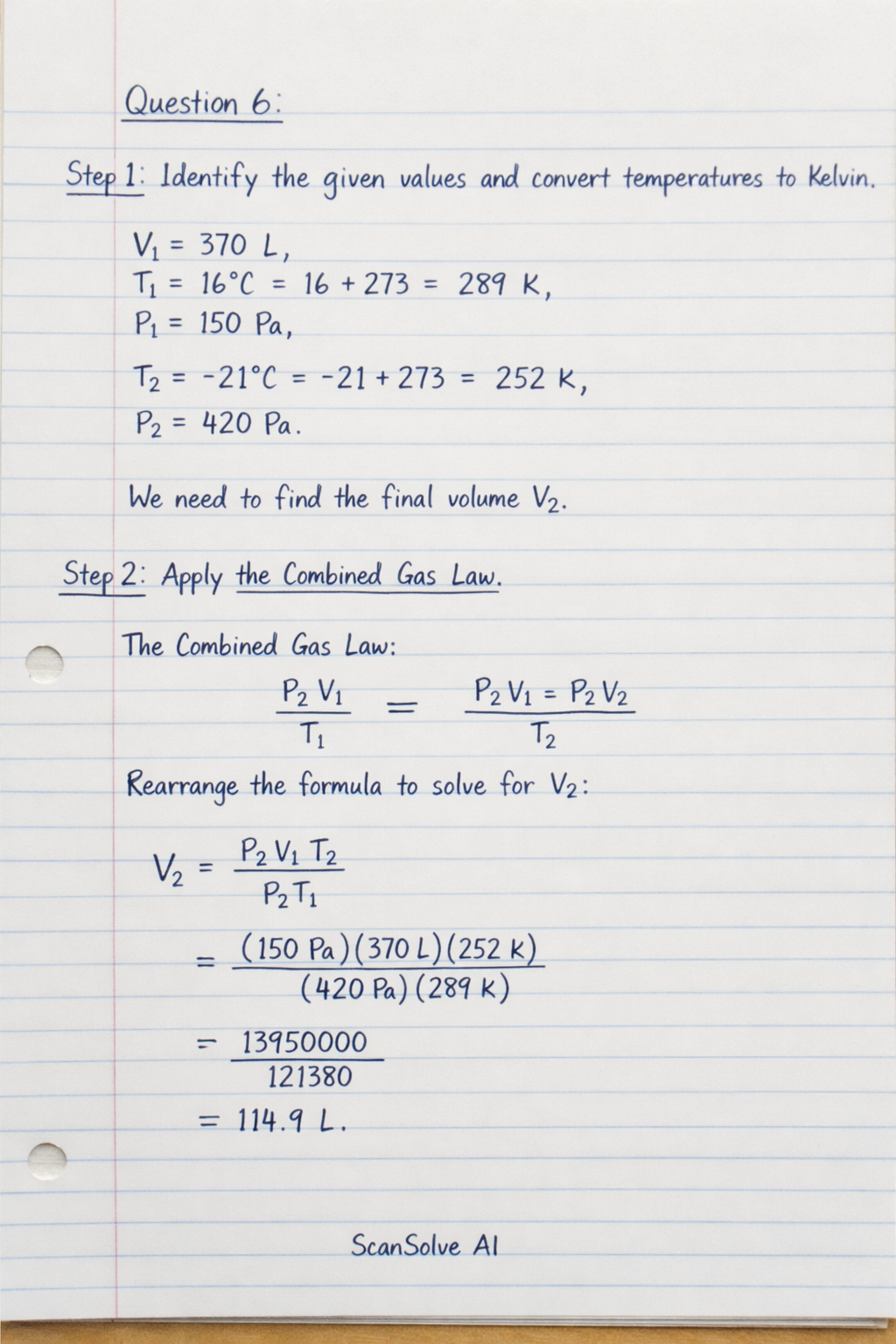
  1. Identify the given values and convert temperatures to Kelvin.

    Initial volume V1=370 LV_1 = 370 \text{ L}.
    Initial temperature T1=16∘C=16+273=289 KT_1 = 16^\circ \text{C} = 16 + 273 = 289 \text{ K}.
    Initial pressure P1=150 PaP_1 = 150 \text{ Pa}.
    Final temperature T2=−21∘C=−21+273=252 KT_2 = -21^\circ \text{C} = -21 + 273 = 252 \text{ K}.
    Final pressure P2=420 PaP_2 = 420 \text{ Pa}.
    We need to find the final volume V2V_2.

  2. Apply the Combined Gas Law.

    The Combined Gas Law states P1V1T1=P2V2T2\frac{P_1V_1}{T_1} = \frac{P_2V_2}{T_2}.
    Rearrange the formula to solve for V2V_2:

    V2=P1V1T2P2T1V_2 = \frac{P_1V_1T_2}{P_2T_1}
  3. Substitute the values and calculate V2V_2.

    V2=(150 Pa)(370 L)(252 K)(420 Pa)(289 K)V_2 = \frac{(150 \text{ Pa})(370 \text{ L})(252 \text{ K})}{(420 \text{ Pa})(289 \text{ K})} V2=13986000121380 LV_2 = \frac{13986000}{121380} \text{ L} V2≈115.225 LV_2 \approx 115.225 \text{ L}

    The volume of the hydrogen gas at −21∘C-21^\circ \text{C} and 420 Pa420 \text{ Pa} is 115.23 L\boxed{115.23 \text{ L}}.


Part 7· 3 steps

  1. Identify the given values and convert temperature and molar mass to SI units.

    Temperature T=0∘C=0+273=273 KT = 0^\circ \text{C} = 0 + 273 = 273 \text{ K}.
    Boltzmann constant k=1.38×10⁻²³ J/Kk = 1.38 \times 10^{-23} \text{ J/K}.
    Avogadro's number NA=6.022×10²³ molecule/molN_A = 6.022 \times 10^{23} \text{ molecule/mol}.
    Molar mass of nitrogen M=28 g/mol=0.028 kg/molM = 28 \text{ g/mol} = 0.028 \text{ kg/mol}.

  2. Calculate the Universal Gas Constant RR.

    The Universal Gas Constant RR can be calculated as R=kNAR = k N_A.

    R=(1.38×10⁻²³ J/K)×(6.022×1023 mol−1)R = (1.38 \times 10^{-23} \text{ J/K}) \times (6.022 \times 10^{23} \text{ mol}^{-1}) R≈8.31036 J/(mol⋅K)R \approx 8.31036 \text{ J/(mol}\cdot\text{K)}
  3. Calculate the root mean square speed (vrmsv_{rms}).

    The formula for the root mean square speed is vrms=3RTMv_{rms} = \sqrt{\frac{3RT}{M}}.

    vrms=3×(8.31036 J/(mol⋅K))×(273 K)0.028 kg/molv_{rms} = \sqrt{\frac{3 \times (8.31036 \text{ J/(mol}\cdot\text{K)}) \times (273 \text{ K})}{0.028 \text{ kg/mol}}} vrms=6806.980.028 m/sv_{rms} = \sqrt{\frac{6806.98}{0.028}} \text{ m/s} vrms=243106.4 m/sv_{rms} = \sqrt{243106.4} \text{ m/s} vrms≈493.06 m/sv_{rms} \approx 493.06 \text{ m/s}

    The root mean square speed of a nitrogen molecule at 0∘C0^\circ \text{C} is 493.06 m/s\boxed{493.06 \text{ m/s}}.


Part 8· 3 steps

  1. Identify the given values and convert them to SI units.

    Mass of nitrogen m=2.0 gm = 2.0 \text{ g}.
    Volume of tube V=30 cm3=30×(10−2 m)3=30×10−6 m3V = 30 \text{ cm}^3 = 30 \times (10^{-2} \text{ m})^3 = 30 \times 10^{-6} \text{ m}^3.
    Temperature T=20∘C=20+273=293 KT = 20^\circ \text{C} = 20 + 273 = 293 \text{ K}.
    Molar mass of nitrogen M=28 g/mol=0.028 kg/molM = 28 \text{ g/mol} = 0.028 \text{ kg/mol}.
    Universal Gas Constant R=8.314 J/(mol⋅K)R = 8.314 \text{ J/(mol}\cdot\text{K)}.

  2. Calculate the number of moles (nn) of nitrogen.

    n=mM=2.0 g28 g/moln = \frac{m}{M} = \frac{2.0 \text{ g}}{28 \text{ g/mol}} n≈0.071428 moln \approx 0.071428 \text{ mol}
  3. Apply the Ideal Gas Law to find the pressure PP.

    The Ideal Gas Law is PV=nRTPV = nRT. Rearrange to solve for PP:

    P=nRTVP = \frac{nRT}{V} P=(0.071428 mol)×(8.314 J/(mol⋅K))×(293 K)30×10−6 m3P = \frac{(0.071428 \text{ mol}) \times (8.314 \text{ J/(mol}\cdot\text{K)}) \times (293 \text{ K})}{30 \times 10^{-6} \text{ m}^3} P=174.1630×10⁻⁶ PaP = \frac{174.16}{30 \times 10^{-6}} \text{ Pa} P=5.805×10⁶ PaP = 5.805 \times 10^6 \text{ Pa}

    The nitrogen pressure in the tube when it is warmed to 20∘C20^\circ \text{C} is 5.81×10⁶ Pa\boxed{5.81 \times 10^6 \text{ Pa}}.

Was this helpful?

Try one yourself

A new problem that tests the same skill.

Still stuck on this one?

Ask a follow-up, and the answer starts from this question.

Got a different question?Ask your own question
Handwritten step-by-step solution preview

Handwritten Step-by-Step Solution

Get this as a handwritten image on WhatsApp — like a tutor wrote it for you.

Try on WhatsApp