We read your photo as:

Define relative atomic mass. (a) Balance the equation: X₂CO₃(s) + HCl(aq) → XCl(aq) + H₂O(l) + CO₂(g). (b) If 23.6 cm³ of 0.15 mol/dm³ HCl reacts completely with X₂CO₃, calculate the moles of HCl used

Chemistry

ScanSolve AI Answer

Step-by-step solution

8 steps

Part a

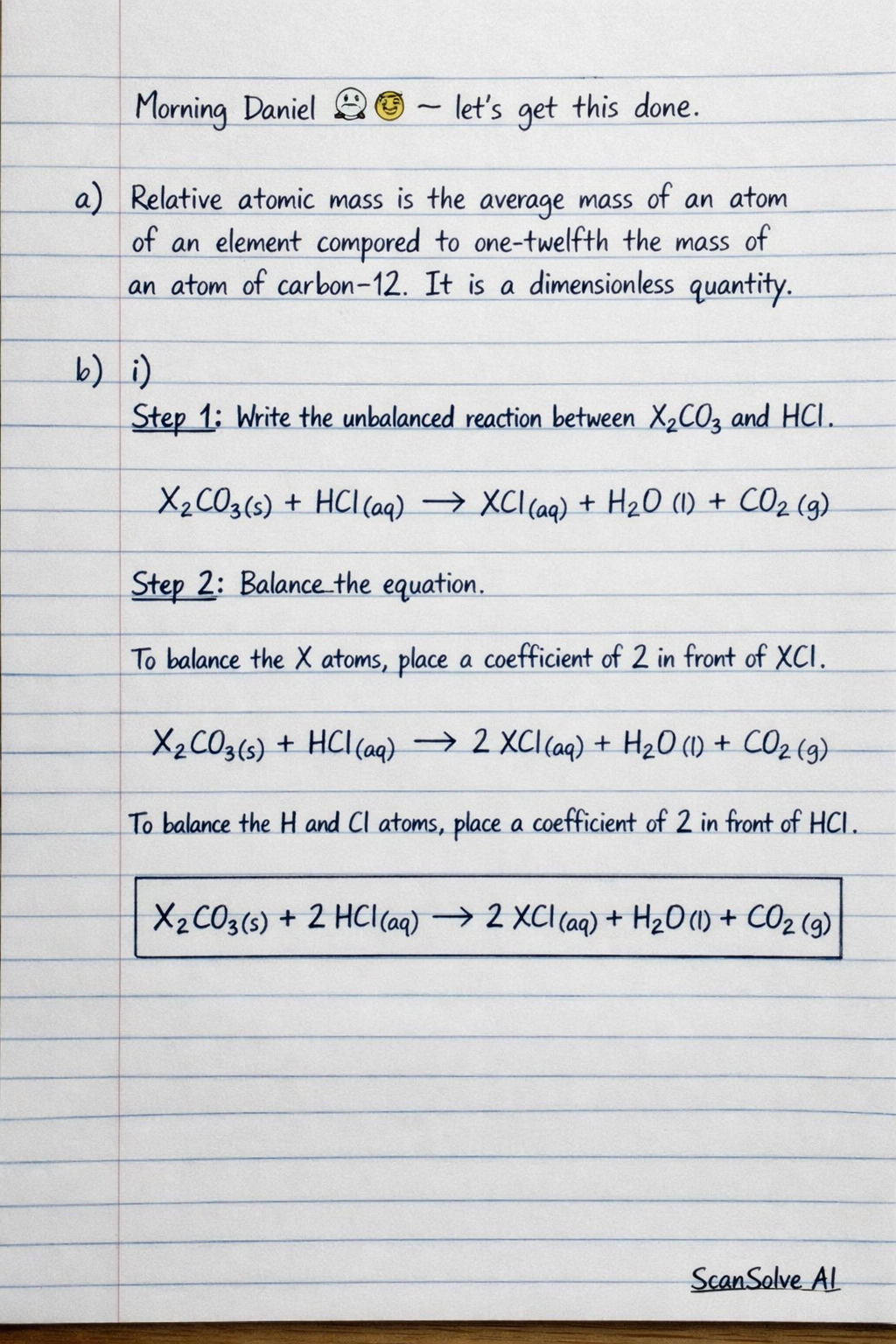
Relative atomic mass is the average mass of an atom of an element compared to one-twelfth the mass of an atom of carbon-12. It is a dimensionless quantity.

Part b(i)· 2 steps

  1. Write the unbalanced reaction between X₂CO₃ and HCl.

    X2CO3(s)+HCl(aq)→XCl(aq)+H2O(l)+CO2(g)\text{X}_2\text{CO}_3\text{(s)} + \text{HCl(aq)} \rightarrow \text{XCl(aq)} + \text{H}_2\text{O(l)} + \text{CO}_2\text{(g)}
  2. Balance the equation.

    To balance the X atoms, place a coefficient of 2 in front of XCl.

    X2CO3(s)+HCl(aq)→2XCl(aq)+H2O(l)+CO2(g)\text{X}_2\text{CO}_3\text{(s)} + \text{HCl(aq)} \rightarrow 2\text{XCl(aq)} + \text{H}_2\text{O(l)} + \text{CO}_2\text{(g)}

    To balance the H and Cl atoms, place a coefficient of 2 in front of HCl.

    X2CO3(s)+2HCl(aq)→2XCl(aq)+H2O(l)+CO2(g)\boxed{\text{X}_2\text{CO}_3\text{(s)} + 2\text{HCl(aq)} \rightarrow 2\text{XCl(aq)} + \text{H}_2\text{O(l)} + \text{CO}_2\text{(g)}}

Part b(ii)· 2 steps

  1. Convert the volume of hydrochloric acid from cm³ to dm³.

    Volume of HCl=23.6 cm3×1 dm31000 cm3=0.0236 dm3\text{Volume of HCl} = 23.6 \text{ cm}^3 \times \frac{1 \text{ dm}^3}{1000 \text{ cm}^3} = 0.0236 \text{ dm}^3
  2. Calculate the number of moles of hydrochloric acid using its concentration and volume.

    Moles of HCl=Concentration×Volume\text{Moles of HCl} = \text{Concentration} \times \text{Volume} Moles of HCl=0.15 mol/dm3×0.0236 dm3\text{Moles of HCl} = 0.15 \text{ mol/dm}^3 \times 0.0236 \text{ dm}^3 Moles of HCl=0.00354 mol\text{Moles of HCl} = 0.00354 \text{ mol} 0.00354 mol\boxed{0.00354 \text{ mol}}

Part b(iii)· 1 step

  1. Use the stoichiometry from the balanced equation to find the moles of X₂CO₃.

    From the balanced equation: 1 mole of X2CO31 \text{ mole of X}_2\text{CO}_3 reacts with 2 moles of HCl2 \text{ moles of HCl}.

    Moles of X2CO3=Moles of HCl2\text{Moles of X}_2\text{CO}_3 = \frac{\text{Moles of HCl}}{2} Moles of X2CO3=0.00354 mol2\text{Moles of X}_2\text{CO}_3 = \frac{0.00354 \text{ mol}}{2} Moles of X2CO3=0.00177 mol\text{Moles of X}_2\text{CO}_3 = 0.00177 \text{ mol} 0.00177 mol\boxed{0.00177 \text{ mol}}

Part b(iv)· 1 step

  1. Determine the Relative molecular mass (M_r) of X₂CO₃ using its mass and moles.

    Mr(X2CO3)=Mass of X2CO3Moles of X2CO3\text{M}_r(\text{X}_2\text{CO}_3) = \frac{\text{Mass of X}_2\text{CO}_3}{\text{Moles of X}_2\text{CO}_3} Mr(X2CO3)=0.245 g0.00177 mol\text{M}_r(\text{X}_2\text{CO}_3) = \frac{0.245 \text{ g}}{0.00177 \text{ mol}} Mr(X2CO3)≈138.418 g/mol\text{M}_r(\text{X}_2\text{CO}_3) \approx 138.418 \text{ g/mol} 138.4 g/mol\boxed{138.4 \text{ g/mol}}

Part b(v)· 2 steps

  1. Use the Relative molecular mass of X₂CO₃ and the known atomic masses of Carbon (C) and Oxygen (O) to find the Relative atomic mass (RAM) of X.

    Assume RAM(C) = 12.0 g/mol and RAM(O) = 16.0 g/mol.

    Mr(X2CO3)=2×RAM(X)+RAM(C)+3×RAM(O)\text{M}_r(\text{X}_2\text{CO}_3) = 2 \times \text{RAM(X)} + \text{RAM(C)} + 3 \times \text{RAM(O)} 138.418=2×RAM(X)+12.0+3×16.0138.418 = 2 \times \text{RAM(X)} + 12.0 + 3 \times 16.0 138.418=2×RAM(X)+12.0+48.0138.418 = 2 \times \text{RAM(X)} + 12.0 + 48.0 138.418=2×RAM(X)+60.0138.418 = 2 \times \text{RAM(X)} + 60.0
  2. Solve for RAM(X).

    2×RAM(X)=138.418−60.02 \times \text{RAM(X)} = 138.418 - 60.0 2×RAM(X)=78.4182 \times \text{RAM(X)} = 78.418 RAM(X)=78.4182\text{RAM(X)} = \frac{78.418}{2} RAM(X)=39.209 g/mol\text{RAM(X)} = 39.209 \text{ g/mol} 39.2 g/mol\boxed{39.2 \text{ g/mol}}
Was this helpful?

Still stuck on this one?

Ask a follow-up, and the answer starts from this question.

Got a different question?Ask your own question
Handwritten step-by-step solution preview

Handwritten Step-by-Step Solution

Get this as a handwritten image on WhatsApp — like a tutor wrote it for you.

Try on WhatsApp