
We read your photo as:
Define relative atomic mass. A student reacts 0.245 g of a metal carbonate X₂CO₃ with 23.6 cm³ of 0.15 M hydrochloric acid. Calculate the relative atomic mass of the metal X.
ScanSolve AI Answer
Step-by-step solution
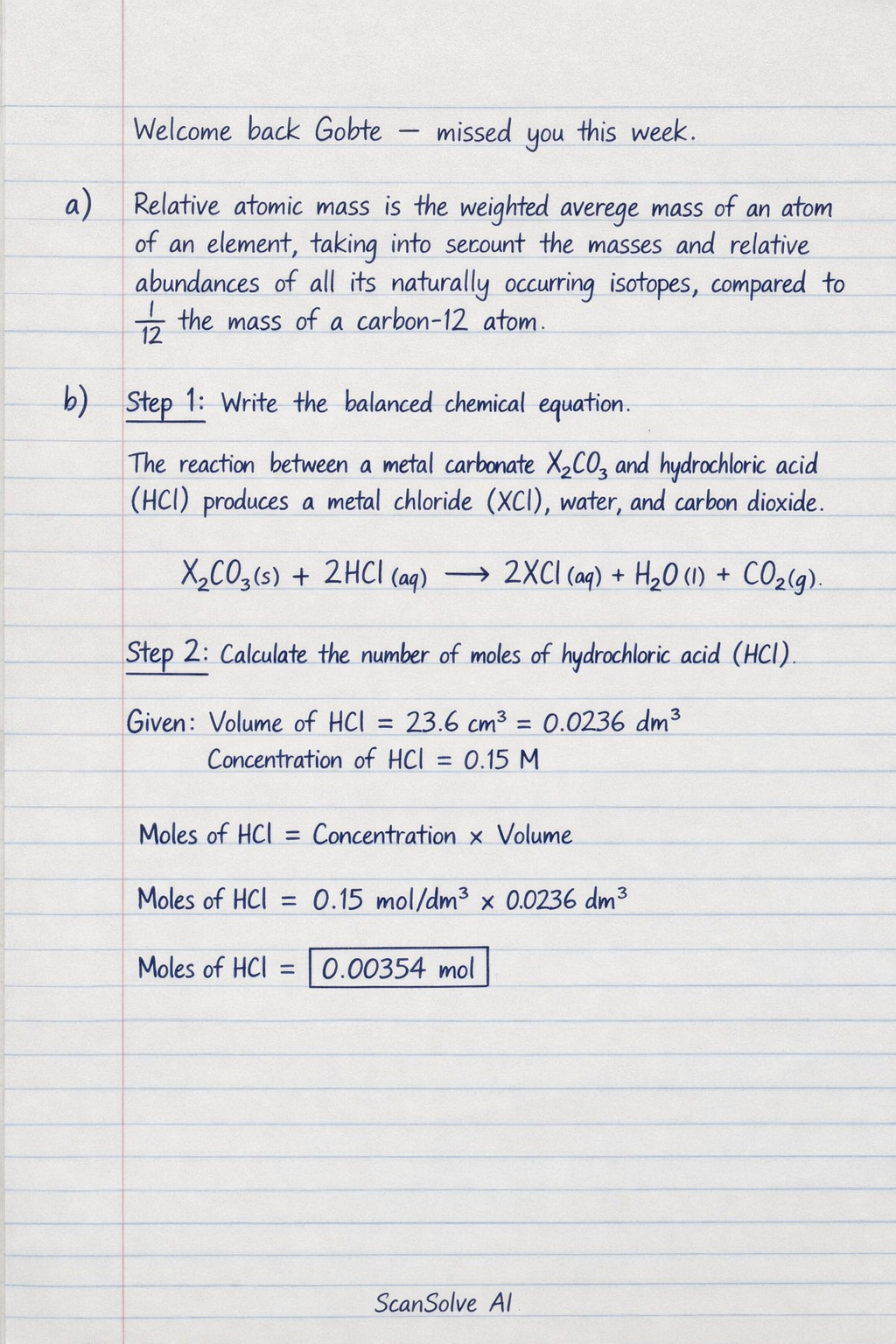
5 stepsa) Relative atomic mass is the weighted average mass of an atom of an element, taking into account the masses and relative abundances of all its naturally occurring isotopes, compared to the mass of a carbon-12 atom.
b)
Write the balanced chemical equation.
The reaction between a metal carbonate X₂CO₃ and hydrochloric acid (HCl) produces a metal chloride (XCl), water, and carbon dioxide.
Calculate the number of moles of hydrochloric acid (HCl).
Given: Volume of HCl =
Concentration of HCl =Calculate the number of moles of the carbonate (X₂CO₃) used.
From the balanced equation, the mole ratio of X₂CO₃ to HCl is .
\text{Moles of X_2CO_3} = \frac{1}{2} \times \text{Moles of HCl}\text{Moles of X_2CO_3} = \frac{1}{2} \times 0.00354 \text{ mol}\text{Moles of X_2CO_3} = \boxed{0.00177 \text{ mol}}Determine the Relative molecular mass of X₂CO₃.
Given: Mass of X₂CO₃ =
Moles of X₂CO₃ =\text{Relative molecular mass (M_r)} = \frac{\text{Mass}}{\text{Moles}}\text{M_r of X_2CO_3} = \frac{0.245 \text{ g}}{0.00177 \text{ mol}}\text{M_r of X_2CO_3} \approx \boxed{138.42 \text{ g/mol}}Calculate the Relative Atomic Mass (RAM) of X.
We know that Mᵣ(X₂CO₃) = .
Using standard atomic masses: RAM(C) = and RAM(O) = .
Still stuck on this one?
Ask a follow-up, and the answer starts from this question.
More Chemistry Questions
Handwritten Step-by-Step Solution
Get this as a handwritten image on WhatsApp — like a tutor wrote it for you.
Try on WhatsApp