
We read your photo as:
The student's handwritten calculation for the moles of MCO₃ is correct. Calculate the relative molecular mass of MCO₃ given the mass is 0.100 g.
ScanSolve AI Answer
Step-by-step solution
5 stepsHere are the solutions to your chemistry questions:
Part a· 4 steps
Calculate the number of moles of hydrochloric acid.
The concentration of hydrochloric acid is and the volume is .
First, convert the volume from to :Now, calculate the moles using the formula:
The student's handwritten calculation is correct.
The number of moles of hydrochloric acid is .Calculate the number of moles of MCO₃.
The balanced chemical equation is:
From the equation, the mole ratio of MCO₃ to HCl is .
So, moles of MCO₃ =The number of moles of MCO₃ is .
Calculate the relative molecular mass of MCO₃.
The mass of MCO₃ is and the moles of MCO₃ are .
The relative molecular mass () is calculated as:Rounding to a reasonable number of significant figures (e.g., 3 sig figs based on 0.24 g):
The relative molecular mass of MCO₃ is .
Calculate the relative atomic mass of the metal M.
The relative molecular mass of MCO₃ is 202.
The atomic mass of Carbon (C) is 12.0.
The atomic mass of Oxygen (O) is 16.0.
In MCO₃, there is one M atom, one C atom, and three O atoms.The relative atomic mass of the metal M is .
Part b· 1 step
Name the theory that is used to explain the shapes of simple covalent molecules and ions.
The theory used to explain the shapes of simple covalent molecules and ions is the Valence Shell Electron Pair Repulsion (VSEPR) theory. This theory states that electron pairs around a central atom will arrange themselves as far apart as possible to minimize repulsion, thus determining the molecule's geometry.
The theory is .
Still stuck on this one?
Ask a follow-up, and the answer starts from this question.
More Chemistry Questions
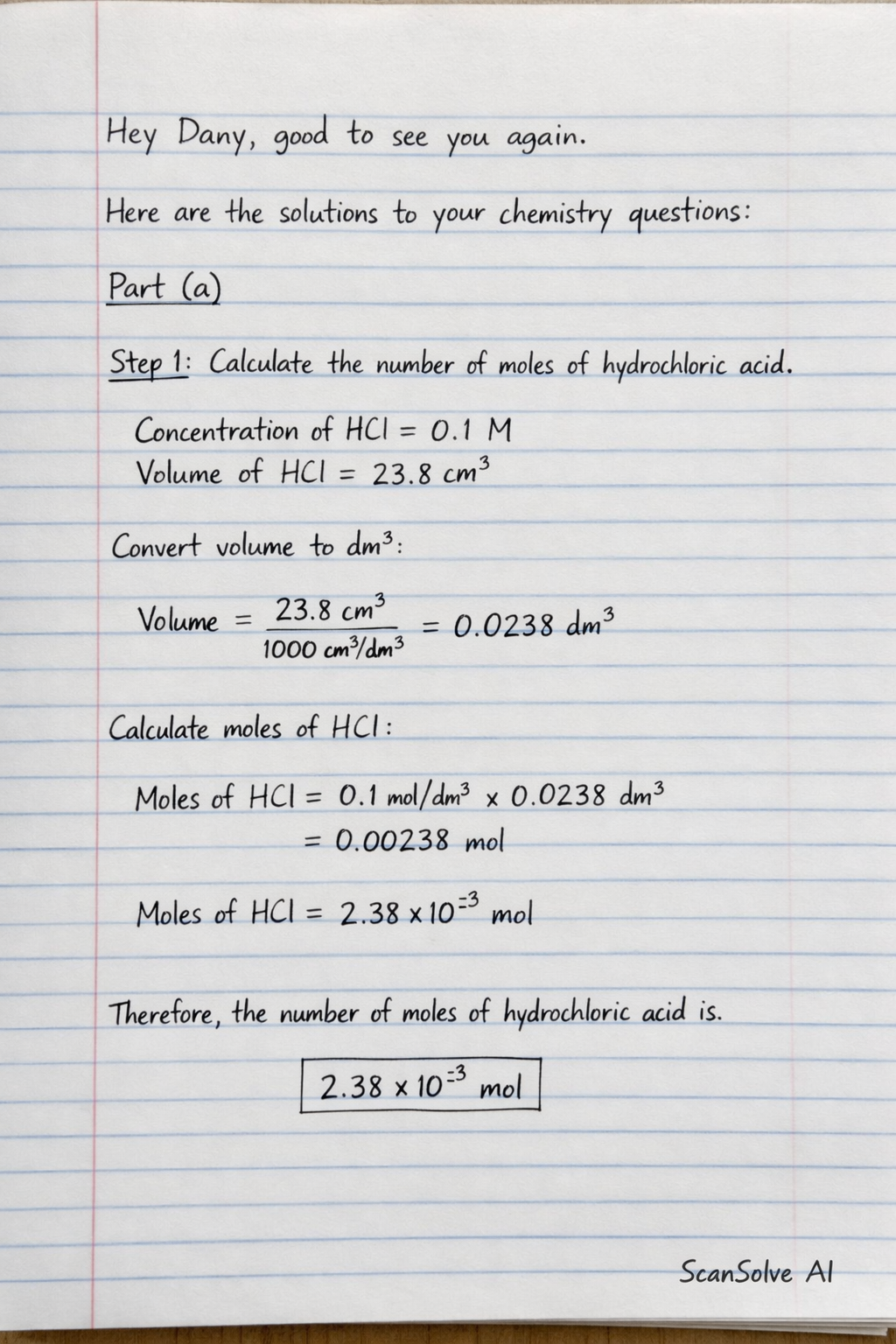
Handwritten Step-by-Step Solution
Get this as a handwritten image on WhatsApp — like a tutor wrote it for you.
Try on WhatsApp