
We read your photo as:
Calculate the relative atomic mass of element X, given the isotopes' mass numbers and abundances.
Chemistry
ScanSolve AI Answer
Step-by-step solution
5 steps6. b) Calculate the relative atomic mass of element X.
The relative atomic mass (Ar) is calculated using the mass numbers and abundances of its isotopes.
Given:
- Isotope X₁: mass number = 35, abundance = 75%
- Isotope X₂: mass number = 37, abundance = 25%
Use the formula for relative atomic mass.
Substitute the given values into the formula.
Perform the multiplication.
Perform the addition.
Perform the division.
The relative atomic mass of element X is 35.5.
7. a) ii) Define: Mass number
The mass number is the total number of protons and neutrons in the nucleus of an atom.
Was this helpful?
Still stuck on this one?
Ask a follow-up, and the answer starts from this question.
Got a different question?Ask your own question
More Chemistry Questions
QA) Define: i) Atomic number ii) Mass number b) Calculate the relative atomic mass of element X given…QThe question does not provide any information (such as isotopes or their abundances) about element…QA) Define: i) Atomic number ii) Mass number. b) Calculate the relative atomic mass of element X. c)…QAn element X has two naturally occurring isotopes of 75% and 25% and 37x with a relative abundance…QCalculate the relative atomic mass of element X given its isotopes X-16 and X-18 occur in a 9:1…
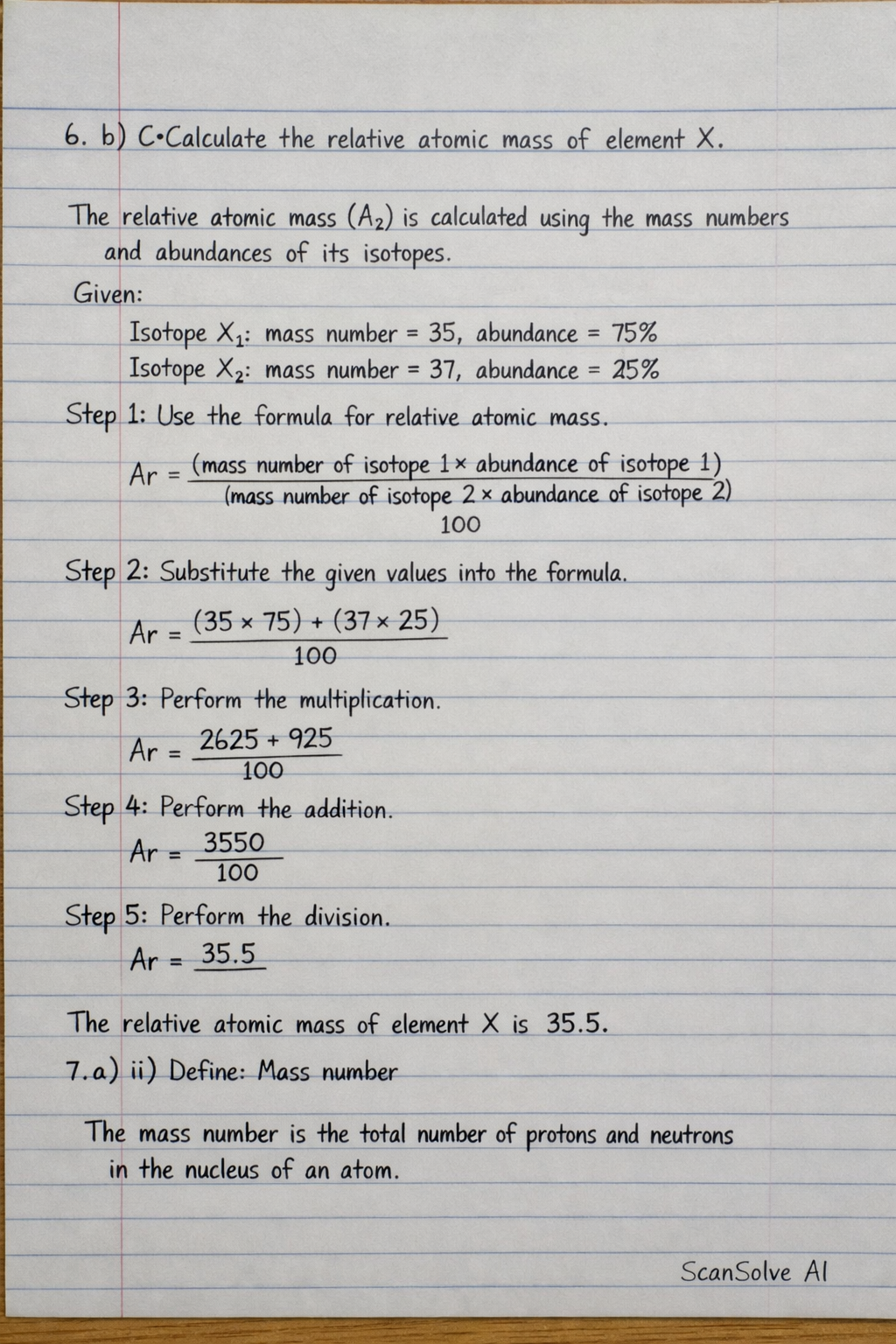
Handwritten Step-by-Step Solution
Get this as a handwritten image on WhatsApp — like a tutor wrote it for you.
Try on WhatsApp