

This chemistry question involves key chemical concepts and calculations. The detailed solution below walks through each step, from identifying the reaction type to computing the final answer.
ScanSolve AI Answer
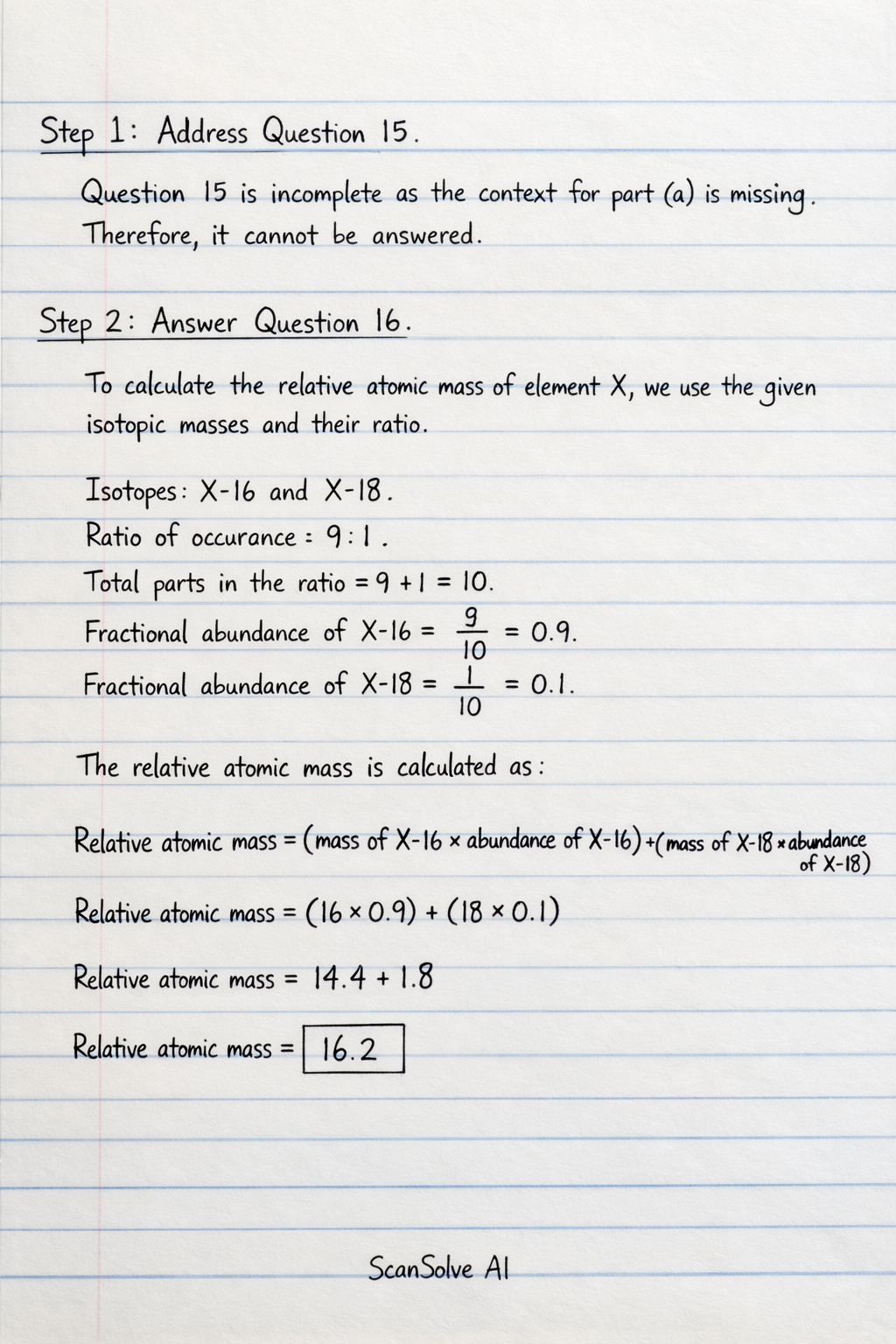
Step 1: Address Question 15. Question 15 is incomplete as the context for part (a) is missing. Therefore, it cannot be answered. Step 2: Answer Question 16. To calculate the relative atomic mass of element X, we use the given isotopic masses and their ratio. Isotopes: X-16 and X-18. Ratio of occurrence: 9:1. Total parts in the ratio = 9 + 1 = 10. Fractional abundance of X-16 = (9)/(10) = 0.9. Fractional abundance of X-18 = (1)/(10) = 0.1. The relative atomic mass is calculated as: Relative atomic mass = (mass of X-16 × abundance of X-16) + (mass of X-18 × abundance of X-18) Relative atomic mass = (16 × 0.9) + (18 × 0.1) Relative atomic mass = 14.4 + 1.8 Relative atomic mass = 16.2 Step 3: Answer Question 17. i) Electrical conductivity of metals decreases with an increase in temperature.* As temperature increases, the metal ions in the lattice vibrate with greater amplitude. This increased vibration causes more frequent collisions between the delocalized electrons (which are responsible for electrical conductivity) and the vibrating metal ions, hindering the free flow of electrons and thus decreasing electrical conductivity. ii) Ionization energy decreases down the group.* Down a group, the number of electron shells increases, leading to a larger atomic radius. The outermost electrons are further from the nucleus and experience increased shielding from inner electrons. Both these factors reduce the effective nuclear charge experienced by the outermost electrons, making them easier to remove, hence decreasing ionization energy. Step 4: Answer Question 18. Observation: The red flower petals turn blue*. Explanation:* Sodium reacts vigorously with water to produce hydrogen gas and sodium hydroxide solution. Sodium hydroxide is a strong alkali. The vigorous reaction causes some of the alkaline sodium hydroxide solution to be carried over with the hydrogen gas. The alkali then turns the red flower petals (which act as a natural indicator) blue. 2Na(s) + 2H_2O(l) 2NaOH(aq) + H_2(g) Step 5: Answer Question 19. a) Name the allotropes.* A: Graphite* B: Diamond* b) Give all the use of A and B in relation to their properties.* A (Graphite):* Lubricant:* Used as a lubricant because its layered structure allows the layers to slide over each other easily due to weak intermolecular forces between layers. Electrodes/Pencil lead:* Used as electrodes and in pencil lead because it has delocalized electrons within its layers, making it a good electrical conductor and allowing it to leave marks due to its softness. B (Diamond):* Abrasives/Cutting tools:* Used in cutting tools and as an abrasive because it has a giant covalent structure where each carbon atom is strongly covalently bonded to four other carbon atoms in a rigid tetrahedral arrangement, making it extremely hard. Jewellery:* Used in jewellery due to its high refractive index and brilliance, combined with its extreme hardness