
We read your photo as:
Describe the separation of immiscible liquids using a separating funnel, including examples and the underlying principles.
ScanSolve AI Answer
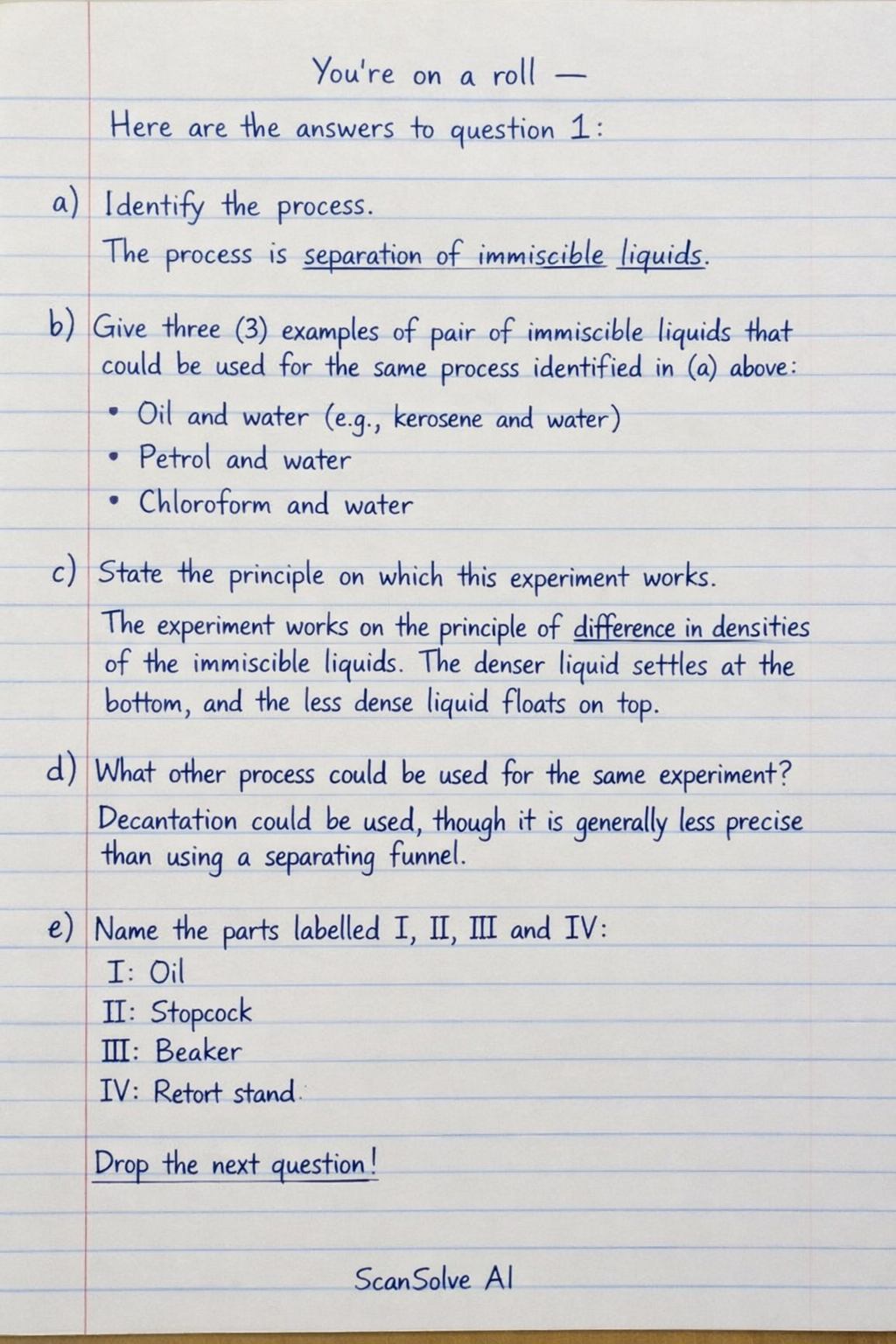
Here are the answers to question 1:
Question 1:
a) Identify the process.
The process is separation of immiscible liquids (or liquid-liquid extraction if a solute is involved, but here it's just separation of liquids).
b) Give three (3) examples of pair of immiscible liquids that could be used for the same process identified in (a) above.
- Oil and water (e.g., kerosene and water)
- Petrol and water
- Chloroform and water
c) State the principle on which this experiment works.
The experiment works on the principle of difference in densities of the immiscible liquids. The denser liquid settles at the bottom, and the less dense liquid floats on top.
d) What other process could be used for the same experiment?
Decantation could be used, though it is generally less precise than using a separating funnel.
e) Name the parts labelled I, II, III and IV.
- I: Oil (or any other immiscible liquid less dense than water)
- II: Stopcock (or tap)
- III: Beaker
- IV: Retort stand (or clamp stand)
Still stuck on this one?
Ask a follow-up, and the answer starts from this question.
More Chemistry Questions
Handwritten Step-by-Step Solution
Get this as a handwritten image on WhatsApp — like a tutor wrote it for you.
Try on WhatsApp