
We read your photo as:
Describe the Solvay process and related chemical reactions, including calculations for the reaction of sodium carbonate with sulfuric acid.
Chemistry
ScanSolve AI Answer
Step-by-step solution
9 stepsHere are the solutions to your questions:
- a)
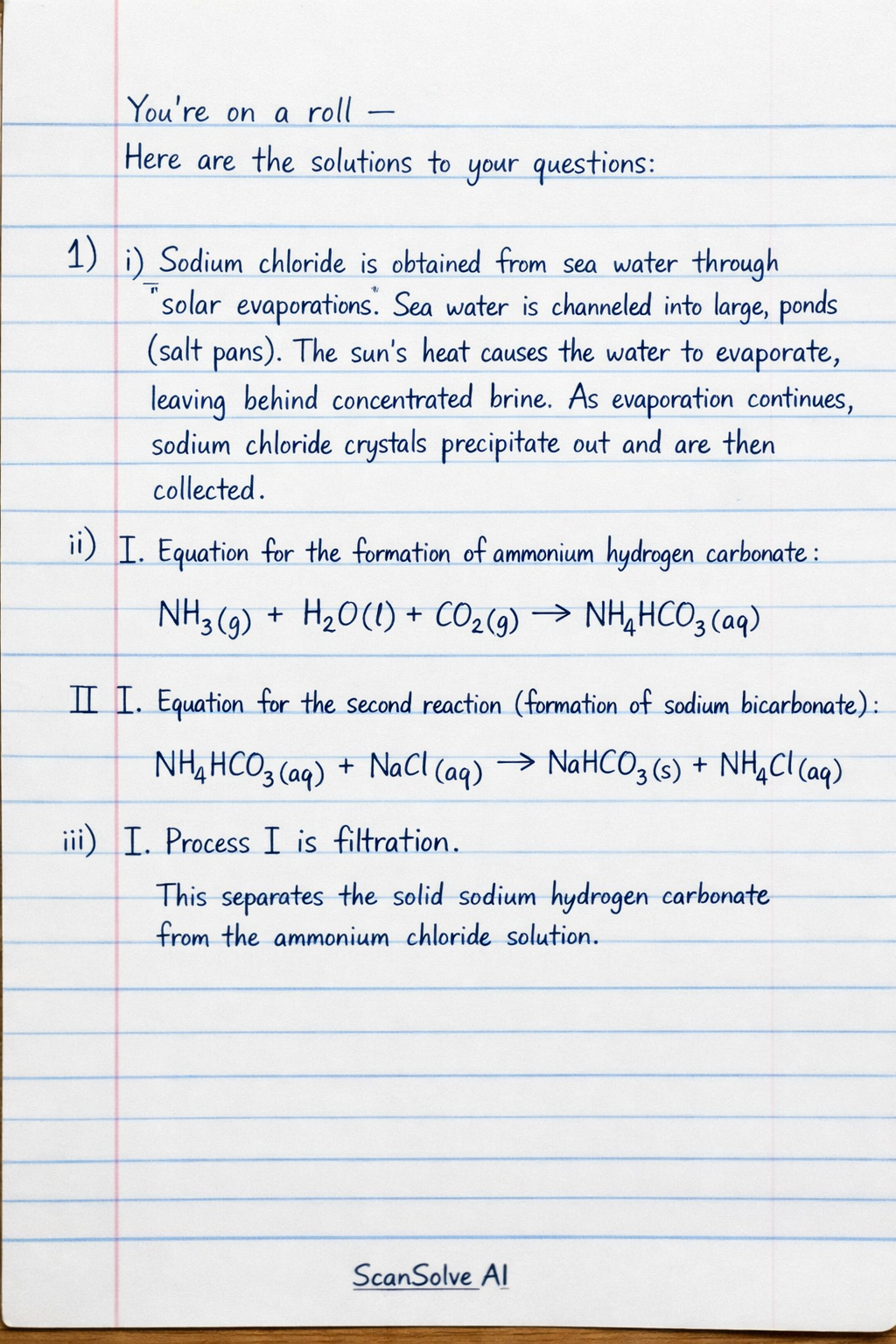
- i) Sodium chloride is obtained from sea water through solar evaporation. Sea water is channeled into large, shallow ponds (salt pans). The sun's heat causes the water to evaporate, leaving behind concentrated brine. As evaporation continues, sodium chloride crystals precipitate out and are then collected.
- ii)
- I. Equation for the formation of ammonium hydrogen carbonate:
- II. Equation for the second reaction (formation of sodium bicarbonate):
- iii)
- I. Process I is filtration. This separates the solid sodium hydrogen carbonate from the ammonium chloride solution.
- II. Process II is heating or thermal decomposition. This converts sodium hydrogen carbonate into sodium carbonate, water, and carbon dioxide.
- iv)
- I. Calculate the number of moles of sodium carbonate that reacted. The reaction between sodium carbonate and sulphuric acid is:
Calculate moles of sulphuric acid.
$$ \text{Moles of H}_2\text{SO}_4 = \text{Molarity} \times \text{Volume} $$ $$ \text{Moles of H}_2\text{SO}_4 = 0.5 \text{ M} \times \frac{40.0}{1000} \text{ L} $$ $$ \text{Moles of H}_2\text{SO}_4 = 0.02 \text{ mol} $$Use the mole ratio from the balanced equation.
From the equation, 1 mole of $\text{Na}_2\text{CO}_3$ reacts with 1 mole of $\text{H}_2\text{SO}_4$. $$ \text{Moles of Na}_2\text{CO}_3 = \text{Moles of H}_2\text{SO}_4 $$ $$ \text{Moles of Na}_2\text{CO}_3 = 0.02 \text{ mol} $$ The number of moles of sodium carbonate that reacted is $\boxed{\text{0.02 mol}}$. * II. Determine the percentage of sodium carbonate in the sample.Calculate the molar mass of .
$$ \text{Molar mass of Na}_2\text{CO}_3 = (2 \times 23.0) + 12.0 + (3 \times 16.0) $$ $$ \text{Molar mass of Na}_2\text{CO}_3 = 46.0 + 12.0 + 48.0 $$ $$ \text{Molar mass of Na}_2\text{CO}_3 = 106.0 \text{ g/mol} $$Calculate the mass of pure in the sample.
$$ \text{Mass of Na}_2\text{CO}_3 = \text{Moles} \times \text{Molar mass} $$ $$ \text{Mass of Na}_2\text{CO}_3 = 0.02 \text{ mol} \times 106.0 \text{ g/mol} $$ $$ \text{Mass of Na}_2\text{CO}_3 = 2.12 \text{ g} $$Calculate the percentage purity.
$$ \text{Percentage purity} = \frac{\text{Mass of pure Na}_2\text{CO}_3}{\text{Mass of sample}} \times 100\% $$ $$ \text{Percentage purity} = \frac{2.12 \text{ g}}{2.15 \text{ g}} \times 100\% $$ $$ \text{Percentage purity} = 98.6046...\% $$ The percentage of sodium carbonate in the sample is $\boxed{\text{98.60\%}}$.- b) Two industrial uses of sodium carbonate:
- Manufacture of glass.
- Manufacture of detergents and soaps.
- Water softening (removing hardness from water).
- a) State the Charles' Law.
- Charles' Law states that for a fixed mass of gas at constant pressure, the volume of the gas is directly proportional to its absolute temperature.
- b) Calculate the temperature at which the volume of the gas would be at . Given: We use the combined gas law: Since , the equation simplifies to Charles' Law:
- b) Two industrial uses of sodium carbonate:
Substitute the given values.
$$ \frac{3.5 \times 10^{-2} \text{ m}^3}{291 \text{ K}} = \frac{2.8 \times 10^{-2} \text{ m}^3}{T_2} $$Solve for .
$$ T_2 = \frac{(2.8 \times 10^{-2} \text{ m}^3) \times 291 \text{ K}}{3.5 \times 10^{-2} \text{ m}^3} $$ $$ T_2 = \frac{2.8 \times 291}{3.5} \text{ K} $$ $$ T_2 = 0.8 \times 291 \text{ K} $$ $$ T_2 = 232.8 \text{ K} $$ The temperature at which the volume would be $2.8 \times 10^{-2} \text{ m}^3$ is $\boxed{\text{232.8 K}}$.3. a) State the Graham's law diffusion. * Graham's Law of Diffusion states that the rate of diffusion of a gas is inversely proportional to the square root of its molar mass (or density), at constant temperature and pressure.
- b) The molar masses of gases W and X are 16.0 and 44.0 respectively. If the rate of diffusion of W through a porous material is , calculate the rate of diffusion of X through the same material. According to Graham's Law of Diffusion: Given:
Substitute the given values into the formula.
$$ \frac{12 \text{ cm}^3\text{s}^{-1}}{\text{Rate}_X} = \sqrt{\frac{44.0}{16.0}} $$ $$ \frac{12}{\text{Rate}_X} = \sqrt{2.75} $$ $$ \frac{12}{\text{Rate}_X} \approx 1.6583 $$Solve for .
$$
\text{Rate}_X = \frac{12}{1.6583}
$$
$$
\text{Rate}_X \approx 7.236 \text{ cm}^3\text{s}^{-1}
$$
The rate of diffusion of X is approximately $\boxed{\text{7.24 cm}^3\text{s}^{-1}}$.
Was this helpful?
Still stuck on this one?
Ask a follow-up, and the answer starts from this question.
Got a different question?Ask your own question
More Chemistry Questions
QDescribe the Solvay process using a text-based diagram, showing the inputs, outputs, and key stages.QAnswer Question 1(a) - Name the substances in the Solvay process.QThe flow chart diagram below shows some of the processes involved in the manufacture of sodium…QDescribe how sodium chloride is obtained from sea water. Write balanced chemical equations for the…QDescribe the Contact Process for the industrial manufacture of sulfuric acid, including reactants…
Handwritten Step-by-Step Solution
Get this as a handwritten image on WhatsApp — like a tutor wrote it for you.
Try on WhatsApp