
We read your photo as:
Calculate the specific rotation of (R)-2-methylbutanol given the observed rotation, mass, volume, and path length.
Chemistry
ScanSolve AI Answer
Answer
Step-by-step solution
6 stepsIdentify the given values.
Observed rotation () =
Mass of (R)-2-methylbutanol =
Volume of solution =
Path length of polarimeter tube () =Convert the path length to decimeters (dm).
Calculate the concentration () of the solution in g/mL.
Use the formula for specific rotation.
The specific rotation is calculated using the formula:
where is the observed rotation, is the path length in decimeters (dm), and is the concentration in g/mL.
Substitute the values and calculate the specific rotation.
The specific rotation of (R)-2-methylbutanol is .
Compare the result with the given options.
The calculated specific rotation is 5.75. This matches option (A).
The final answer is
Was this helpful?
Try one yourself
A new problem that tests the same skill.
Still stuck on this one?
Ask a follow-up, and the answer starts from this question.
Got a different question?Ask your own question
More Chemistry Questions
QCalculate the specific rotation of glucose given the observed rotation, mass, volume, and path…QThe given compound is 2-methylbutan-2-ol.QWhat us the formula for butanolQWhat is the specific rotation of the product mixture from an SN1 reaction that produces a racemic…QWhat are the steps to determine the IUPAC name for 2-butanol?
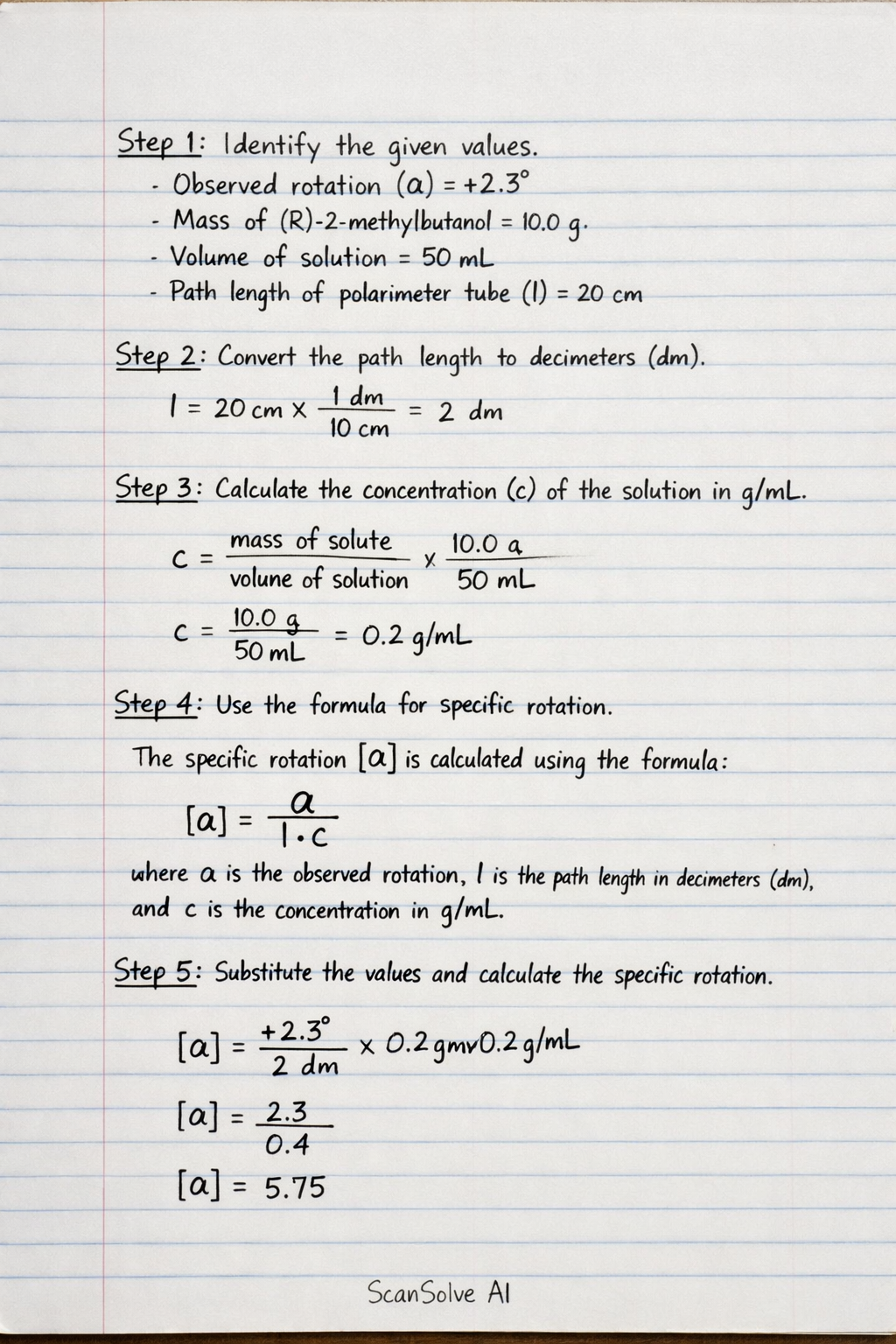
Handwritten Step-by-Step Solution
Get this as a handwritten image on WhatsApp — like a tutor wrote it for you.
Try on WhatsApp