
We read your photo as:
Explain the structure and bonding of Al2Cl6 and MgCl2 and the reaction of CaCO3 with HCl.
ScanSolve AI Answer
Answer
Step-by-step solution
4 stepshere are the solutions to the questions:
Part e(ii)
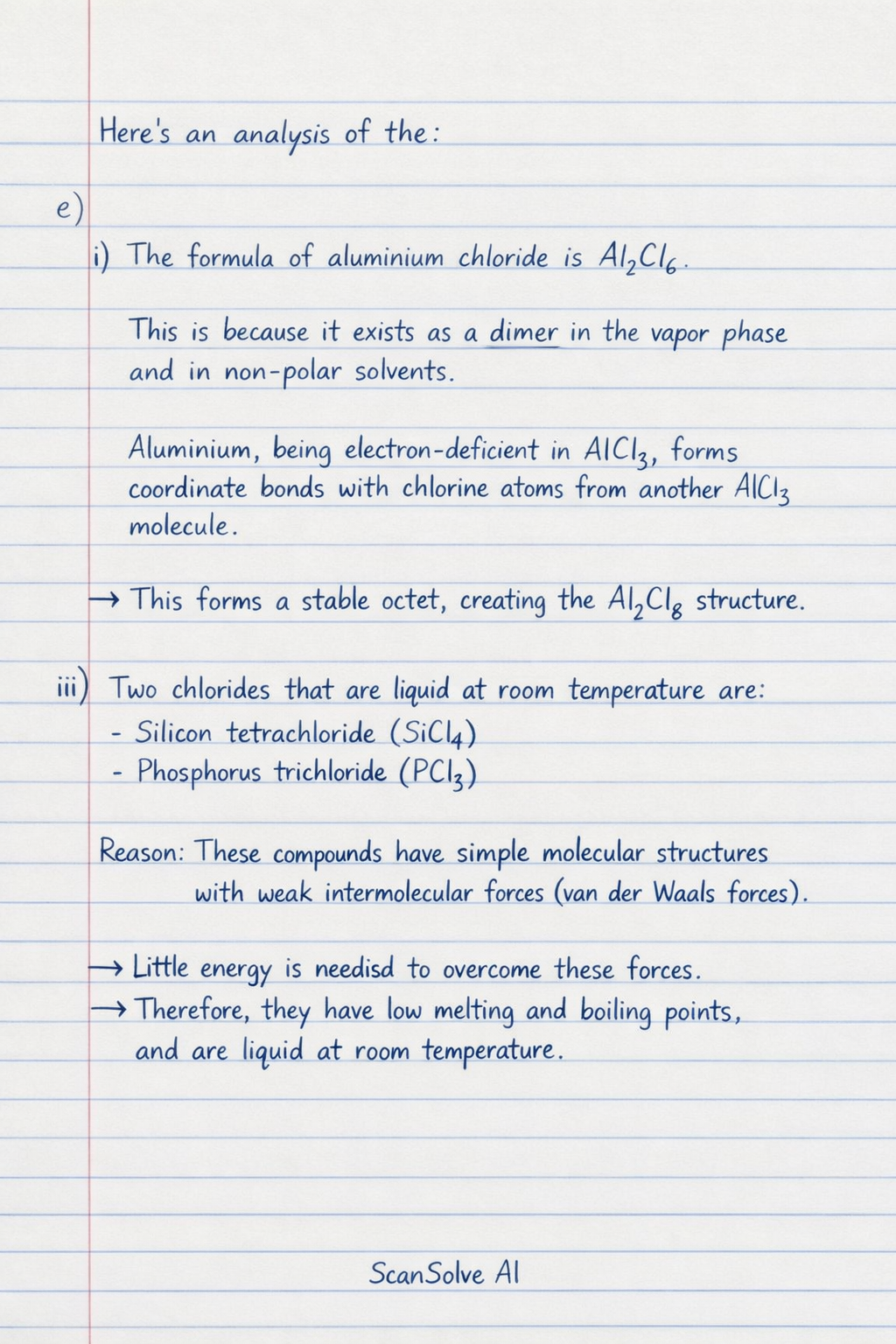
Two chlorides that are liquid at room temperature are silicon tetrachloride () and phosphorus trichloride ().
-
i) The formula of aluminium chloride is given as because it exists as a dimer in the vapor phase and in non-polar solvents. Aluminium, being electron-deficient in , forms coordinate bonds with chlorine atoms from another molecule to achieve a stable octet, forming the structure.
- Reason: These compounds have simple molecular structures with weak intermolecular forces (van der Waals forces). Little energy is required to overcome these forces, resulting in low melting and boiling points, making them liquid at room temperature.
-
iii) has a lower melting point than because is an ionic compound with a giant ionic lattice structure held together by strong electrostatic forces, requiring a lot of energy to melt. In contrast, is a covalent compound with a simple molecular structure where only weak intermolecular forces need to be overcome to melt it.
Part f
The balanced equation for the reaction is:
Part a
When dilute hydrochloric acid is added to marble chips, the following observations would be made
- Effervescence (fizzing) due to the production of carbon dioxide gas.
- The marble chips would decrease in size or dissolve.
Part b
To calculate the mass of carbon (IV) oxide produced
Determine the molar mass of and .
Molar mass of $\text{CaCO}_3 = 40.08 (\text{Ca}) + 12.01 (\text{C}) + 3 \times 16.00 (\text{O}) = 100.09 \text{ g/mol}$ Molar mass of $\text{CO}_2 = 12.01 (\text{C}) + 2 \times 16.00 (\text{O}) = 44.01 \text{ g/mol}$Calculate the moles of reacted.
$$ \text{Moles of CaCO}_3 = \frac{\text{Mass}}{\text{Molar mass}} = \frac{2.0 \text{ g}}{100.09 \text{ g/mol}} \approx 0.020 \text{ mol} $$Use the mole ratio from the balanced equation to find moles of .
From the equation, 1 mole of $\text{CaCO}_3$ produces 1 mole of $\text{CO}_2$. $$ \text{Moles of CO}_2 = \text{Moles of CaCO}_3 = 0.020 \text{ mol} $$Calculate the mass of produced.
$$
\text{Mass of CO}_2 = \text{Moles} \times \text{Molar mass} = 0.020 \text{ mol} \times 44.01 \text{ g/mol} = \boxed{\text{0.88 g}}
$$
Try one yourself
A new problem that tests the same skill.
Still stuck on this one?
Ask a follow-up, and the answer starts from this question.
More Chemistry Questions
Handwritten Step-by-Step Solution
Get this as a handwritten image on WhatsApp — like a tutor wrote it for you.
Try on WhatsApp