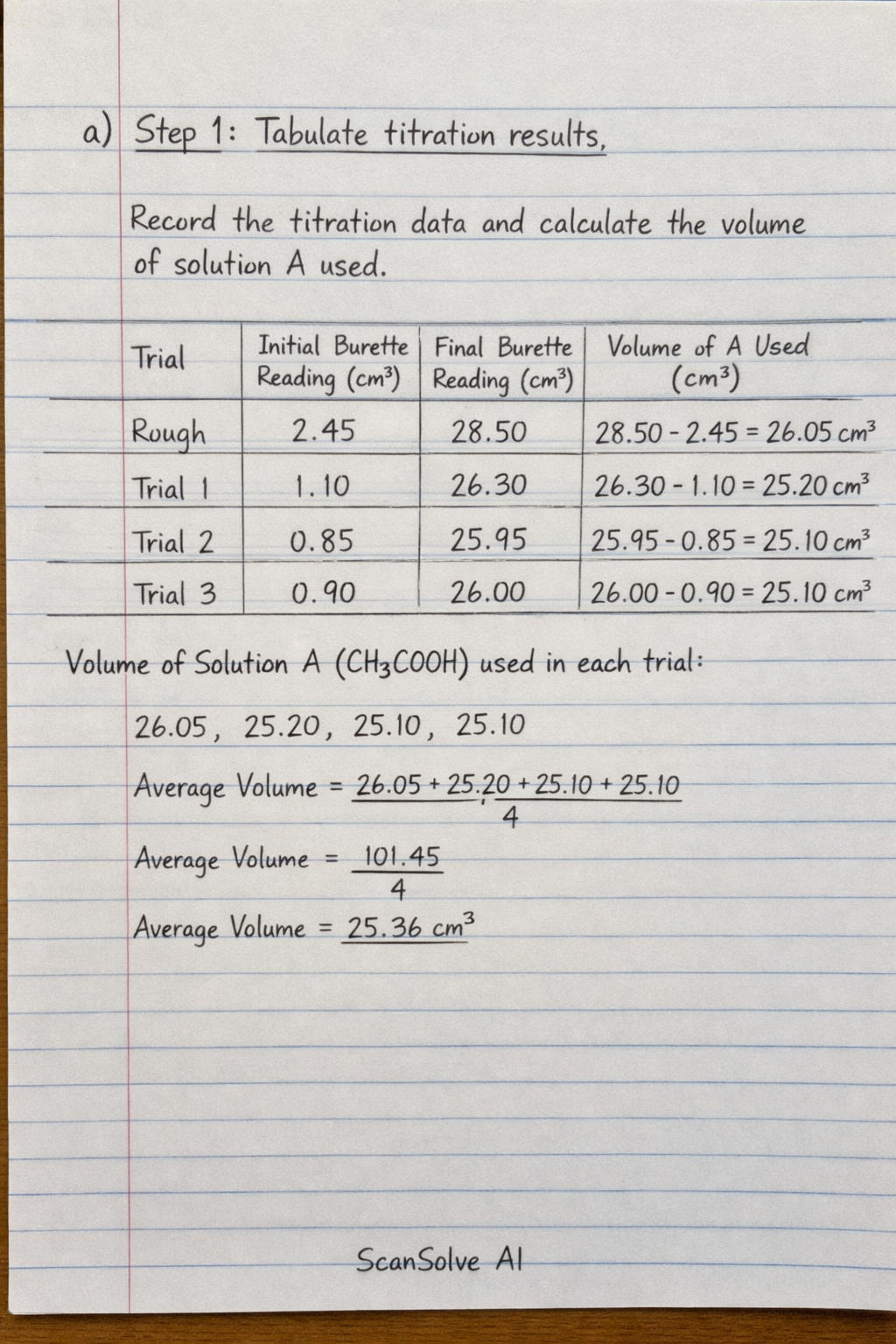
We read your photo as:

Tabulate titration results

Chemistry

ScanSolve AI Answer

Answer

25.025 cm3\text{25.025 cm}^3

Step-by-step solution

3 steps

To tabulate the results and calculate the average volume of A used, experimental burette readings are required. Since these readings are not provided in the question, I will outline the structure for the tabulation and explain how to calculate the average volume from hypothetical data.

a)

  1. Tabulate titration results

    A table is used to record the initial and final burette readings for each titration, and to calculate the volume of solution A (acetic acid) used in each trial. A common practice is to perform a rough titration first, followed by at least two accurate titrations to obtain concordant results. Let's assume a 25.0 cm325.0 \text{ cm}^3 portion of solution B (KOH) is used.

    Titration NumberInitial Burette Reading (cm3)Final Burette Reading (cm3)Volume of A used (cm3)Roughe.g., 0.00e.g., 25.50e.g., 25.501e.g., 0.00e.g., 25.10e.g., 25.102e.g., 25.10e.g., 50.15e.g., 25.053e.g., 0.00e.g., 25.00e.g., 25.00\begin{array}{|c|c|c|c|} \hline \text{Titration Number} & \text{Initial Burette Reading (cm}^3\text{)} & \text{Final Burette Reading (cm}^3\text{)} & \text{Volume of A used (cm}^3\text{)} \\ \hline \text{Rough} & \text{e.g., } 0.00 & \text{e.g., } 25.50 & \text{e.g., } 25.50 \\ \text{1} & \text{e.g., } 0.00 & \text{e.g., } 25.10 & \text{e.g., } 25.10 \\ \text{2} & \text{e.g., } 25.10 & \text{e.g., } 50.15 & \text{e.g., } 25.05 \\ \text{3} & \text{e.g., } 0.00 & \text{e.g., } 25.00 & \text{e.g., } 25.00 \\ \hline \end{array}
  2. Identify concordant titres

    Concordant titres are those that are in close agreement, typically within ±0.10 cm3\pm 0.10 \text{ cm}^3 or ±0.05 cm3\pm 0.05 \text{ cm}^3 of each other. In the hypothetical example above, titrations 2 and 3 (25.05 cm3\text{cm}^3 and 25.00 cm3\text{cm}^3) are concordant as they are within 0.05 cm30.05 \text{ cm}^3.

  3. Calculate the average volume of A used

    The average volume is calculated by summing the concordant titre values and dividing by the number of concordant titrations. Using the hypothetical concordant values from Step 2:

    Average volume of A used=Volume from Titration 2+Volume from Titration 3Number of concordant titrations\text{Average volume of A used} = \frac{\text{Volume from Titration 2} + \text{Volume from Titration 3}}{\text{Number of concordant titrations}} Average volume of A used=25.05 cm3+25.00 cm32\text{Average volume of A used} = \frac{25.05 \text{ cm}^3 + 25.00 \text{ cm}^3}{2} Average volume of A used=50.05 cm32\text{Average volume of A used} = \frac{50.05 \text{ cm}^3}{2} Average volume of A used=25.025 cm3\text{Average volume of A used} = \boxed{\text{25.025 cm}^3}

    Note: Without actual experimental data, a numerical answer for the average volume of A used cannot be definitively provided.

Was this helpful?

Try one yourself

A new problem that tests the same skill.

Still stuck on this one?

Ask a follow-up, and the answer starts from this question.

Got a different question?Ask your own question
Handwritten step-by-step solution preview

Handwritten Step-by-Step Solution

Get this as a handwritten image on WhatsApp — like a tutor wrote it for you.

Try on WhatsApp