
We read your photo as:
To tabulate results, but no titration data (burette readings) has been provided. Therefore, this part cannot be completed.
Chemistry
ScanSolve AI Answer
Here's the solution to the volumetric analysis problem:
-
Part (a): Tabulate your results and calculate the average volume of A used. The question asks to tabulate results, but no titration data (burette readings) has been provided. Therefore, this part cannot be completed. To proceed with the calculations in part (b), I will assume an average titre (volume of A used) of . I will also assume that of solution B was pipetted for each titration.
-
Part (b): From your results and information provided, calculate:
- Relative atomic masses: .
- Molar mass of (Solution A):
- Molar mass of (Solution B):
Was this helpful?
Still stuck on this one?
Ask a follow-up, and the answer starts from this question.
Got a different question?Ask your own question
More Chemistry Questions
QTo tabulate titration results and calculate the average volume of solution A used. However, the…QWhat data is missing to complete the calculations for heat change and titration analysis?QTo tabulate your results and calculate the average volume of A used, I need the experimental…QThe table for burette readings is empty. To complete the calculations, I will assume an average…
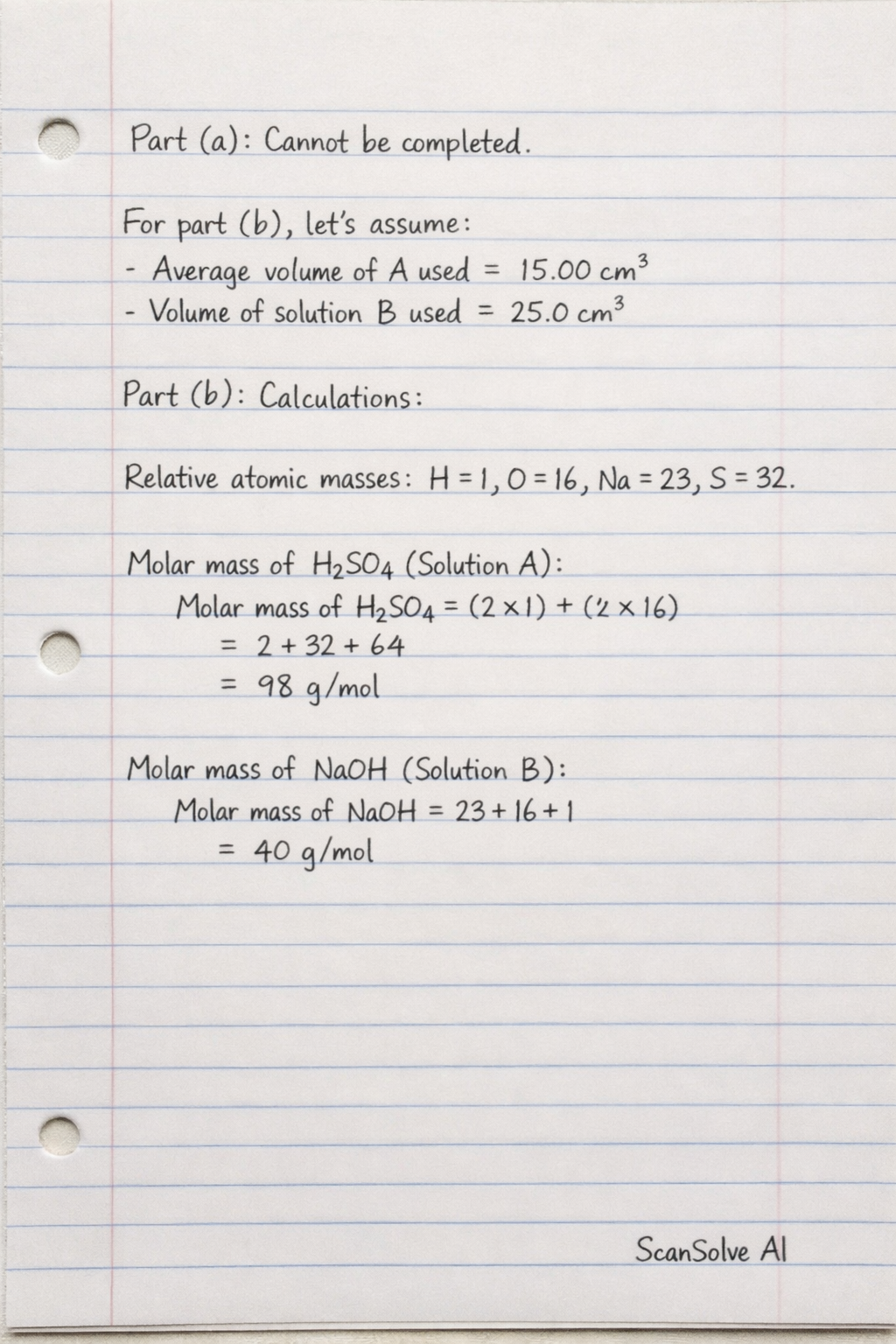
Handwritten Step-by-Step Solution
Get this as a handwritten image on WhatsApp — like a tutor wrote it for you.
Try on WhatsApp