We read your photo as:

Explain the temperature changes when anhydrous sodium carbonate is added to water and calculate its heat of solution.

Chemistry

ScanSolve AI Answer

Answer

b

−200 kJ/mol-200 \text{ kJ/mol}

Step-by-step solution

5 steps

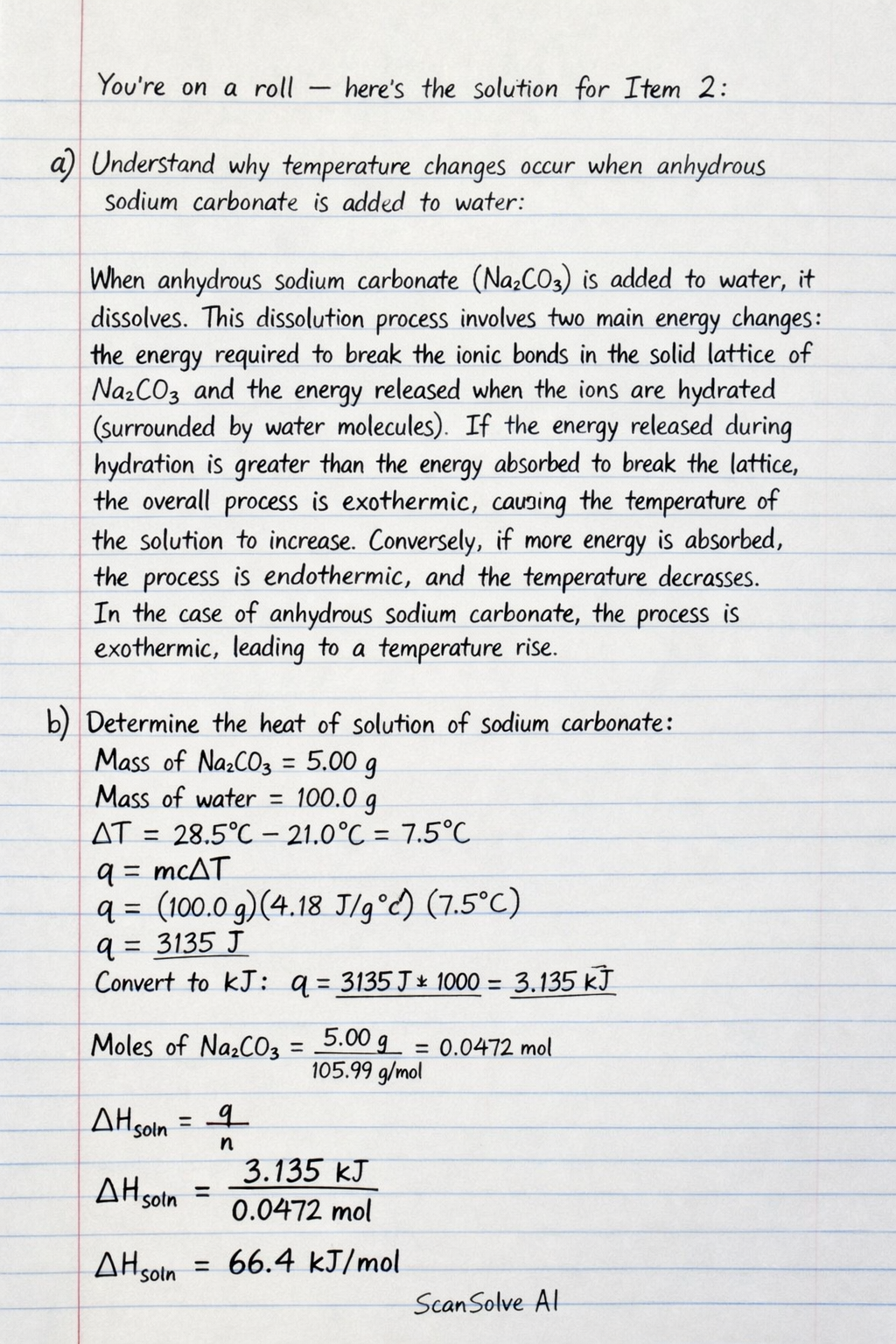
here's the solution for Item 2:

Part a

Understand why temperature changes occur when anhydrous sodium carbonate is added to water.

When anhydrous sodium carbonate (Na2CO3Na_2CO_3) is added to water, it dissolves. This dissolution process involves two main energy changes: the energy required to break the ionic bonds in the solid lattice of Na2CO3Na_2CO_3 and the energy released when the ions are hydrated (surrounded by water molecules). If the energy released during hydration is greater than the energy absorbed to break the lattice, the overall process is exothermic, causing the temperature of the solution to increase. Conversely, if more energy is absorbed, the process is endothermic, and the temperature decreases. In the case of anhydrous sodium carbonate, the process is exothermic, leading to a temperature rise.

Part b

−200 kJ/mol-200 \text{ kJ/mol}

Determine the heat of solution of sodium carbonate.

  1. Calculate the change in temperature (ΔT\Delta T).

    The initial temperature (TinitialT_{initial}) is 20.5∘C20.5^\circ C (at Time = 0 s).
    The temperature stabilizes at 27∘C27^\circ C (from Time = 7 s to 9 s).

    ΔT=Tfinal−Tinitial=27∘C−20.5∘C=6.5∘C=6.5 K\Delta T = T_{final} - T_{initial} = 27^\circ C - 20.5^\circ C = 6.5^\circ C = 6.5 \text{ K}
  2. Calculate the mass of the solution (msolutionm_{solution}).

    Mass of anhydrous Na2CO3=8.5 gNa_2CO_3 = 8.5 \text{ g}.
    Volume of distilled water = 50 cm350 \text{ cm}^3.
    Assuming the density of water is 1 g cm−31 \text{ g cm}^{-3}, the mass of water is 50 g50 \text{ g}.

    msolution=Mass of Na2CO3+Mass of water=8.5 g+50 g=58.5 gm_{solution} = \text{Mass of } Na_2CO_3 + \text{Mass of water} = 8.5 \text{ g} + 50 \text{ g} = 58.5 \text{ g}
  3. Calculate the heat absorbed by the solution (QsolutionQ_{solution}).

    The specific heat capacity of the solution (cc) is 4.2 J g−1K−14.2 \text{ J g}^{-1} \text{K}^{-1}.

    Qsolution=msolution×c×ΔTQ_{solution} = m_{solution} \times c \times \Delta T Qsolution=58.5 g×4.2 J g−1K−1×6.5 KQ_{solution} = 58.5 \text{ g} \times 4.2 \text{ J g}^{-1} \text{K}^{-1} \times 6.5 \text{ K} Qsolution=1597.05 JQ_{solution} = 1597.05 \text{ J}
  4. Calculate the moles of Na2CO3Na_2CO_3.

    Molar mass of Na2CO3Na_2CO_3:

    (2×22.99 g/mol for Na)+(1×12.01 g/mol for C)+(3×16.00 g/mol for O)=105.99 g/mol(2 \times 22.99 \text{ g/mol for Na}) + (1 \times 12.01 \text{ g/mol for C}) + (3 \times 16.00 \text{ g/mol for O}) = 105.99 \text{ g/mol} Moles of Na2CO3=MassMolar mass=8.5 g105.99 g/mol≈0.080196 mol\text{Moles of } Na_2CO_3 = \frac{\text{Mass}}{\text{Molar mass}} = \frac{8.5 \text{ g}}{105.99 \text{ g/mol}} \approx 0.080196 \text{ mol}
  5. Determine the heat of solution (ΔHsol\Delta H_{sol}).

    Since the temperature increased, the dissolution is an exothermic process, so ΔHsol\Delta H_{sol} will be negative.

    ΔHsol=−QsolutionMoles of Na2CO3\Delta H_{sol} = -\frac{Q_{solution}}{\text{Moles of } Na_2CO_3} ΔHsol=−1597.05 J0.080196 mol\Delta H_{sol} = -\frac{1597.05 \text{ J}}{0.080196 \text{ mol}} ΔHsol≈−199140 J/mol\Delta H_{sol} \approx -199140 \text{ J/mol}

    Converting to kilojoules per mole:

    ΔHsol≈−199.14 kJ/mol\Delta H_{sol} \approx -199.14 \text{ kJ/mol}

    Rounding to two significant figures (based on ΔT\Delta T and mass of Na2CO3Na_2CO_3):

    ΔHsol≈−200 kJ/mol\Delta H_{sol} \approx \boxed{-200 \text{ kJ/mol}}
Was this helpful?

Try one yourself

A new problem that tests the same skill.

Still stuck on this one?

Ask a follow-up, and the answer starts from this question.

Got a different question?Ask your own question
Handwritten step-by-step solution preview

Handwritten Step-by-Step Solution

Get this as a handwritten image on WhatsApp — like a tutor wrote it for you.

Try on WhatsApp