

This chemistry question involves key chemical concepts and calculations. The detailed solution below walks through each step, from identifying the reaction type to computing the final answer.
ScanSolve AI Answer
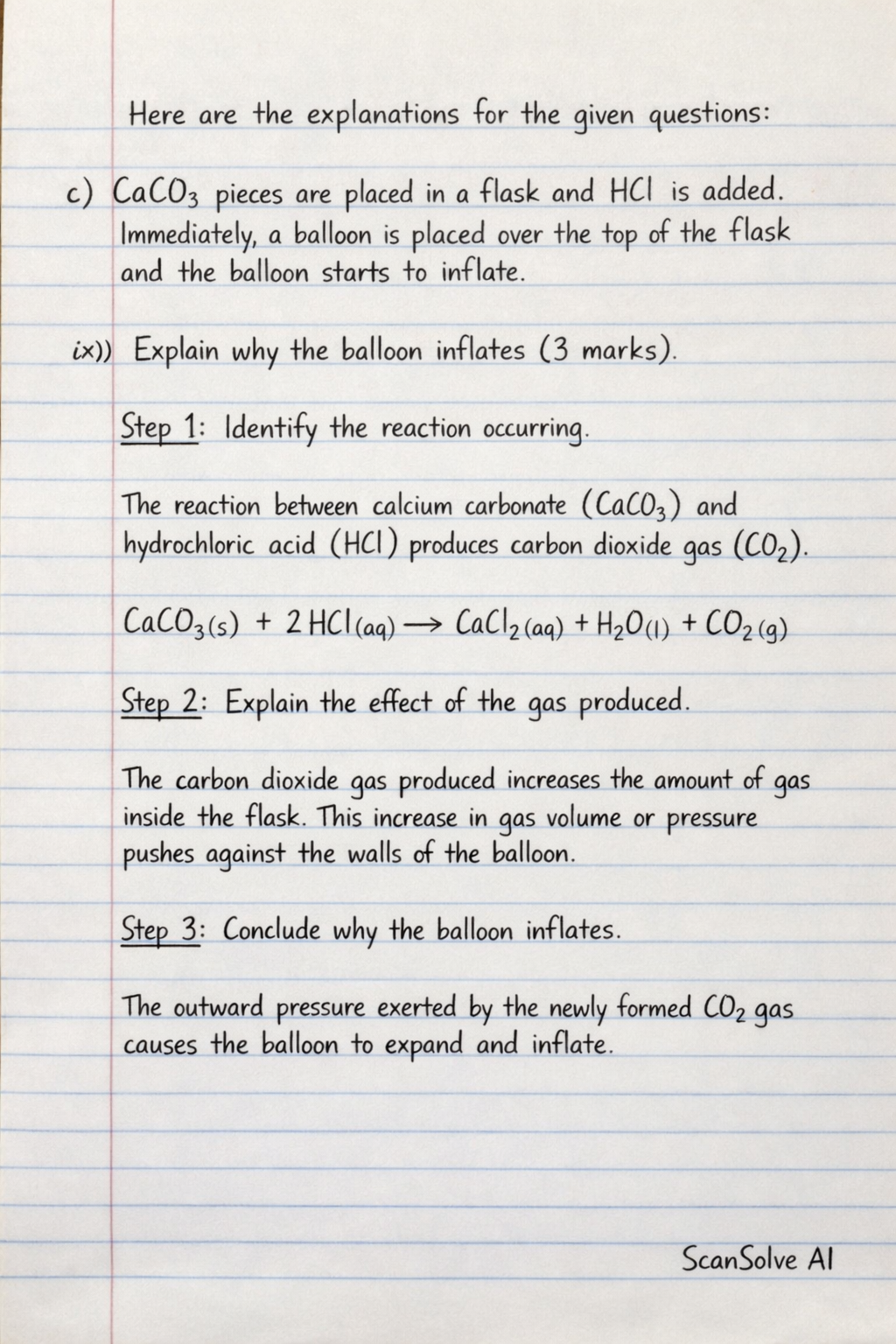
Here are the explanations for the given questions: c) CaCO_3 pieces are placed in a flask and HCl is added. Immediately a balloon is placed over the top of the flask and the balloon starts to inflate. xix) Explain why the balloon inflates (3 marks). Step 1: Identify the reaction occurring. The reaction between calcium carbonate (CaCO_3) and hydrochloric acid (HCl) produces carbon dioxide gas (CO_2). CaCO_3(s) + 2HCl(aq) CaCl_2(aq) + H_2O(l) + CO_2(g) Step 2: Explain the effect of the gas produced. The carbon dioxide gas produced increases the amount of gas inside the flask. This increase in gas volume or pressure pushes against the walls of the balloon. Step 3: Conclude why the balloon inflates. The outward pressure exerted by the newly formed CO_2 gas causes the balloon to expand and inflate. xx) If the same mass of CaCO_3 in a powdered form is used, the balloon inflates faster. Explain why using collision theory (3 marks). Step 1: Relate powdered form to surface area. Using CaCO_3 in powdered form significantly increases its surface area compared to pieces. Step 2: Apply collision theory to surface area. According to collision theory, a larger surface area means more CaCO_3 particles are exposed and available to collide with HCl particles at any given time. Step 3: Explain the effect on reaction rate. This leads to a higher frequency of effective collisions between the reactant particles. A greater number of effective collisions per unit time results in a faster rate of reaction, thus producing CO_2 gas more quickly and inflating the balloon faster. xxi) Using the same chemical substances and collision theory, discuss two other ways to make the balloon inflate faster (4 marks). 1. Increase the concentration of HCl: According to collision theory, increasing the concentration of HCl means there are more HCl particles per unit volume. This increases the frequency of collisions between HCl and CaCO_3 particles. A higher frequency of collisions leads to a greater number of effective collisions, thus speeding up the production of CO_2 gas and inflating the balloon faster. 2. Increase the temperature of the reaction: According to collision theory, increasing the temperature increases the kinetic energy of the reactant particles. This has two effects: • The particles move faster, leading to a higher frequency of collisions. • A larger proportion of collisions will have energy equal to or greater than the activation energy, resulting in more effective collisions. Both factors contribute to a faster reaction rate, leading to quicker CO_2 production and faster balloon inflation. Last free one today — make it count tomorrow, or type /upgrade for unlimited.