

This chemistry question involves key chemical concepts and calculations. The detailed solution below walks through each step, from identifying the reaction type to computing the final answer.
ScanSolve AI Answer
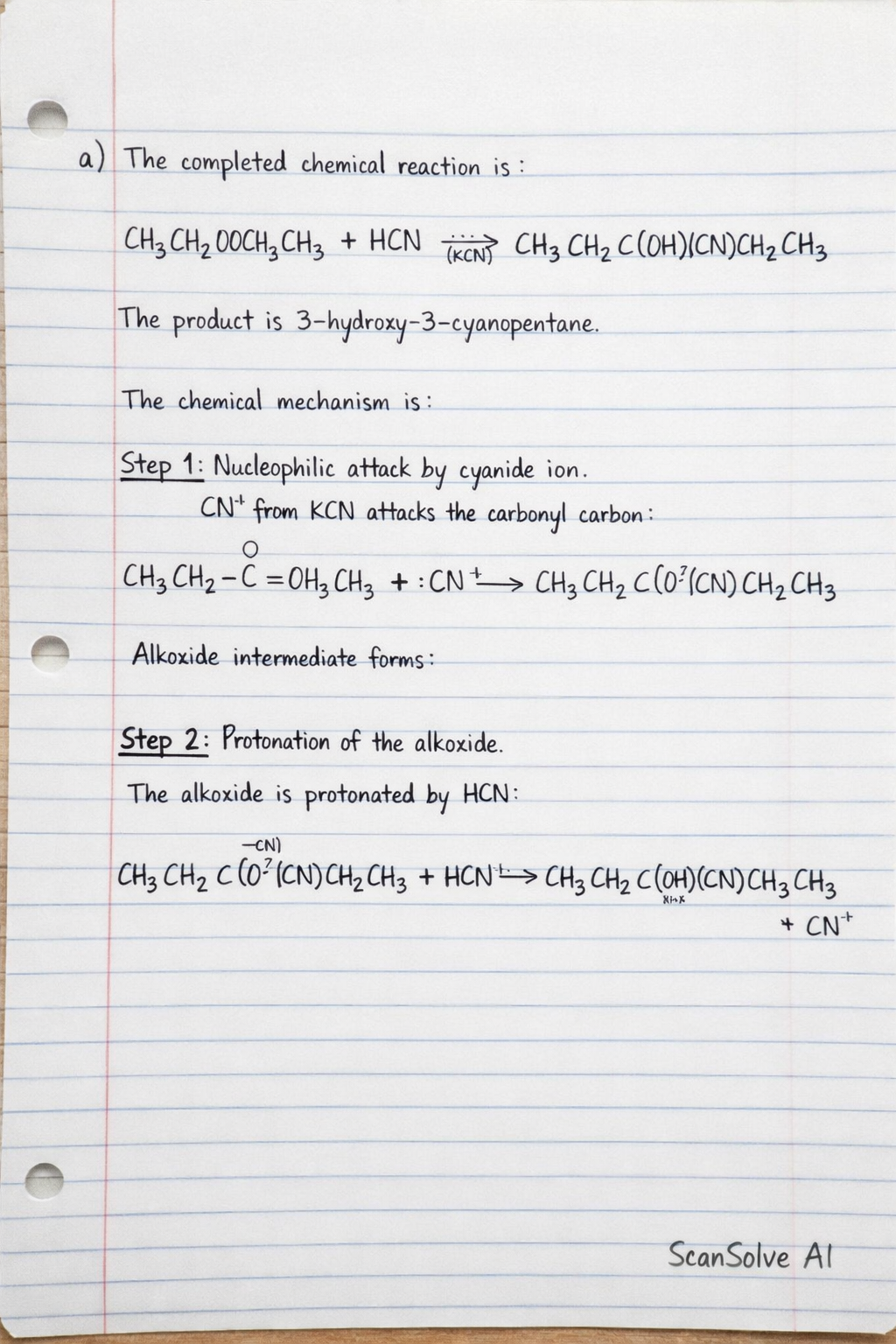
a) The completed chemical reaction is: CH_3CH_2COCH_2CH_3 + HCN KCN CH_3CH_2C(OH)(CN)CH_2CH_3 The product is 3-hydroxy-3-cyanopentane. The chemical mechanism is: Step 1: Nucleophilic attack by cyanide ion. The cyanide ion (CN^-), generated from KCN, acts as a nucleophile and attacks the electrophilic carbon atom of the carbonyl group in 3-pentanone. The electrons of the carbon-oxygen double bond shift to the oxygen atom, forming an alkoxide intermediate. CH_3CH_2C(=O)CH_2CH_3 + CN^- CH_3CH_2C(O^-)(CN)CH_2CH_3 Step 2: Protonation of the alkoxide. The alkoxide intermediate is then protonated by hydrogen cyanide (HCN) to form the stable cyanohydrin product. CH_3CH_2C(O^-)(CN)CH_2CH_3 + HCN CH_3CH_2C(OH)(CN)CH_2CH_3 + CN^- b) The completed chemical reaction is: CH_3CH_2CH_2CH_2CHO + HCN NaCN CH_3CH_2CH_2CH_2CH(OH)CN The product is 2-hydroxypentanenitrile. The chemical mechanism is: Step 1: Nucleophilic attack by cyanide ion. The cyanide ion (CN^-), generated from NaCN, acts as a nucleophile and attacks the electrophilic carbon atom of the carbonyl group in pentanal. The electrons of the carbon-oxygen double bond shift to the oxygen atom, forming an alkoxide intermediate. CH_3CH_2CH_2CH_2CHO + CN^- CH_3CH_2CH_2CH_2CH(O^-)CN Step 2: Protonation of the alkoxide. The alkoxide intermediate is then protonated by hydrogen cyanide (HCN) to form the stable cyanohydrin product. CH_3CH_2CH_2CH_2CH(O^-)CN + HCN CH_3CH_2CH_2CH_2CH(OH)CN + CN^-