

This chemistry question involves key chemical concepts and calculations. The detailed solution below walks through each step, from identifying the reaction type to computing the final answer.
ScanSolve AI Answer
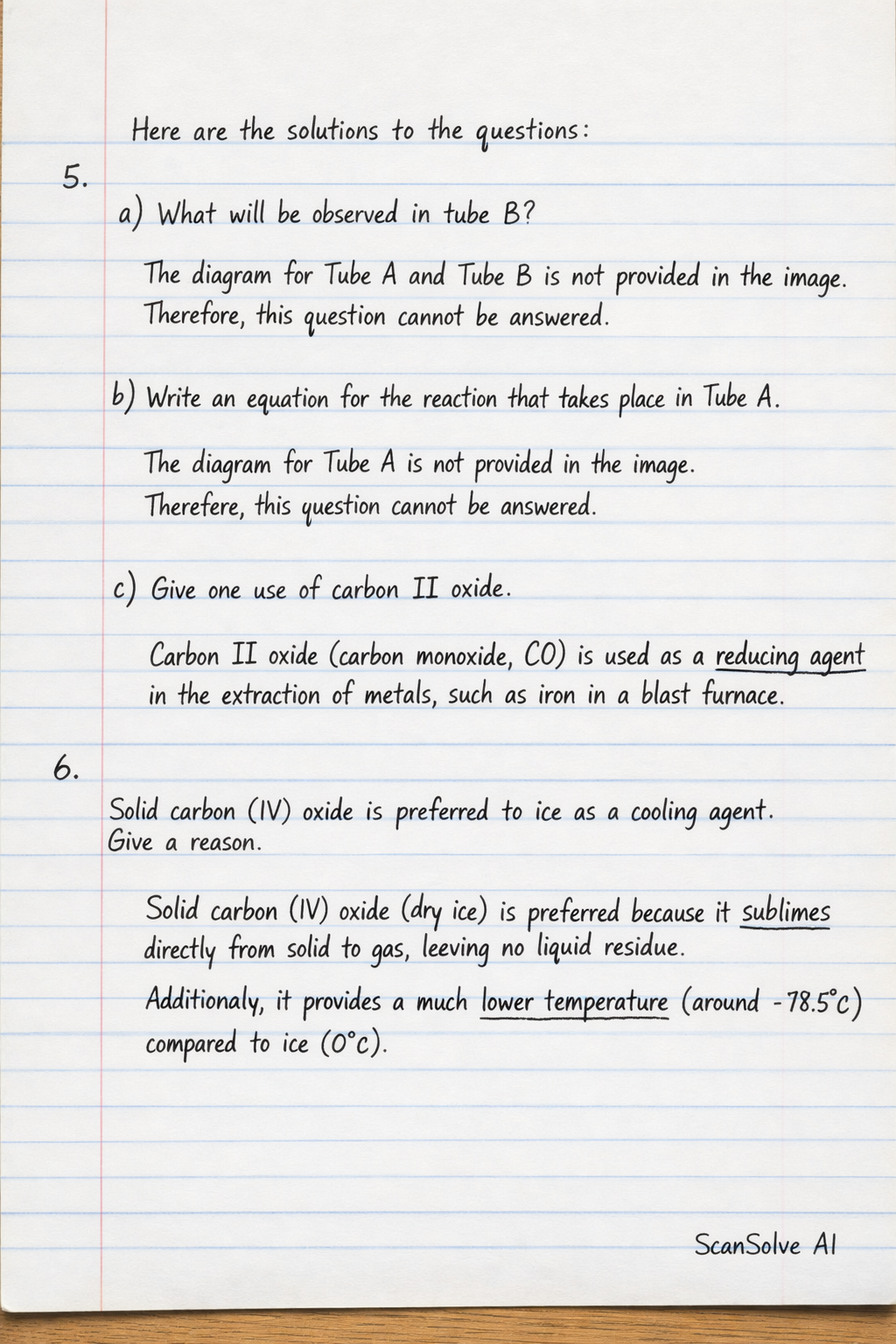
Here are the solutions to the questions: 5. a) What will be observed in tube B? The diagram for Tube A and Tube B is not provided in the image. Therefore, this question cannot be answered. b) Write an equation for the reaction that takes place in Tube A. The diagram for Tube A is not provided in the image. Therefore, this question cannot be answered. c) Give one use of carbon II oxide. Carbon II oxide (carbon monoxide, CO) is used as a reducing agent in the extraction of metals, such as iron in a blast furnace. 6. Solid carbon (IV) oxide is preferred to ice as a cooling agent. Give a reason. Solid carbon (IV) oxide (dry ice) is preferred because it sublimes directly from solid to gas, leaving no liquid residue. Additionally, it provides a much lower temperature (around -78.5^) compared to ice (0^). 7. A certain colourless gas was suspected to be carbon (IV) oxide. Suggests a chemical test that can confirm its identity. Step 1: Bubble the suspected gas through limewater (calcium hydroxide solution, Ca(OH)_2). Step 2: If the gas is carbon (IV) oxide (CO_2), the limewater will turn milky or cloudy due to the formation of insoluble calcium carbonate. The equation for the reaction is: Ca(OH)_2(aq) + CO_2(g) → CaCO_3(s) + H_2O(l) 8. The flow chart diagram below shows some of the processes involved in the manufacture of sodium carbonate by Solvay process. Study it and answer the questions that follows. a) Identify the substances labelled A, B, C and D. • A: Sodium carbonate (Na_2CO_3) • B: Sodium hydrogen carbonate (NaHCO_3) • C: Ammonia (NH_3) • D: Sodium carbonate (Na_2CO_3) b) Name Gas X and Gas Y. • Gas X: Carbon dioxide (CO_2) • Gas Y: Carbon dioxide (CO_2) c) State one use of the by-product P. By-product P is calcium chloride (CaCl_2). It is used for de-icing roads or as a drying agent. d) Identify substances M, hence write equations for the two reactions taking place in the kiln. • Substance M: Limestone (CaCO_3) • Reactions in the kiln: 1. Decomposition of limestone: CaCO_3(s) heat CaO(s) + CO_2(g) 2. Combustion of fuel (e.g., coke) to provide heat and additional CO_2: C(s) + O_2(g) heat CO_2(g) e) Solvay tower is cooled from time to time give a reason. The Solvay tower is cooled to increase the solubility of carbon dioxide and ammonia in the ammoniacal brine, and to increase the yield of sodium hydrogen carbonate by reducing its solubility, causing it to precipitate out. f) Give two uses of sodium carbonate. • Manufacture of glass • Manufacture of detergents and soaps • Water softening g) Potassium hydrogen carbonate and ammonium chloride cannot be prepared by the same method. Give a reason. The Solvay process relies on the low solubility of sodium hydrogen carbonate (NaHCO_3) which allows it to precipitate out. Potassium hydrogen carbonate (KHCO_3) is much more soluble than NaHCO_3, so it would not precipitate from the solution, making the method unsuitable. Ammonium chloride (NH_4Cl) is also highly soluble. 9. If two unlabelled black powders were placed before you on the laboratory bench and you are told that they are copper (II) oxide and charcoal, what simple test would you perform to distinguish them? Step 1: Add dilute hydrochloric acid to a small sample of each powder in separate test tubes. Step 2: Copper (II) oxide (CuO) will react with the acid to form a blue or green solution of copper(II) chloride: CuO(s) + 2HCl(aq) → CuCl_2(aq) + H_2O(l) Step 3: Charcoal (carbon, C) will not react with the dilute acid. 10. A student mixed up the labels of solid sodium carbonate and solid sodium hydrogencarbonate. How did she go about differentiating the two solids? Step 1: Heat a small sample of each solid in separate test tubes and test any gas evolved with limewater. Step 2: Sodium hydrogencarbonate (NaHCO_3) will decompose upon heating to produce carbon dioxide gas (which turns limewater milky): 2NaHCO_3(s) heat Na_2CO_3(s) + CO_2(g) + H_2O(g) Step 3: Sodium carbonate (Na_2CO_3) is stable to heat and will not decompose under these conditions, so no gas will be evolved. 11. Explain the following: a) Carbon (IV) oxide is one of the causes of greenhouse effect. Carbon (IV) oxide (CO_2) is a greenhouse gas. It absorbs and re-emits infrared radiation (heat) from the Earth's surface, trapping this heat in the atmosphere. This process leads to the warming of the Earth's surface and lower atmosphere, contributing to the greenhouse effect and global warming. b) Diamond and methane have the same type of bonding, yet methane is a gas at room temperature and pressure, while diamond is a very hard solid. Both diamond and methane (CH_4) contain covalent bonds. However, diamond has a giant covalent network structure where each carbon atom is strongly covalently bonded to four other carbon atoms in a rigid 3D lattice. A large amount of energy is needed to break these strong bonds, making diamond extremely hard. Methane is a simple molecular substance with weak intermolecular forces between its molecules. Little energy is required to overcome these weak forces, so it is a gas at room temperature. c) The reaction between dilute sulphuric acid and barium carbonate is not suitable for preparing carbon (IV) oxide. When dilute sulfuric acid reacts with barium carbonate (BaCO_3), barium sulfate (BaSO_4) is formed. Barium sulfate is an insoluble salt that precipitates and coats the surface of the unreacted barium carbonate. This coating prevents further contact between the acid and the carbonate, stopping the reaction prematurely and yielding very little carbon (IV) oxide. 12. Carbon occurs in both pure and impure forms. Give examples of both pure and impure forms of carbon. • Pure forms of carbon: Diamond, graphite, fullerenes. • Impure forms of carbon: Charcoal, coke, coal. 13. Global warming can be controlled using the carbon cycle. Explain how this is possible. The carbon cycle involves the natural exchange of carbon between the atmosphere, oceans, land, and living organisms. Global warming can be controlled by enhancing processes that remove carbon dioxide from the atmosphere and reducing those that release it. This includes afforestation (planting more trees to increase CO_2 absorption through photosynthesis), reducing deforestation (to prevent release of stored carbon), and implementing carbon capture and storage technologies to sequester industrial CO_2 emissions. 3 done, 2 left today. You're making progress.